

Foundations Series · Volume 1 · Understand
An Introduction to Rhetoric
A visual guide to how messages shape meaning, judgment, and response
$7One-time purchase · PDF download
- Instant PDF download
- 104 full-color pages
- Secure checkout
- Pages
- 104
- Format
- Full-color visual PDF
- Delivery
- Instant digital download
- Price
- $7
- Free preview
- First 15 pages
Rhetoric is everywhere — in speeches, advertisements, headlines, arguments, presentations, social media, workplace communication, and everyday conversation.
Whenever someone chooses what to say, what to emphasize, what evidence to include, or how to address an audience, rhetorical choices are being made.
An Introduction to Rhetoric is a clear, visual introduction to those choices. Rather than treating rhetoric as a list of terms to memorize, the book shows how situation, audience, credibility, emotion, reasoning, timing, framing, and purpose work together.
The goal is simple: to help you see how messages work.

What you’ll learn
- What rhetoric actually means—and why it is more than persuasion
- How to identify the rhetorical situation surrounding a message
- How audience, purpose, context, and constraints shape communication
- How ethos, pathos, and logos work in real arguments
- How credibility is built through expertise, character, fairness, and restraint
- How to separate claims, reasons, and evidence
- How assumptions and warrants connect evidence to conclusions
- Why qualifiers, rebuttals, and exceptions can strengthen an argument
- How kairos, exigence, timing, and occasion influence rhetorical choices
- How framing and language affect interpretation
- How platforms shape the messages people create and encounter
- How to evaluate arguments without automatically accepting or dismissing them
Look inside
Every idea gets a page you can see.


Want more? Flip through the first 15 pages free before you decide.
What’s inside
The book is designed as a visual learning system, with concepts broken into focused pages that can be read in order or revisited individually.
Inside you’ll find full-color explanations, analytical frameworks, comparison pages, annotated examples, argument breakdowns, diagrams, case studies, checklists, diagnostic questions, a capstone analysis, key terms, further reading, and a master Rhetoric at a Glance reference page.
Complex ideas are made easier to see without reducing them to oversimplified rules.

Who this book is for
An Introduction to Rhetoric is designed for anyone who wants a clearer way to understand communication, argument, persuasion, and influence.
It may be especially useful for students, writers, teachers, content creators, marketers, communicators, presenters, professionals who evaluate arguments or evidence, and readers interested in media literacy and critical thinking.
No previous background in rhetoric is required.
Learn to ask better questions
Rhetorical analysis is not about assuming every message is manipulative. It is about noticing the choices that shape communication.
Who is speaking? Who is the audience? What situation created the message? What is being emphasized or omitted? Why should the audience trust the communicator? What emotions or values are being activated? What claim is being made? What evidence supports it? What assumptions connect that evidence to the conclusion? Why this message now? What response is being invited?
Those questions change the way you read—and the way you write, speak, argue, present, and respond.
From terminology to understanding
Terms such as ethos, pathos, logos, kairos, exigence, audience, purpose, and warrant matter, but definitions are only the beginning.
This book focuses on the relationships between them: how a communicator responds to a situation, how an audience shapes the message, how evidence supports a claim, how framing directs attention, and how timing and context influence meaning.
Once you can see those relationships, rhetorical concepts become much easier to use.

Built for visual learning
Some ideas become clearer when you can see them.
That is why An Introduction to Rhetoric uses diagrams, comparisons, frameworks, and annotated examples throughout. Explanation and visualization work together so you can quickly see how credibility develops, how evidence supports a claim, how assumptions connect an argument, how frames change interpretation, and how rhetorical choices interact in complete examples.
The book is designed not only to be read, but to be used as a reference.
Rhetoric is a form of literacy
We encounter an extraordinary amount of communication every day. Headlines compete for attention. Advertisements frame choices. Organizations defend decisions. Experts interpret evidence. Social platforms reward particular kinds of messages.
The goal is neither cynicism nor gullibility.
It is informed judgment.
Notice what is being emphasized. Question the assumptions. Compare possible frames. Examine the support. Then decide what conclusion the evidence actually justifies.
That is rhetorical literacy.
A foundation you can build on
By the end of the book, you will have a working framework for analyzing:
SITUATION — Who is communicating, why, where, and under what conditions?
AUDIENCE — What do they know, value, expect, and need?
MESSAGE — What is selected, emphasized, arranged, framed, or omitted?
APPEALS — How are credibility, emotion, and reasoning working?
KAIROS — Why this message, in this form, at this moment?
PURPOSE — What judgment or action is being invited?
RESPONSE — How might audiences interpret, resist, accept, or act?
Start seeing messages differently
Once you learn to recognize rhetorical choices, they become difficult to unsee.
You begin noticing why one headline feels different from another, why the same evidence can support different arguments, why credibility matters, how language changes a frame, why timing matters, and why audiences can respond differently to the same message.
Download An Introduction to Rhetoric and build a clearer framework for understanding the messages competing for your attention every day.
Before you buy
Questions, answered.
What exactly do I get?
One full-color PDF of An Introduction to Rhetoric: 104 designed pages of diagrams, frameworks, annotated examples, and quick-reference pages.
How is it delivered?
Right after checkout you get a download link on the order confirmation page and in your order email. There is nothing to ship and nothing to wait for.
What can I read it on?
Any device that opens a PDF: laptop, desktop, tablet, or phone. It is designed in full color, so a tablet or computer screen shows it best. You can also print it.
Can I see it before I buy?
Yes. Read the first 15 pages free, with no signup.
What if something goes wrong with my download?
Because this is a digital download, we recommend reading the free preview first. If your file does not arrive or does not open, contact us and we will help.
Complete the Foundations Series
Understand, analyze, build.
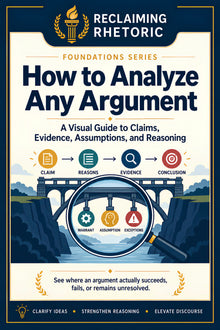
Volume 2 · Analyze
How to Analyze Any Argument
A visual guide to seeing where an argument actually works (and where it doesn’t)
$7 · See the guide →
Volume 3 · Build
How to Build a Better Argument
A practical visual guide to building clearer claims, finding stronger evidence, addressing objections, and revising your reasoning.
$7 · See the guide →