Meet Dr. Elias Rowan, a fictional creator who holds a doctorate. Before he says anything else, you can already see the bookshelf behind him. Professional microphone. Clean studio lighting. An animated brain graphic. An academic-looking chart. A research paper appears on screen. Hundreds of thousands of followers.
Then he looks into the camera and says: “New research proves that listening to music while working destroys deep focus.”
Before you have checked a single piece of evidence, how much has the video already encouraged you to trust him? Or, more precisely, how much has the presentation encouraged you to trust him? Online, credibility can arrive several seconds before the evidence does.
This article, a companion to the Reclaiming Rhetoric video, looks at how expertise can be signaled, borrowed, stretched, and sometimes manufactured online, and at a few practical habits for telling the difference between authority that fits a claim and authority that is merely on display.

Foundations Series · Volume 2
How to Analyze Any Argument
A visual guide to claims, evidence, assumptions, and reasoning.
Being knowledgeable vs. appearing knowledgeable
Start with an important distinction. Someone can be knowledgeable. Someone can appear knowledgeable. And very often, those things overlap. That is exactly why credibility cues are useful.
- Doctors use professional titles because those titles can communicate meaningful training.
- Researchers cite studies because evidence matters.
- Institutional affiliations can tell us where somebody works and what communities of expertise they participate in.
- Specialists use technical vocabulary because specialized subjects sometimes require specialized language.
So the lesson is not that professional-looking people are suspicious. The problem begins when the cues that suggest credibility start doing more argumentative work than they can actually support. The cue may be legitimate, but the cue is not the evidence.
In classical terms, these cues are part of ethos: the audience's sense that a speaker is competent, trustworthy, and well-intentioned. Aristotle thought ethos could be among the most powerful forms of persuasion. Online video simply gives creators an enormous toolkit for building it visually, before a single argument is made.

Expertise has a domain: "Expert in what?"
Return to Elias. His doctorate is real. That matters. But imagine his doctorate is in electrical engineering, and his claim is about cognitive performance, attention, and what happens to the human mind when people listen to music while working.
That does not prove his claim is false. It changes what his credential establishes. A doctorate can be excellent evidence that someone has substantial expertise. But expertise has a domain. Someone may know far more than the average person about electrical systems and still lack comparable expertise in cognitive psychology.
Philosophers discuss a related problem as epistemic trespassing. The philosopher Nathan Ballantyne, in an influential 2019 paper in Mind, described trespassers as people who have competence to make good judgments in one field but move into another field where they lack that competence, and pass judgment there anyway. He noted it is common among highly accomplished people, precisely because success in one area breeds confidence in others.
That does not mean experts must never discuss anything outside their specialties. And it certainly does not mean someone without the obvious credential cannot make a correct argument. It means the credential becomes useful only when you finish the sentence: expert in what? Relevant expertise affects how much initial weight we reasonably give a source. It does not make the argument self-proving.
Real evidence, wrong-sized claim
Now look at the research paper Elias flashed on screen. Suppose the paper is real, the university is real, the researchers are real, and the study really did find an effect. But the experiment examined one particular type of music, on one specific attention task, under a particular set of conditions.
Elias tells his audience: “Music destroys deep focus.” Notice what happened. The evidence did not have to be fake. The source did not have to be invented. A genuine study became visual support for a substantially broader conclusion than the study itself established.
That is an important feature of manufactured credibility. You do not always need counterfeit evidence. Sometimes you only need real evidence attached to the wrong-sized claim. A citation legitimately supports something narrow. Then the speaker stretches the arrow farther and farther until the citation appears to support something much larger.
A real source can be attached to a conclusion the source never established.
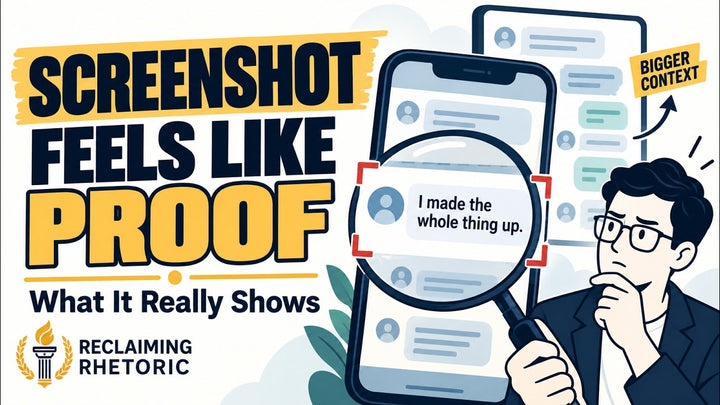
Watch for the verbs that do the stretching. “Proves” is rare in research; “suggests,” “is associated with,” and “under these conditions” are common. “Destroys” turns a measured effect into a sweeping verdict. And a single study is presented as “new research,” as though one result settles a question that a whole field is still investigating. The screenshot of the paper does a lot of persuasive work on its own, the same way screenshots feel like proof in other settings.

Borrowed credibility: other people's authority
Expertise can also be borrowed. A creator quotes a well-known scientist, flashes a university logo, or mentions that “Harvard researchers found” something. Sometimes that is exactly right: they are accurately reporting what a credible source said. But the borrowed authority deserves the same checks as the creator's own.
- Is the quotation complete, or has a qualifying sentence been trimmed?
- Was the expert speaking about this question, or a related one?
- Is the institution actually connected to the claim, or only to one of the researchers?
- Has the expert since revised or clarified the statement?
A short clip of a respected figure, cut at the right moment, can appear to endorse a conclusion the person would reject. The logo and the name carry the persuasive weight; the context that would limit them is missing.
Inventory the cues
Now rewind Elias's video and inventory everything surrounding the argument:
- Doctoral title
- Bookshelf
- Charts and brain graphics
- Technical vocabulary
- Professional editing
- Research paper screenshot
- University name
- Confident delivery
None of those things proves dishonesty. Legitimate experts use exactly the same cues. That is why the cues work. A polished presentation may genuinely reflect expertise, preparation, and professionalism. The mistake is treating the appearance of authority as though it settles whether the authority is relevant to this particular claim.
Professionalism can tell you that someone knows how to present authority. It cannot tell you whether the authority fits the claim.
Popularity is a different variable
Then add another layer. Elias has 600,000 followers, thousands of comments, guest appearances on podcasts, and clips circulating everywhere. You keep seeing him.
Popularity is not meaningless. Reputation sometimes tracks genuine expertise, and communities can identify people who repeatedly provide useful information. But popularity is a different variable. A follower count can tell you that attention has accumulated. It does not tell you why.
Repeated exposure can also make a person feel increasingly familiar. Their name becomes recognizable. Their face becomes recognizable. Other people appear to trust them. Eventually, the credibility itself can begin to feel socially established. A similar dynamic operates on claims themselves: the illusory truth effect describes how repetition makes statements feel more true. Familiarity is a feeling, not a credential.
Popularity can tell you that credibility has circulated. It does not tell you how that credibility was earned.
Why "Is this a fake expert?" is the wrong question
This is why it helps to avoid reducing the whole problem to one question: Is this person a fake expert? That label can actually make the analysis worse. Elias may be a genuine expert in electrical engineering. He may be accurately describing some findings from a real study. He may even turn out to be correct about part of his conclusion. Calling him a fraud would be inaccurate; calling him an authority on attention would be, too.
The more useful analysis asks how four things relate: the person, their actual expertise, the specific claim, and the evidence being invoked.
- What exactly is the claim?
- What expertise would be relevant to evaluating it?
- What expertise does this person actually have?
- What does the cited evidence actually establish?
- Is any other expert being quoted in context?
- Do independent knowledgeable sources converge on the broader conclusion?
The better question is not simply is this person an expert? It is what gives this person authority over this claim? This is a version of the same move behind any careful rhetorical analysis: separate what is being claimed from the devices that make it persuasive.

Why these cues work on careful people too
It is tempting to think only gullible viewers fall for presentation. But credibility cues work on nearly everyone, for a good reason: they are usually reliable shortcuts. Most of the time, the person in the white coat at the hospital really is a doctor, and the paper with a university header really did come from researchers. We would be paralyzed if we independently verified everything.
The trouble is that online video makes those shortcuts cheap to produce. A bookshelf, a ring light, and a confident tone cost very little. The cues have become decoupled from the institutions that once guaranteed them, so the shortcut that serves us well offline can mislead us on a feed. Recognizing that is not cynicism. It is calibration.
Leave the page: lateral reading
There is also one practical move that dramatically improves this kind of evaluation: leave the page. Do not investigate Elias only by scrolling farther through Elias's own profile. Open another tab.
- Search his name independently.
- Find his actual field.
- Locate the original study.
- Read what the researchers say they found, including the limitations.
- Track down any quotation that appeared in the video.
- See how independent knowledgeable sources describe the issue.
This is called lateral reading. In research by Sam Wineburg and Sarah McGrew (2019) at the Stanford History Education Group, professional fact-checkers were compared with historians and Stanford undergraduates as they evaluated unfamiliar websites. The fact-checkers were faster and more accurate, largely because they quickly left the site to see what other sources said about it, while the others tended to read “vertically,” staying on the page and judging it by its own appearance.
Instead of allowing one page, creator, or account to provide all the evidence for its own credibility, you step outside it. Three questions guide the move: Who is behind this? What is the evidence? What do other credible sources say?
A useful variation is to search for the claim, not just the creator. Type the core assertion, such as “music while working focus research,” into a search engine or a library database and see what the broader body of research says. If independent researchers and reputable science reporting describe a mixed or conditional picture, the confident one-line verdict in the video is probably stretching. If they converge on the same conclusion, the creator may simply be a good communicator of a well-supported finding. Either way, you now know something the video alone could not tell you.
Do not let a source provide all the evidence for its own credibility.
If you are the one sharing expertise
These habits also apply when you are the person with the credential. If you speak publicly about your field, or near it, a few practices make your authority more honest and more durable:
- Name your actual field, especially when you step outside it.
- Describe studies with the same scope the researchers used.
- Link the original source so viewers can check it.
- Distinguish what the evidence shows from what you personally think it implies.
Audiences increasingly reward this kind of transparency, and it protects you when someone does read laterally.
The takeaway
Return to the video we started with: the doctorate, the professional studio, the research paper, the chart, the followers. Some or all of those cues may be completely legitimate. But they answer different questions.
- A title can establish training.
- A citation can establish that research exists.
- A follower count can establish attention.
- A polished video can establish production skill.
None of those things by itself establishes the claim. So when someone looks like an expert online, do not stop at the title. Finish the sentence: expert in what? And does that expertise actually support this?
To keep going, browse all articles, explore structured lessons on the Courses page, or see the illustrated guides on the Guides page.
Foundations Series · Volume 2
How to Analyze Any Argument
A visual guide to claims, evidence, assumptions, and reasoning. Stop reacting. Start diagnosing.
A visual method for seeing where an argument actually works, and where it does not. Name the claim, test the evidence, and find the assumption holding it all together.
Sources and further reading
- Ballantyne, N. (2019). Epistemic trespassing. Mind, 128(510), 367–395
- Wineburg, S., & McGrew, S. (2019). Lateral reading and the nature of expertise: Reading less and learning more when evaluating digital information. Teachers College Record, 121(11), 1–40
- Aristotle. Rhetoric, Book I, ch. 2, on ethos (Perseus Digital Library)
- Reclaiming Rhetoric, The Rhetorical Appeals
- Reclaiming Rhetoric, Why Screenshots Feel Like Proof
- Reclaiming Rhetoric, The Illusory Truth Effect
Frequently Asked Questions
How can you spot a fake expert online?
Rather than labeling people, ask how four things relate: the person, their actual expertise, the specific claim, and the evidence. Ask what gives this person authority over this particular claim.
What is epistemic trespassing?
Philosopher Nathan Ballantyne's term for people with competence in one field who pass judgment on questions in another field where they lack comparable expertise.
Does a doctorate make someone an expert?
A doctorate is good evidence of substantial expertise in its field. Expertise has a domain, though, so finish the sentence: expert in what, and is that relevant to this claim?
Can a real study be used misleadingly?
Yes. A genuine study can be stretched to support a much broader conclusion than it established. Check the study's actual scope, conditions, and the researchers' own description.
What is lateral reading?
Leaving a page to check what other sources say about it. Wineburg and McGrew (2019) found fact-checkers who read laterally evaluated sites faster and more accurately than historians and students.
Does a large following mean someone is credible?
Not by itself. A follower count shows that attention has accumulated, not why. Repeated exposure makes people feel familiar and trustworthy, but familiarity is not a credential.
Should I distrust professional-looking creators?
No. Legitimate experts use the same cues: titles, citations, polished production. The cues are not evidence of dishonesty; they just can't settle whether the authority fits the claim.
Reclaiming Rhetoric is independent and reader-supported.
If this helped, you can help keep it free.