You have been asked to do a rhetorical analysis, and the first question is: of what? Maybe you get to choose, and you are staring at a blank assignment thinking, I could analyze anything, so what do I pick? Maybe the text is assigned and you are not sure where to begin.
Here is the good news. Once you know how to analyze rhetoric, you can apply it to anything persuasive: a speech, an ad, an article, a viral video, even a movie trailer. This article, a companion to the Reclaiming Rhetoric video on rhetorical analysis, gives you a five-step process you can use on any persuasive text, a worked example, and a short list of mistakes to avoid.
A good analysis starts with a short text that is trying to persuade
If you are choosing, pick something with a clear persuasive purpose, something trying to convince someone of something. Good candidates include:
- A product advertisement or a public service announcement.
- A short talk or a speech excerpt.
- An opinion piece or an editorial.
- A company's homepage or a nonprofit's fundraising page.
- A political campaign video or a social media post with a clear call to action.
Avoid texts that are purely informational or purely entertaining. A train timetable informs. A cat video entertains. You want something where persuasion is the point.
One practical tip: pick something short. A three-minute ad is far easier to analyze thoroughly than a thirty-minute speech. Depth beats coverage. A tight analysis of one strong text will teach you more, and earn you more credit, than a thin tour of a long one.
Rhetorical analysis is also a core skill in college writing courses. The College Board describes AP English Language and Composition as a course in which students read, analyze, and write texts while exploring topics like "rhetorical situation, claims and evidence, reasoning and organization, and style" (AP Central). The five steps below map directly onto those topics.
Before you start the steps, experience the text twice. The first time, read or watch it as an ordinary member of the audience and notice your reactions: where you leaned in, where you felt skeptical, where you felt something. The second time, slow down and take notes with a pen or a timestamped list. Your first-pass reactions are data. They often point straight at the strategies doing the most work. If a line made you roll your eyes, ask why. If an image made you pause, ask what it was doing there. Then write down three plain facts before any interpretation: who is speaking, where the text appeared, and when. Those three facts will save you from the most common error in rhetorical analysis, which is analyzing a message as if it floated free of any context.
Step one: the rhetorical situation shapes everything else
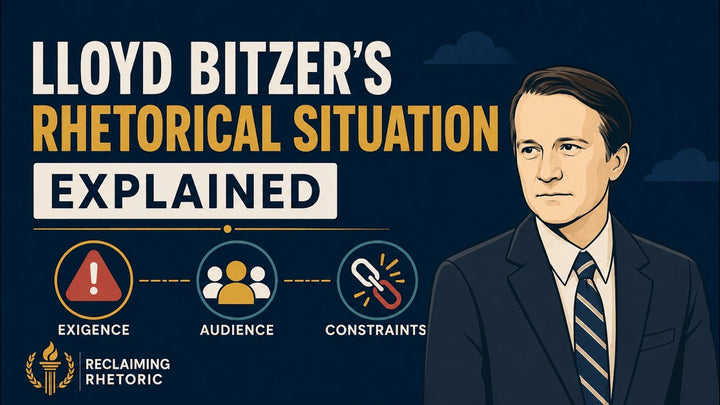
Before you analyze how something persuades, you need to understand its context. Every piece of communication exists in a specific situation, and that situation shapes everything about the message. The idea comes from Lloyd Bitzer's 1968 essay "The Rhetorical Situation" (Philosophy & Rhetoric), and you can read a full explanation in our guide to Bitzer's rhetorical situation. For analysis, ask three questions.
What is the exigence?
Exigence is the problem or occasion that prompted the message. Why does this text exist? What is it responding to? For a public health campaign, the exigence might be rising disease rates. For a charity ad, it might be a crisis that needs funding. For a product launch, it might be a gap in the market the company claims to fill.
Who is the audience?
Not "everyone." Be specific. Who is this message actually designed to reach? An ad for luxury cars targets different people than an ad for budget vehicles. A conference talk on climate science reaches a different audience than a short viral video on the same topic. Know the target, because every other choice in the text is aimed at it.

What are the constraints?
Constraints are the limits the speaker works within: time, platform, format, budget, cultural expectations, professional norms. A short social post has different constraints than a keynote. A chief executive addressing investors faces different constraints than a nonprofit founder addressing donors.
Understanding the situation tells you what the speaker is working with and what they are working against. Writing teachers often add the writer's own position and purpose to this list; Keith Grant-Davie's influential essay breaks the situation into exigence, rhetors, audiences, and constraints (Rhetoric Review, 1997). The Purdue OWL's overview is a good plain-language reference (Purdue OWL).
Step two: name the purpose precisely, because purpose drives strategy
What is this message trying to do? Not all persuasion has the same goal. Some messages want to inform, some want to inspire, some want to change your mind, and some just want you to click.
Ask what action or belief the speaker is trying to produce. Do they want you to buy a product, donate money, change a behavior, trust a brand, share the message, or sign up for something?
Be precise. "This ad wants me to feel good about the brand" is a different purpose from "This ad wants me to buy the product right now." The first is a long game. The second is a deadline. If you misidentify the purpose, you will misread every strategy that follows.

Foundations Series · Volume 2
How to Analyze Any Argument
A visual guide to claims, evidence, assumptions, and reasoning.
Step three: the appeals reveal how the message persuades
Now you get to the mechanics. Look for ethos, pathos, and logos. You may have met them as vocabulary; here you use them as analytical tools. If you need a refresher, see Rhetorical Appeals Explained: Ethos, Pathos, and Logos. Aristotle described them as proofs depending on the speaker's character, on putting the hearer "into a certain frame of mind," and on "the speech itself, in so far as it proves or seems to prove" (Rhetoric 1.2).
Ethos: how is credibility built?
Does the speaker cite credentials, reference experience, align with trusted authorities, or build common ground with the audience? Look for phrases like "as a doctor," "studies show," or appeals to shared values. These are all ethos moves.
Pathos: which emotions are evoked, and how?
Fear, hope, anger, compassion, pride, urgency. Look at word choice, imagery, and stories. Pathos often works through narrative, putting a human face on an abstract issue. If you feel something while reading or watching, that is pathos at work. Name the emotion, then explain how the text creates it.
Logos: what is the structure of the reasoning?
Is the text offering evidence, comparisons, cause and effect, or data? Find each claim and the support behind it. Then ask whether the logic holds up or just sounds smart.
Here is the key: most strong messages use all three appeals. Your job is not to list them. It is to identify which appeal is doing the heavy lifting and whether that balance fits the purpose and the audience.

Step four: style and delivery are strategy, not decoration
How something is said matters as much as what is said. Look at language choices. Is the tone formal or casual, technical or accessible, aggressive or conciliatory? Are there repeated phrases, rhetorical questions, or metaphors that frame the issue a particular way?
Compare "Act now, limited time offer!" with "This promotion is available for a limited time." That is not just different phrasing. It is different rhetoric. One creates urgency. One does not.
If the text is a speech or video, consider delivery too: body language, vocal tone, pacing, eye contact, music, editing. A speech read in monotone has different effects than the same words delivered with conviction. Style and delivery are two of the five canons of rhetoric, and the canons make a useful checklist here.
Step five: effectiveness means fit with the audience, not your agreement
Now step back and assess: did it work? The question is not "Do I personally agree with this message?" It is "Is this message likely to persuade its intended audience?"
- Does the rhetoric match the situation? If the audience values data and the message is pure emotion, there is a mismatch.
- Are the appeals appropriate and well executed? Strong ethos with weak logos might work for some audiences and fail for others.
- Does anything undercut the message? An appeal to an authority who is not actually authoritative, an emotional story that feels manipulative, or logic that collapses under scrutiny.
Effectiveness is not about whether you are convinced. It is about whether the rhetoric is well suited to achieve its purpose with its intended audience. You can find an ad distasteful and still explain precisely why it works.
A worked example shows the five steps in under five minutes
Imagine you are analyzing an ad for a reusable water bottle made from sustainable materials.
1. Rhetorical situation. The exigence is plastic waste and environmental concern, a real and widely reported problem (UNEP). The audience is environmentally conscious consumers, perhaps 18 to 35 with some disposable income. The constraints include a crowded market of similar bottles and a short ad slot.
2. Purpose. Get viewers to buy this specific bottle by clicking a link or visiting the site. Not merely to care about the ocean.

3. Appeals. Moderate pathos: images of ocean pollution, or of beautiful nature worth protecting, evoke concern. Strong ethos: certifications, eco-friendly materials, and partnerships with environmental organizations establish credibility. Solid logos: figures on plastic reduction, durability data, and cost savings compared with disposable bottles.
4. Style. A clean, modern look that matches the product. A calm, aspirational tone rather than an alarmist one. Phrases like "make a difference" and "join the movement" create a sense of community. A clear call to action at the end.
5. Effectiveness. For the intended audience, likely effective. The balance of appeals gives this audience what it wants: proof the product works (logos), trust in the brand (ethos), and a good feeling about the purchase (pathos). The style matches the audience's values.
Notice what the analysis does. It does not just say, "This ad cares about the environment." It explains how environmental values are strategically invoked to achieve a specific goal. That is the difference between describing and analyzing.
Rhetorical analysis is not summary, opinion, or nitpicking
Three common mistakes weaken otherwise solid analyses:
- It is not summary. Do not just restate what the text says. Analyze how it says it.
- It is not opinion. "I think this argument is wrong" is not analysis. "This argument relies on ethos but offers weak credentials" is.
- It is not nitpicking. You are not hunting for every device in the text. You are identifying the major strategies that make the message work or fail.
A useful sentence frame keeps you on track: [Speaker] uses [strategy] to [effect] because [audience/situation]. For example: "The ad uses calm, communal language to make the purchase feel like joining a movement, because its audience wants to feel their spending reflects their values." Strategy, effect, reason. That is analysis.
Your notes become an analysis when each claim links strategy to effect
Once you have worked through the five steps, you will have a page of observations. Turning them into a paragraph is mostly a matter of connection. Each sentence should do three things: name a strategy, describe its effect, and explain why that effect suits this audience in this situation.
Here is how the water bottle notes might become a paragraph:
The ad's strongest move is its ethos. By opening with environmental certifications and a partnership logo, it borrows the credibility of organizations its young, eco-conscious audience already trusts. That trust matters because the market is crowded with similar bottles; the ad cannot win on novelty, so it wins on reliability. The calm tone reinforces this choice. Rather than shocking viewers with images of disaster, it invites them to join a movement, which fits an audience that wants its purchases to reflect its values.
Notice that the paragraph makes an argument of its own. It claims that ethos is doing the heaviest lifting, supports the claim with evidence from the text, and ties both to the situation. Your analysis is persuasive writing too.
Practice makes rhetorical analysis fast and makes you harder to manipulate
Here is the whole process, start to finish:
- Identify the rhetorical situation: exigence, audience, constraints.
- Determine the purpose: what is the speaker trying to accomplish?
- Analyze the appeals: ethos, pathos, logos, and how they work together.
- Examine style and delivery: word choice, tone, techniques, performance.
- Evaluate effectiveness: does the rhetoric fit the situation and achieve its purpose?
The more you practice, the faster it becomes. You start seeing rhetorical patterns everywhere: in ads, news articles, social posts, and conversations. And once you can name what is happening, once you can say "that is an appeal to authority" or "that is a false equivalence," you are no longer a passive audience.
That is also the heart of media literacy, which the National Association for Media Literacy Education defines as "the ability to access, analyze, evaluate, create, and act using all forms of communication" (NAMLE). Rhetorical analysis is the analyze-and-evaluate part, done deliberately. For the broader case for why it matters, read What Is Rhetoric? From Aristotle to TikTok.
Find more in all articles, go deeper on the Courses page, or get the full illustrated method on the Guides page.
Foundations Series · Volume 2
How to Analyze Any Argument
A visual guide to claims, evidence, assumptions, and reasoning. Stop reacting. Start diagnosing.
A visual method for seeing where an argument actually works, and where it does not. Name the claim, test the evidence, and find the assumption holding it all together.
Sources and further reading
- Lloyd F. Bitzer, "The Rhetorical Situation," Philosophy & Rhetoric 1, no. 1 (1968): 1–14
- Keith Grant-Davie, "Rhetorical Situations and Their Constituents," Rhetoric Review 15, no. 2 (1997): 264–279
- Purdue Online Writing Lab, "Rhetorical Situations"
- Aristotle, Rhetoric, Book 1, Chapter 2 (Perseus Digital Library, trans. J. H. Freese)
- College Board, AP English Language and Composition course overview
- National Association for Media Literacy Education, "Media Literacy Defined"
Frequently Asked Questions
What is a rhetorical analysis?
A rhetorical analysis explains how a text tries to persuade its audience: the situation it responds to, its purpose, its appeals, its style, and whether those choices are likely to work.
What are the steps of a rhetorical analysis?
Identify the rhetorical situation, determine the purpose, analyze the appeals, examine style and delivery, and evaluate effectiveness.
What should I choose to analyze?
Pick a short text with a clear persuasive purpose, such as an ad, a public service announcement, an opinion piece, a short talk, or a fundraising page.
What is the rhetorical situation?
The context of a message: the exigence that prompted it, the audience it addresses, and the constraints the speaker works within.
What is exigence in a rhetorical analysis?
The problem, need, or occasion that prompted the text. It answers the question, why does this message exist right now?
How do I analyze ethos, pathos, and logos?
Find where the text builds credibility, where it evokes emotion, and where it offers reasons or evidence. Then decide which appeal does the most work and whether that balance suits the audience.
Is a rhetorical analysis the same as a summary?
No. A summary restates what a text says. An analysis explains how and why the text says it the way it does.
Should I include my opinion?
Not as agreement or disagreement. Judge effectiveness instead: is the rhetoric well suited to persuade its intended audience?
How long should a rhetorical analysis be?
It depends on the assignment. A focused analysis of a short text can be done well in a few paragraphs. Depth matters more than covering every device.
How do I write a strong thesis for a rhetorical analysis?
Name the speaker, the main strategies, the intended effect, and the audience. For example: the ad uses calm, communal language and credible certifications to persuade eco-conscious young adults that buying the bottle is a meaningful act.
Reclaiming Rhetoric is independent and reader-supported.
If this helped, you can help keep it free.