She built a successful company, so she can run the city.
That sounds like a complete argument. We have a reason (she built a successful company) and a conclusion (she can run the city). But something important is missing. Why should success in business predict success in government? Are companies and cities managed in the same way? Do the same skills transfer from one institution to the other? Was the company successful because of her leadership, or because of the employees, investors, market conditions, or timing?
The sentence does not answer any of those questions. Instead, it quietly asks you to answer them. And if you supply the right connection yourself, the conclusion can begin to feel obvious before that connection has ever been examined. That is the basic power of the enthymeme: an argument in which some of the reasoning happens inside the audience rather than entirely inside the words.
This article, a companion to the Reclaiming Rhetoric video, explains what an enthymeme is, why the textbook definition is useful but incomplete, how enthymemes work with signs and probabilities, how images and interfaces make them, and a step-by-step method for finding the hidden assumption in any argument.
What Aristotle meant by an enthymeme
In Book 1 of the Rhetoric, Aristotle makes the enthymeme central to persuasion. "I call an enthymeme a rhetorical syllogism," he writes in J. H. Freese's translation (Rhetoric 1.2). It is rhetoric's counterpart to the formal deductions of logic.
But rhetoric usually deals with questions less certain than those of formal logic or mathematics. What probably happened? What caused something? Is this person trustworthy? Is this policy likely to work? What should we do next? These are judgments made under uncertainty. So an enthymeme usually does not prove what absolutely must be true. It helps an audience move from something it already accepts toward something it is being asked to accept.

Foundations Series · Volume 2
How to Analyze Any Argument
A visual guide to claims, evidence, assumptions, and reasoning.
The textbook definition, and why it is only a start
You may have encountered a simpler definition: an enthymeme is a syllogism with a missing premise. The classic classroom example begins with a full syllogism:
- All humans are mortal.
- Socrates is human.
- Therefore, Socrates is mortal.
Compress that into "Socrates is human, so Socrates is mortal," and the audience supplies the familiar proposition that all humans are mortal.
That explanation is genuinely useful because it teaches us to look for an unstated connection, and Aristotle himself makes the point. Enthymemes, he says, are
deduced from few premises, often from fewer than the regular syllogism; for if any one of these is well known, there is no need to mention it, for the hearer can add it himself.
His example is an Athenian sports fact. To prove that Dorieus won a contest whose prize was a crown, "it is enough to say that he won a victory at the Olympic games; there is no need to add that the prize at the Olympic games is a crown, for everybody knows it."
But defining the enthymeme simply as a defective syllogism with one sentence deleted goes too far. The more useful rhetorical idea is broader: an enthymeme is a compressed inference whose persuasive force depends partly on assumptions the audience is expected to recognize, accept, or supply. Sometimes there is a neat missing premise. Sometimes there are several. Sometimes the unstated material is less a formal proposition than a culturally familiar value, association, or expectation.

Eleven words, a page of reasoning
Go back to our example. One possible bridge between "She built a successful company" and "she can run the city" would be: someone who successfully builds a company possesses the skills required to govern a city. But even that sentence hides smaller assumptions:
- that a city is sufficiently similar to a company;
- that leadership skills transfer between the two;
- that the candidate herself was substantially responsible for the company's success;
- perhaps even that efficiency, growth, or cost control should be central standards for judging government.
The original argument contains eleven words. The reasoning underneath it could fill a page. And different listeners may complete it differently. One person hears she has executive experience. Another hears she understands budgets. Another hears something more ideological: government should be run like a business. The audience is not merely receiving a finished argument. It is helping construct the version of the argument that becomes persuasive.
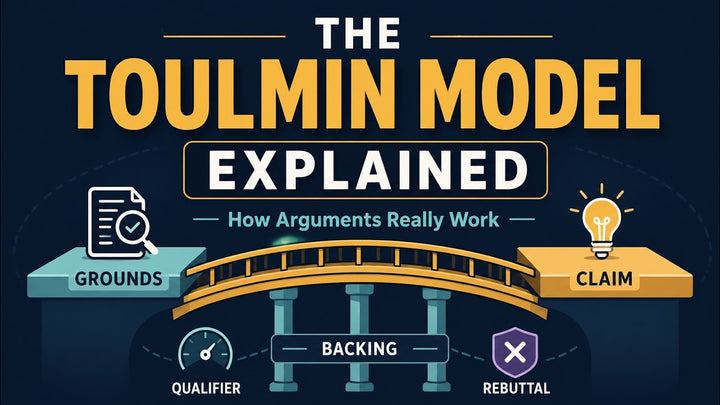
If you know the Toulmin model of argument, you will recognize the missing bridge as the warrant, the often unstated principle that licenses the move from data to claim. Toulmin's vocabulary and Aristotle's enthymeme are two ways of pointing at the same gap.
Why enthymemes are so persuasive
Three features explain their power.
- They are efficient. Ordinary communication would become unbearable if speakers had to state every assumption behind every conclusion. We compress. We rely on shared knowledge. We skip steps that seem familiar.
- They recruit common ground. The connection works especially smoothly when the audience already finds it plausible.
- The audience participates in the reasoning. Listeners sometimes experience the missing connection as something they already knew.
That third point matters psychologically and rhetorically. A premise supplied by the audience may feel less like somebody else's controversial assertion and more like simple common sense. The crucial question, then, is what kind of common sense the argument is recruiting. Shared assumptions can contain useful knowledge, but they can also contain stereotypes, ideological commitments, and values so familiar that they no longer feel like claims at all. This is one reason, explored in why smart people believe bad arguments, that intelligence alone does not protect us: the premise we supply ourselves is the one we are least likely to inspect.
Signs, probabilities, and the space before certainty
Aristotle notes that the materials of enthymemes are, in large part, "probabilities and signs." That is where many everyday arguments live: in the space between evidence and certainty.
Consider: The candidate's support rose after the debate, so the debate changed voters' minds. The rise may be perfectly real, but the causal inference requires more. Perhaps another news event occurred. Perhaps the opponent made a mistake. Perhaps the poll's sample changed. Perhaps the debate really did cause the movement. The evidence can be accurate while the inference remains uncertain.
Or: She refuses to release the records, so she must be hiding something. The refusal is evidence of something, but the argument depends on another assumption: that people who refuse disclosure usually do so because the information would damage them. Sometimes that is correct. It is not necessarily correct. Good rhetorical analysis asks whether the evidence supports the strength of the conclusion being drawn.

Hidden bridges are everywhere
Once you begin looking for these bridges, you see them constantly:
- "Millions of people bought it, so it must work." Popularity becomes evidence of effectiveness.
- "He grew up in this community, so he understands people like us." Shared background becomes evidence of understanding.
- "She has never held office, so she is not qualified." Political experience becomes a necessary condition for competence.
- "This post has thousands of shares, so it must be credible." Visibility becomes evidence of truth.
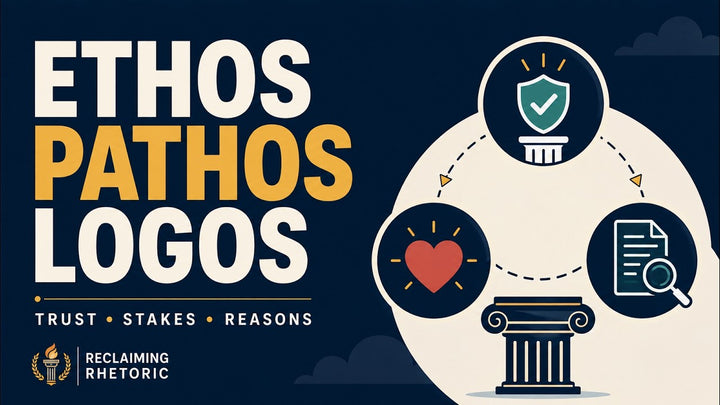
These assumptions reveal more than the mechanics of an argument. They reveal what an audience treats as meaningful: what counts as expertise, trustworthiness, belonging, and evidence. Several of them are really claims about ethos, about whose character and experience we should trust. One of the most revealing things about an enthymeme is precisely what does not need to be said. What a speaker can leave unstated tells you what the intended audience has already learned to regard as obvious.
Visual enthymemes: arguments without sentences
Enthymemes do not have to be verbal. Imagine a political advertisement showing a candidate in work boots standing beside factory employees, followed by two words: one of us. No formal argument appears, but the arrangement invites one. This person shares your identity. Someone who shares your identity shares your interests. Someone who shares your interests will represent you well.
Or imagine an advertisement showing a before photograph, then a product, then an after photograph. Simply placing those images in sequence invites the conclusion that the product caused the transformation, without ever stating it, and without ever having to defend it.
Even interfaces encourage enthymematic reasoning. A claim appears above thousands of likes and shares, and the platform presents popularity beside the message. The interface does not have to say, "Many people approve of this, therefore it deserves your approval." The audience can complete that inference on its own.

How to find the hidden assumption: a five-step method
- Start with what is actually stated. What reason or evidence appears, and what conclusion appears or is being invited?
- Complete one sentence: "This conclusion follows only if ..." For our example: This conclusion follows only if success in business gives us good reason to expect success in governing.
- Generate more than one possible bridge. Maybe the argument concerns leadership; maybe financial management; maybe discipline; maybe the deeper belief that government resembles business.
- Test those assumptions. Are they always true? Usually true? True only under particular conditions? Are they values presented as facts? Could alternative explanations weaken them?
- Ask about the audience. Who is expected to supply this connection automatically? Who might reject it? What shared belief is the argument depending upon?
The goal is not to invent the stupidest possible premise and declare the argument defeated. That is a straw man. Reconstruct the most plausible bridge and then evaluate it fairly. This is the same principle of charity that makes any rhetorical analysis credible.
Using enthymemes well when you write or speak
The enthymeme is not only a tool for critics. It is how skilled speakers build arguments that feel natural rather than lecturing. The craft lies in choosing which premises to leave unstated. Leave out what your audience genuinely shares, and your argument feels brisk and respectful of their intelligence. Leave out what they do not share, and your argument either confuses them or quietly smuggles in a claim they would have rejected if they had heard it.
So before you speak, list the assumptions your conclusion depends on and sort them. Which ones does this audience already hold? Which ones are contested? State and support the contested ones, and let the shared ones do their work in silence. A speech to fellow nurses about staffing can leave unstated that patient safety matters; a speech to a budget committee may need to argue it. Same conclusion, different enthymeme, because the rhetorical situation and its audience have changed.
The ethical test: say the hidden premise aloud
None of this means enthymemes are deceptive. Communication requires compression. We cannot explain every background assumption every time we speak. But there is a useful ethical test: say the hidden premise aloud.
If an argument suddenly sounds far weaker, much more controversial, or substantially more prejudiced once the unstated assumption becomes explicit, then the omission may have been doing more than saving time. A responsible speaker should be especially cautious about leaving unstated the very proposition on which the controversy depends. If the whole debate is about whether business experience transfers to government, then assuming it silently is not efficiency. It is skipping the argument.
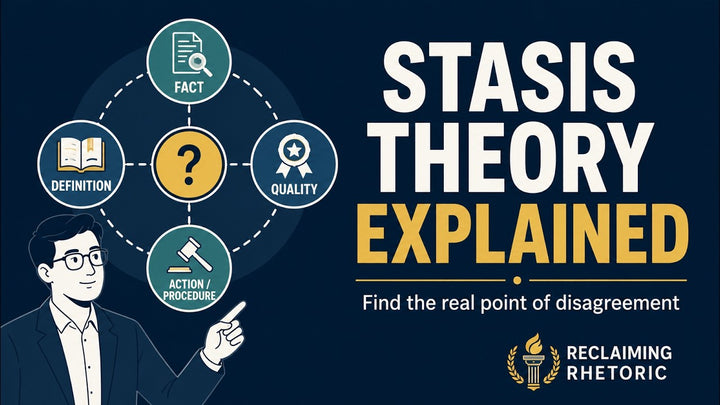
And a responsible listener should remember that finding one neat missing sentence is not always enough. Real rhetorical reasoning can involve several assumptions, images, narratives, emotional associations, categories, and cultural values at once. When the disagreement turns out to hinge on what a key word means, stasis theory can help you see that the argument has moved from fact to definition.
The point is not to turn every argument into a broken three-line syllogism. The point is to expose the movement between what has been stated and what the audience is being asked to supply. The most persuasive part of an argument may not be the claim, or even the evidence. It may be the bridge you are expected to build between them. So the next time a conclusion feels immediate, obvious, or inevitable, ask one question before you accept it: What did I have to believe to get from that reason to this conclusion? Once you can hear the missing premise, you can decide whether it deserves to be supplied.
To keep going, browse all articles, explore structured lessons on the Courses page, or see the illustrated guides on the Guides page.
Foundations Series · Volume 2
How to Analyze Any Argument
A visual guide to claims, evidence, assumptions, and reasoning. Stop reacting. Start diagnosing.
A visual method for seeing where an argument actually works, and where it does not. Name the claim, test the evidence, and find the assumption holding it all together.
Sources and further reading
- Aristotle, Rhetoric 1.2 (Perseus Digital Library, trans. J. H. Freese)
- Stephen E. Toulmin, The Uses of Argument (Cambridge University Press)
- Reclaiming Rhetoric, The Toulmin Model of Argument
- Reclaiming Rhetoric, The Rhetorical Appeals: Ethos, Pathos, and Logos
Frequently Asked Questions
What is an enthymeme in simple terms?
A compressed argument that leaves part of its reasoning unstated, so the audience supplies the missing assumption that connects the reason to the conclusion.
How did Aristotle define the enthymeme?
He called it a rhetorical syllogism: a deduction from few premises, often fewer than a full syllogism, because the hearer can add what is well known.
Is an enthymeme just a syllogism with a missing premise?
That is a useful starting point, but the unstated part can be several assumptions, a cultural value, or an association rather than one neat sentence.
What is an example of an enthymeme?
"She built a successful company, so she can run the city" assumes that business success predicts success in governing, without saying so.
Can images be enthymemes?
Yes. A before photo, a product, and an after photo invite the conclusion that the product caused the change without ever stating it.
How do you find the hidden premise?
Complete the sentence "This conclusion follows only if ...", generate more than one possible bridge, test each one, and ask who is expected to supply it.
Are enthymemes manipulative?
Not inherently, since all communication compresses. A good test is to say the hidden premise aloud: if the argument suddenly sounds much weaker or more prejudiced, the omission was doing real work.
Reclaiming Rhetoric is independent and reader-supported.
If this helped, you can help keep it free.