Why does the same message work in one situation and completely fail in another?
Imagine seeing this headline: "Major announcement coming tomorrow." If it comes from your favorite band, you are excited. New album, tour dates. If it comes from your employer, you are anxious. Layoffs, restructuring. If it comes from your doctor's office, you are concerned. Test results, a diagnosis.
Same headline. Same words. Three completely different reactions. What changed was the situation.
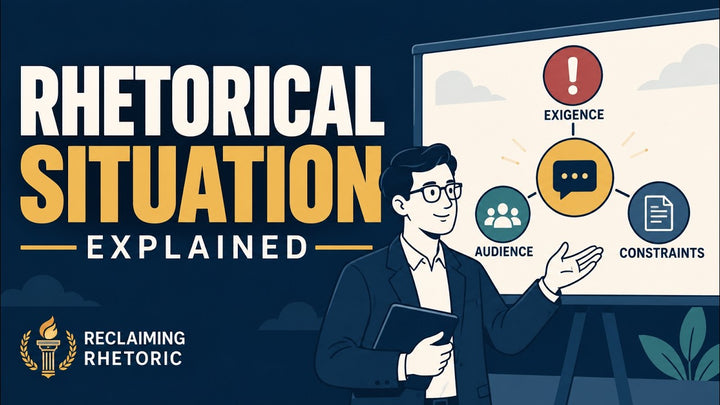
This article, a companion to the Reclaiming Rhetoric video on the rhetorical situation, explains the framework that accounts for that difference. It comes from Lloyd Bitzer, and it is one of the most useful tools in rhetoric for both analyzing messages and writing your own.
Rhetoric never happens in a vacuum, because every message answers a situation
In 1968, Lloyd Bitzer published a short, influential essay called "The Rhetorical Situation" in the first issue of the journal Philosophy & Rhetoric (Bitzer, 1968). His central insight was simple and far-reaching: rhetoric does not exist in a vacuum. Every message is shaped by the situation it responds to.
Bitzer argued that situations call rhetoric into being. A speech, a statement, or a post exists because something in the world needed a response. To understand the message, you have to understand the situation. He named three elements:
- Exigence: the problem or occasion that calls for a response.
- Audience: the people who can be influenced and can act on that problem.
- Constraints: the factors that limit or shape what can be said and done.
These three questions are also step one of our five-step rhetorical analysis method. Here, we look at each one closely.

Foundations Series · Volume 2
How to Analyze Any Argument
A visual guide to claims, evidence, assumptions, and reasoning.
Exigence is an imperfection that words can actually address
Exigence is the problem, issue, or occasion that calls the rhetoric into being. It is the reason the message exists, the thing that needs to be addressed. Bitzer's own definition is memorable: an exigence is "an imperfection marked by urgency." Something is wrong, incomplete, or needs attention, and rhetoric is the response.
A simple example: a company discovers its product has a safety defect. That is an exigence. The company has to respond, with a recall notice, a public apology, and a plan to fix it. The defect and the public concern it creates prompted the rhetoric. No exigence, no need for rhetoric. If there is no problem to solve and no occasion demanding a response, you are just talking into the void.
Only some problems are rhetorical exigences
Here is the key refinement. An exigence is not just any problem. It has to be one that discourse can actually change. Bitzer called this a rhetorical exigence: something that can be resolved or modified through communication.
A hurricane approaching the coast is not a rhetorical exigence. You cannot talk a hurricane away. But the need to evacuate people before it makes landfall is rhetorical. Warnings, instructions, and appeals can change what people do. Communication can solve that problem.
So when you analyze any message, ask two questions. What problem or occasion prompted this? And can rhetoric actually do anything about it? When the honest answer to the second question is no, the message is likely to be noise, however polished.

The rhetorical audience is only the people who can act
Not everyone who hears a message is part of the rhetorical audience. Bitzer drew a sharp line here. The rhetorical audience is not whoever might encounter a message. In his words, it consists of "those persons who are capable of being influenced by discourse and of being mediators of change." In other words, the people who can actually do something about the exigence.
Take a local referendum on a school funding measure. A campaign ad urges people to vote yes. Who is the rhetorical audience?
- Not children. They cannot vote.
- Not people in a different city. The measure does not affect them, and they cannot vote on it.
- Not people who have already voted. Their decision is made.
The rhetorical audience is registered voters in that district who have not yet voted and might still be persuaded. That is who the ad is really for. Everyone else is an overhearer.
This is why the same message can succeed with one group and fail with another. If you speak to the wrong audience, people who do not care about the exigence or cannot act on it, your rhetoric fails no matter how well crafted. So ask: Who has the power to resolve this exigence? Who cares about it? Who can be moved to act? If the answer is no one, or not these people, you do not have a rhetorical situation. You have a speech no one needs to hear.
Constraints are the conditions every persuader has to work within
Constraints are the factors that limit or shape the rhetoric. Bitzer described them as the "persons, events, objects, and relations" in a situation that have the power to constrain decision and action. He distinguished two broad kinds: those that are part of the situation and those the speaker brings.
Situational constraints
- Time. With thirty seconds for an ad, you cannot tell a complex story. With three minutes for a speech, you have to get straight to the point.
- Medium and platform. A billboard gets a few words and an image. A podcast gives you time to develop ideas. A short social post forces brevity.
- Cultural and social norms. Some topics are sensitive. Some language is inappropriate in some settings.
- Competing messages. If ten others are making similar arguments, you have to stand out. If everyone is shouting, quiet might get attention.
Speaker constraints
- Credibility. A recognized expert starts with trust. An unknown speaker has to build it. This is ethos seen as a constraint.
- Access to evidence. Do you have data, personal experience, or expert testimony, or are you working with limited proof?
- Relationship to the issue. Are you directly affected, or an outside observer? That shapes how audiences receive you.
Constraints are not necessarily bad. They are the reality you work within. A thirty-second limit is not a failure. It is a parameter. Your job is to make the most persuasive message possible within it. Skilled communicators understand their constraints and adapt. Unskilled ones ignore them and wonder why their message does not land.
Change one element of the situation, and the message has to change
This framework explains why "just say what you mean" often does not work. What you mean is not enough. You have to say it to the right audience, in response to a real exigence, while navigating your constraints. Same exigence, different audience: different message. Same audience, different constraints: different approach.

Example one: a restaurant's failed health inspection
Exigence. The report is public, customers are worried, and the restaurant's reputation is at risk. Communication and corrective action can address it.
Audiences. Current customers who saw the report want reassurance. Potential customers deciding whether to try the place want proof it is safe. The health department wants a corrective action plan. Three audiences, three different needs.
Constraints. Time: they need to respond before losing more business. Platform: a social post for customers, formal documentation for the inspectors. Credibility: a history of violations damages their ethos, while a clean record gives them more trust to work with. One exigence, multiple audiences, real constraints.
Example two: a university tuition increase
Exigence. Students and families need to know why costs are going up and whether the increase is justified.
Audiences. Current students and families want justification and support: why is this happening, and what help will I get? Prospective students want value: is this worth the cost? Alumni want impact: will my donation make a difference? Faculty and staff want transparency: where is the money going? Same exigence, different rhetoric for each group.
Constraints. The university cannot hide financial realities or make promises it cannot keep, and it is limited by what it can legally disclose. A record of mismanagement is a credibility constraint. A record of transparency gives it more room.
Example three: your own message
The framework is not only for institutions. Suppose you want the city to add a crosswalk near a neighborhood park where cars speed past children.
Exigence. A real safety risk, and one that communication can address, because crosswalks are installed when officials are persuaded they are needed.
Audience. Not the drivers, who may never read your message, and not the whole internet. The rhetorical audience is the people who can act: the city traffic office, your council representative, and neighbors whose signatures add weight to the request.
Constraints. Officials receive many requests and have limited budgets. You are a resident, not a traffic engineer, so your credibility comes from local knowledge and evidence: photos, a simple count of cars during school pickup, and a list of families who use the park. A short, specific letter with that evidence fits the situation far better than an angry post that tags everyone.

Map the situation first, and the right message almost writes itself.
Most failed messages are mismatches with the situation, not bad writing
Here is what happens when you ignore the rhetorical situation. You send a formal, data-heavy message to an audience that wants empathy and action. You answer an exigence your audience does not care about. You ignore time, platform, or credibility, and the message falls flat.
Bad rhetoric usually is not bad writing. It is a mismatch between the rhetoric and the situation. That makes the framework a diagnostic tool. When communication fails, ask:
- Was there a real exigence, or was I solving a problem no one cared about?
- Was I speaking to the rhetorical audience, or to people who could not or would not act?
- Did I understand my constraints, or did I try something the situation would not allow?
More often than not, the failure is not in the words. It is in the fit.
Mapping the situation first makes every message stronger
Before you write, speak, or create any persuasive message, map the situation:
- What is the exigence? What problem am I addressing, and can rhetoric actually address it?
- Who is my rhetorical audience? Who can act on this, and who cares enough to be persuaded?
- What are my constraints? What limits my message: time, platform, credibility, context?
If you can answer those three questions clearly, you are ahead of most communicators. Most people start with "What do I want to say?" They should start with "What does this situation call for?" The situation tells you what is needed. Then you craft the message to meet it, using the five canons to build it.
Critics showed that rhetoric also shapes the situations it responds to
Bitzer's framework is not the only way to think about rhetorical situations, and scholars have debated and expanded it for decades. The most famous reply came in 1973, when Richard Vatz published "The Myth of the Rhetorical Situation" (Philosophy & Rhetoric, 1973). Vatz argued that speakers do not simply respond to situations. They help create them, by choosing which events to talk about and how to frame them. Meaning, in his view, is created by rhetors more than discovered in situations.
Others refined the model further. Keith Grant-Davie added rhetors, the speakers and writers themselves, as a constituent of the situation and noted that a single situation can involve several exigences and audiences at once (Rhetoric Review, 1997). Jenny Edbauer proposed thinking of "rhetorical ecologies," in which messages circulate, mutate, and interact with other messages over time rather than answering one fixed situation (Rhetoric Society Quarterly, 2005). That view feels especially apt for content that travels across social platforms.
All of these are useful. Rhetoric is both responsive and creative. But Bitzer's three elements remain the best starting point: a way to see what is already happening before you decide how to intervene. That is why the rhetorical situation appears in nearly every writing course, from the Purdue OWL's overview (Purdue OWL) to the AP English Language course framework (AP Central).
Exigence, audience, constraints. Three elements, one situation, and the difference between rhetoric that works and rhetoric that does not. Every time someone tries to persuade you, they are operating in a rhetorical situation, whether they realize it or not. Every time you try to persuade someone, you are too. Words are never enough on their own. For the bigger picture, start with What Is Rhetoric? From Aristotle to TikTok, browse all articles, or explore the Courses page and the Guides page.
Foundations Series · Volume 2
How to Analyze Any Argument
A visual guide to claims, evidence, assumptions, and reasoning. Stop reacting. Start diagnosing.
A visual method for seeing where an argument actually works, and where it does not. Name the claim, test the evidence, and find the assumption holding it all together.
Sources and further reading
- Lloyd F. Bitzer, "The Rhetorical Situation," Philosophy & Rhetoric 1, no. 1 (1968): 1–14
- Richard E. Vatz, "The Myth of the Rhetorical Situation," Philosophy & Rhetoric 6, no. 3 (1973): 154–161
- Keith Grant-Davie, "Rhetorical Situations and Their Constituents," Rhetoric Review 15, no. 2 (1997): 264–279
- Jenny Edbauer, "Unframing Models of Public Distribution: From Rhetorical Situation to Rhetorical Ecologies," Rhetoric Society Quarterly 35, no. 4 (2005): 5–24
- Purdue Online Writing Lab, "Rhetorical Situations"
- College Board, AP English Language and Composition course overview
Frequently Asked Questions
What is the rhetorical situation?
The context that calls a message into being: the exigence that prompts it, the audience that can act on it, and the constraints that shape what can be said. The framework comes from Lloyd Bitzer's 1968 essay.
Who is Lloyd Bitzer?
An American rhetorical scholar whose 1968 essay "The Rhetorical Situation" became one of the most cited works in modern rhetoric and writing studies.
What does exigence mean?
Bitzer defined exigence as "an imperfection marked by urgency": a problem or need that prompts someone to communicate.
What is the difference between an exigence and a rhetorical exigence?
Any problem is an exigence, but a rhetorical exigence is one that communication can change. You cannot persuade a hurricane, but you can persuade people to evacuate.
What is a rhetorical audience?
The people who can be influenced by the message and can act to change the situation. For a referendum ad, that is eligible voters in the district who have not yet voted.
What are constraints in a rhetorical situation?
The factors that limit or shape a message. Some belong to the situation, like time, platform, norms, and competing messages. Others come from the speaker, like credibility, evidence, and relationship to the issue.
Why does the rhetorical situation matter?
Because messages fail most often through mismatch: the wrong audience, a problem nobody cares about, or ignored constraints. Mapping the situation first prevents those failures.
What was Vatz's critique of Bitzer?
Richard Vatz argued in 1973 that speakers help create situations by choosing what to talk about and how to frame it, so meaning is made by rhetors, not simply discovered.
Is Bitzer's model still used today?
Yes. It remains a standard starting point in writing courses and AP English Language, often alongside later refinements such as Grant-Davie's constituents and Edbauer's rhetorical ecologies.
How do I use the rhetorical situation in my own writing?
Before drafting, answer three questions: What problem am I addressing, and can words help? Who can act on it? What limits my message? Then shape your content to fit those answers.
Reclaiming Rhetoric is independent and reader-supported.
If this helped, you can help keep it free.