Two people can say essentially the same thing, and one message is unforgettable while the other disappears instantly. The difference is not the idea. It is the language: the phrasing, the rhythm, the imagery, the tone.
Persuasion is not only about discovering arguments and organizing them. It is also about how those ideas sound, how they feel, and how they stay in the mind. Classical rhetoric called this dimension style, and it is the third of the five canons of rhetoric.
This article, a companion to the Reclaiming Rhetoric video on the third canon, explains what rhetorical style is, the four tools that do most of its work, why it can mislead as easily as it clarifies, and how to judge the style of any message.
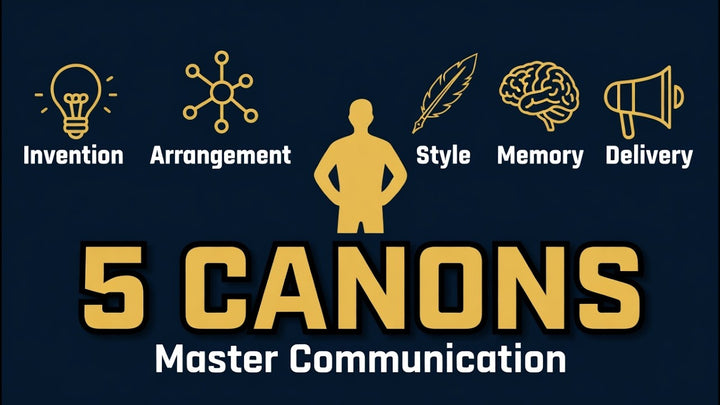
The five canons series: 1. Invention · 2. Arrangement · 3. Style (you are here) · 4. Memory · 5. Delivery. For the overview of all five in one place, start with The Five Canons of Rhetoric.
Style is where language becomes persuasion
Once an argument has been discovered through invention and ordered through arrangement, one crucial decision remains: how should these ideas be expressed? The Romans called this canon elocutio. The word looks like "elocution," but it did not mean voice training. It meant the choice of language: word choice, sentence structure, figures of speech, and sound.
The Rhetorica ad Herennium defines style as "the adaptation of suitable words and sentences to the matter devised" (Ad Herennium 1.3). Notice the word suitable. From the start, style meant fit, not decoration.
Two arguments can contain identical logic. If one is expressed more clearly, more vividly, and more memorably, that version usually wins. Consider a simple sentence: "This policy will improve economic conditions." It is accurate but abstract. Now try: "This policy puts money back into people's pockets." The basic idea is the same, but it now feels concrete, personal, and immediate. That shift is style.

Foundations Series · Volume 3
How to Build a Better Argument
A practical visual guide to claims, evidence, structure, and objections.
Four tools do most of the work of style
1. Clarity comes first
Before language can persuade, it has to be understood. Aristotle put clarity at the top of his list: "one of its chief merits may be defined as perspicuity. This is shown by the fact that the speech, if it does not make the meaning clear, will not perform its proper function" (Rhetoric 3.2).
Clear language removes friction: short sentences, precise words, direct explanations. Clarity respects the audience's attention. Confusion weakens persuasion, and understanding strengthens it.
2. Imagery makes abstractions visible

When language creates pictures, ideas become easier to grasp. Instead of saying "the system has structural problems," you might say "the system is cracking under pressure." Suddenly the concept is visible. Imagery turns an abstraction into something the audience can almost experience, and experiences are easier to remember than abstractions.
Imagery carries a frame with it, though. "Cracking under pressure" suggests the system is about to fail. Choose images that are vivid and also fair to the facts.
Aristotle gave metaphor a special place here. "It is metaphor above all that gives perspicuity, pleasure, and a foreign air," he wrote, while insisting that metaphors be appropriate and proportionate to what they describe (Rhetoric 3.2). The point is subtle: a good metaphor is not an ornament added after the meaning is clear. It is often the thing that makes the meaning clear.
3. Rhythm gives arguments momentum
Language has sound: cadence, repetition, and parallel structure. These make ideas feel natural, memorable, even inevitable. Two famous lines show how.
Martin Luther King Jr.'s 1963 speech at the March on Washington returns again and again to "I have a dream," a repetition at the start of successive sentences that rhetoricians call anaphora (King Institute, Stanford). John F. Kennedy's 1961 inaugural address turned a phrase back on itself: "ask not what your country can do for you, ask what you can do for your country" (National Archives). That reversal is called chiasmus. In both cases the rhythm carries the meaning forward.
4. Tone tells the audience how to take the message
Tone signals attitude: serious, playful, urgent, reflective. A calm tone builds trust. An energetic tone creates excitement. A solemn tone communicates gravity. Tone helps the audience interpret not just what is said but how it should be received, and a mismatch, such as a breezy tone about a serious loss, can sink an otherwise sound message.
Classical rhetoric matched style to the moment
Ancient teachers organized style around fit. The Ad Herennium describes "three kinds of style": "the first we call the Grand; the second, the Middle; the third, the Simple" (Ad Herennium 4.8). The grand style used ornate, impressive language for moments that called for intensity. The simple style came down "to the most current idiom of standard speech," ideal for teaching and explaining. The middle style sat between them.

The handbook also warned that each level has a neighboring fault. Reach too hard for the grand style and you get swollen, inflated language. Let the middle style go slack and it drifts into something loose and spineless. Mishandle the simple style and it becomes what the handbook calls the Meager: "dry and bloodless" (Ad Herennium 4.10–11). Every level can be done well or badly. The question is never which style is best in general, only which one this occasion calls for and whether you are executing it with control.
A related tradition, traced to Aristotle's student Theophrastus and passed on by Cicero, named four virtues of style: correctness, clarity, appropriateness, and ornament. Ornament comes last for a reason. It only works when the first three are already in place.
The principle still holds. Different audiences expect different styles. Academic readers value precision. Public audiences value clarity. Marketing values memorability. Friends value a conversational tone. Effective communicators adapt, matching their language to the expectations of the situation. Style is always situational.
Style works because distinctive language sticks
Plain, generic language tends to evaporate. Distinctive language lingers: repetition sticks, metaphors stay with us, and rhythm echoes. In that sense style acts like a memory device. It makes ideas portable, easy to repeat, easy to share, and easy to remember.

That is why slogans work, why speeches get quoted, and why certain lines survive for generations. It is also why style is so closely tied to the next canon, memory: what is well phrased is easier for both speaker and audience to recall.
A short field guide to figures you hear every day
The Roman handbooks catalogued dozens of figures of speech, the Ad Herennium alone devotes most of its fourth book to them. You do not need to memorize the list, but a handful turn up constantly in speeches, ads, and posts, and naming them makes them easier to notice:
- Antithesis sets opposites side by side so each sharpens the other. Kennedy's inaugural used it repeatedly: "Let us never negotiate out of fear. But let us never fear to negotiate" (National Archives).
- Tricolon, or the rule of three, groups ideas in threes of similar shape: faster, cheaper, safer. Three items feel complete in a way two often do not.
- Alliteration repeats initial sounds, which is why so many brand names and campaign slogans sound the way they do.
- Rhetorical questions invite the audience to supply the answer themselves, which can feel more persuasive than being told.
- Metaphor and analogy carry an idea across from a familiar domain, such as calling a budget a household budget, along with all the assumptions that come with it.
The handbook's advice on using them still holds: "Distributed sparingly, these figures set the style in relief, as with colours; if packed in close succession, they set the style awry" (Ad Herennium 4.11). It also recommends varying the level of style within a single speech, moving from grand to middle to simple and back, so that the audience never tires of one register.
Each of these is neutral. The same tricolon can summarize a sound plan or make an empty one sound finished. That is the theme of the next section.
Style can make weak arguments sound strong
Style carries a danger. Language can sound persuasive without being meaningful. Elegant phrases can hide weak arguments. Complicated language can disguise confusion. A rhetorical flourish can distract from a lack of substance. A beautifully worded idea is not automatically a true one.
Style amplifies whatever it carries. Strong arguments become stronger. Weak arguments can appear stronger than they are. That is why classical rhetoricians warned against excess. Aristotle devoted a whole chapter to what he called "frigidity of style," the overwrought language of speakers who piled on strange words, needless epithets, and far-fetched metaphors (Rhetoric 3.3). He also insisted style must be "neither mean, nor above the dignity of the subject, but appropriate to it."
The goal of style is not decoration. It is precision: the right language, for the right moment, for the right audience. When you analyze an argument, strip away the phrasing and ask whether the claim still stands.
Revising one message for style
Here is a notice a building manager might send:
Please be advised that, due to necessary maintenance procedures, water service may be subject to interruption during the period in question, and residents are encouraged to plan accordingly.
Nothing in it is false. But it is wordy, vague about the period, and passive about who is doing what. A revision for style:
The water will be off on Thursday from 9 a.m. to noon while we replace a main valve. Fill a pitcher the night before. We will text you when it is back on.
The second version applies the four tools. It is clear: day, time, and reason in one sentence. It is concrete: a pitcher, a text. It has rhythm: three short sentences of similar weight. Its tone is calm and helpful. The facts have not changed. The effect has.
Weak style and strong style look very different
Weak style looks like wordy sentences, vague language, clichés, jargon that hides meaning, and language that makes the audience work harder than necessary. Strong style looks like clear phrasing, concrete language, memorable structure, and words that guide understanding instead of obstructing it.
When you write or speak, ask yourself: Are my ideas clear? Are my examples vivid? Does the rhythm help the message flow? Does the tone match the moment? Strong style serves the argument. It does not overshadow it.
A diagnostic for reading the style of any message
When you meet a persuasive message, ask:
- What language choices stand out?
- What images is it creating?
- What phrases are repeated?
- What tone is being set?
- What emotional atmosphere does the language create, and does the substance justify it?
These questions reveal how style supports persuasion, or how it substitutes for it. Invention finds the argument, arrangement organizes it, and style gives it a voice that people remember, repeat, and act on. Once you see it, you cannot unsee it.
The five canons series: 1. Invention · 2. Arrangement · 3. Style (you are here) · 4. Memory · 5. Delivery. For the overview of all five in one place, start with The Five Canons of Rhetoric.
To keep going, browse all articles, explore structured lessons on the Courses page, or see the illustrated guides on the Guides page.
Foundations Series · Volume 3
How to Build a Better Argument
A practical visual guide to claims, evidence, structure, and objections. Opinion in. Case out.
Move from an initial opinion to a clear, well-supported case that can withstand fair scrutiny. Gather evidence that tests the claim, then treat serious objections fairly.
Sources and further reading
- Rhetorica ad Herennium, Book 1 (LacusCurtius, trans. H. Caplan)
- Rhetorica ad Herennium, Book 4 (LacusCurtius, trans. H. Caplan)
- Aristotle, Rhetoric, Book 3, Chapter 2 (Perseus Digital Library, trans. J. H. Freese)
- Aristotle, Rhetoric, Book 3, Chapter 3 (Perseus Digital Library, trans. J. H. Freese)
- Martin Luther King, Jr. Research and Education Institute, "I Have a Dream"
- National Archives, President John F. Kennedy's Inaugural Address (1961)
Frequently Asked Questions
What is style in rhetoric?
Style is the third canon of rhetoric: the choice of language used to express an argument, including word choice, sentence structure, figures of speech, rhythm, and tone. The Romans called it elocutio.
Is elocutio the same as elocution?
No. Modern "elocution" means voice and pronunciation training, which belongs to the canon of delivery. Classical elocutio meant choosing and arranging words.
What did Aristotle say about style?
He named clarity, or perspicuity, as a chief virtue and said style should be appropriate to its subject. He also warned against "frigid" style that overloads speech with strange words and strained metaphors.
What are the three levels of style?
The grand, middle, and simple (or plain) styles, described in the Rhetorica ad Herennium and by Cicero. Each suits different purposes, from stirring emotion to teaching.
What are anaphora and chiasmus?
Anaphora repeats a phrase at the start of successive clauses, as in "I have a dream." Chiasmus reverses a structure, as in Kennedy's "ask not what your country can do for you, ask what you can do for your country."
Can good style make a bad argument persuasive?
Yes. Style amplifies whatever it carries, so polished language can make a weak claim sound stronger than it is. That is why it helps to restate an argument plainly before judging it.
How do I improve my rhetorical style?
Start with clarity: cut extra words and make the subject and action obvious. Then add one concrete image, check the rhythm by reading aloud, and make sure the tone fits the audience and occasion.
Does style matter in everyday writing?
Yes. Emails, notices, and messages succeed or fail on clarity, concreteness, and tone just as speeches do.
Reclaiming Rhetoric is independent and reader-supported.
If this helped, you can help keep it free.