You are giving a presentation. You know the material. You practiced the argument. Then your mind goes blank. The next point disappears, the structure collapses, and the moment slips away.
That is not a failure of knowledge. It is a failure of recall. Persuasion does not end when the argument is written: the speaker still has to carry it into the room. Classical rhetoric gave that skill its own canon, memory, the fourth of the five canons of rhetoric.
This article, a companion to the Reclaiming Rhetoric video on the fourth canon, covers how ancient speakers remembered long speeches, what modern research says about their most famous technique, and why memory matters more than ever in a world where algorithms remember for us.
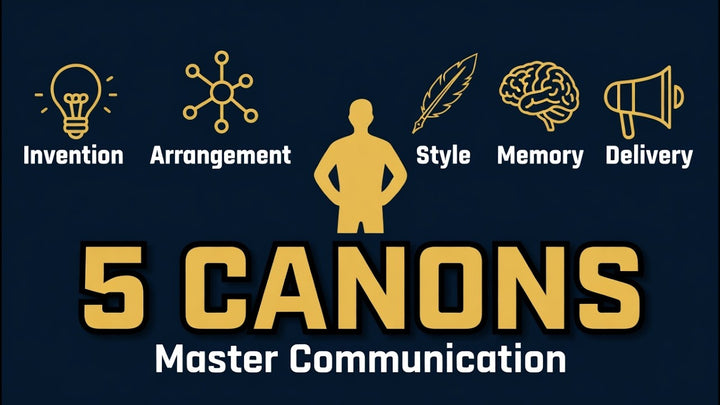
The five canons series: 1. Invention · 2. Arrangement · 3. Style · 4. Memory (you are here) · 5. Delivery. For the overview of all five in one place, start with The Five Canons of Rhetoric.
In the ancient world, memory was not optional
Once ideas have been discovered, arranged, and given style, they still have to be stored and retrieved at the right moment. Memory turns preparation into performance.
For Greek and Roman speakers this was a practical necessity. Speeches in the law courts and assemblies were performed, not read aloud from a page, and an important case could run for hours. The Rhetorica ad Herennium defines the canon as "the firm retention in the mind of the matter, words, and arrangement" (Ad Herennium 1.3).
Its author also made a distinction that still holds: "There are, then, two kinds of memory: one natural, and the other the product of art" (Ad Herennium 3.16). Natural memory is the ability we are born with. Artificial memory is natural memory "strengthened by a kind of training and system of discipline." Rhetoric's claim was that memory can be trained.
The method of loci turned places into a filing system
The most famous training method is the method of loci, Latin for "places." Today it is usually called the memory palace, a modern nickname rather than an ancient term.
The origin story of Simonides
Cicero and Quintilian both tell the story of how it began. The poet Simonides of Ceos was called outside during a banquet moments before the roof of the hall collapsed. The bodies were too badly crushed to recognize, but Simonides could identify each guest because he remembered the order in which they had been sitting. Quintilian reports that "the first person to discover an art of memory is said to have been Simonides" (Institutio Oratoria 11.2). Note the "is said to have been": even in antiquity this was a well-loved story, not a documented event.
How the technique works
The Ad Herennium explains that "the artificial memory includes backgrounds and images." The backgrounds are places you know well, "for example, a house, an intercolumnar space, a recess, an arch, or the like" (Ad Herennium 3.16). The images are vivid mental pictures standing for the things you need to remember.
- Choose a familiar place: your home, your street, a route you walk every day.
- Fix a sequence of locations in it: the front door, the hallway, the kitchen table.
- Place a striking image for each point of your speech at each location.
- When you speak, walk through the place in your mind. Each location cues the next idea.

Space becomes structure. That is why memory and arrangement are so closely linked: a well-ordered speech is much easier to store along a route.
The handbook's rules for good places and good images
The Ad Herennium is surprisingly specific about what makes the technique work. Its backgrounds should be varied in form so they do not blur together, which is why a row of identical columns makes a poor route. They should be of moderate size, neither so large that images get lost in them nor so small that they feel crowded, and neither too bright nor too dim. A quiet place works better than a busy one, because "the crowding and passing to and fro of people confuse and weaken the impress of the images." It even suggests marking every fifth location, for example with a golden hand, so you never lose count (Ad Herennium 3.18–19).
The images get rules too. The author observes that we forget things that are "petty, ordinary, and banal" but remember what is extraordinary, unbelievable, or laughable, and so recommends images that are striking, few rather than many, and "doing something" rather than sitting still (Ad Herennium 3.22). A calm picture of a budget spreadsheet fades. A spreadsheet on fire in your kitchen sink does not. The absurdity is the point.
You may hear that the phrase "in the first place" comes from this technique. It is a charming idea and a handy mnemonic, but treat it as folk etymology rather than established history.

Foundations Series · Volume 1
An Introduction to Rhetoric
A visual guide to persuasion, argument, and influence.
Modern research shows the memory palace works
The method of loci is not just a classroom curiosity. A 2003 study in Nature Neuroscience examined top competitors from events such as the World Memory Championships. The researchers found that superior memory "was not driven by exceptional intellectual ability or structural brain differences." Instead, the memorizers "used a spatial learning strategy," engaging brain regions such as the hippocampus that are central to spatial memory (Maguire et al., 2003).
A 2017 study in Neuron went further. Memory athletes recalled an average of 70.8 of 72 words, compared with 39.9 for matched controls. Then ordinary participants trained in the method of loci for 30 minutes a day over 40 days. They improved significantly more than control groups, and the gains persisted four months later (Dresler et al., 2017).
The likely reason is the one the video gives: human brains are very good at remembering places and routes. The memory palace borrows that strength and puts it to work on ideas.
Even the ancients said the goal was understanding, not word-for-word recall
Memory in rhetoric was never only about reciting words. Quintilian, who described the method of loci in detail, was skeptical of using it for whole speeches. "How can our words be expected to flow in connected speech," he asked, "if we have to look back at separate symbols for each individual word?" His own advice was simpler: learn a long speech in sections, and practice constantly. "If anyone asks me what is the one supreme method of memory, I shall reply, practice and industry" (Institutio Oratoria 11.2).
The deeper goal was internalization: knowing the arguments so well that you could adapt to the audience, respond to questions, and recover from interruptions. When ideas live only on the page, communication becomes rigid. When ideas live in memory, it becomes flexible.
Memory did not disappear. It moved into our devices
The worry that external tools weaken memory is ancient too. Quintilian notes that Plato "asserts that the use of written characters is a hindrance to memory," because once something is written down we stop guarding it in our minds (Institutio Oratoria 11.2).
Today, external memory surrounds us: search engines, cloud storage, phones, databases. At first glance it can seem that the canon of memory no longer matters. In reality it has changed shape.

Digital platforms are, in effect, enormous memory systems. They store what we watched, clicked, searched for, and skipped. And they do not just store it. They recall it strategically. Advertisements appear based on past behavior. Recommendations are built from remembered interests. A message can be retrieved and shown to you at exactly the moment you are most likely to respond. This is a new kind of rhetorical memory, one that lives not in the speaker's mind but in computational systems, and it shapes which messages reach us and when. From Aristotle to TikTok looks more closely at how platforms reshape persuasion.
Speaker memory still matters, because persuasion requires presence
Human memory has not become irrelevant. If you depend entirely on notes or slides, your attention shifts away from the audience. Strong communicators internalize their message. They do not memorize every word. They remember the architecture: the sequence, the key ideas, and the two or three pieces of evidence they cannot afford to lose. Memory becomes a map.

A practical approach for a talk or meeting:
- Reduce your message to a short sequence of key points, ideally no more than five.
- Attach each point to a location or a vivid image.
- Rehearse aloud from the sequence, not the full script, so the wording can flex.
- Memorize the first and last sentences exactly. Those are the moments when nerves hit hardest and impressions form.
If you blank anyway, the route is your recovery tool. Pause, picture the location you were standing in, and step to the next one. A brief silence while you find your place usually looks like thoughtfulness to an audience. A frantic search through printed pages does not.
Audience memory is where persuasion lasts
There is a second direction to this canon: what the audience remembers. A message that is understood instantly but forgotten by evening has limited persuasive power. Strong rhetoric lingers. It plants ideas that come back to mind hours, days, or years later.
That is why repetition works and why slogans exist. Think of Nike's "Just Do It" (1988), Apple's "Think Different" (1997), or the dairy campaign "Got Milk?" (1993). These lines survive because they are easy to recall. Style makes them memorable. Memory lets them persist.
Easy recall has a shadow side worth knowing. Repetition can make a claim feel familiar, and familiar claims can start to feel true whether or not they are. When something sticks, it is worth asking whether it stuck because it is right or because you have heard it many times.
Weak memory and strong memory look very different
Weak rhetorical memory looks like speakers glued to scripts, arguments forgotten under pressure, and messages that evaporate the moment they are heard. Strong rhetorical memory looks like a clear structure the speaker has internalized, ideas recalled naturally, and language designed to stay in the mind after the moment ends.
When you prepare, ask two questions. Can I recall my ideas clearly without relying entirely on notes? And what part of my message will the audience remember tomorrow? If the honest answer to the second is "nothing," the message needs work.
A diagnostic for spotting memory at work in any message
When you meet a persuasive message, ask:
- What elements are designed to be remembered?
- What phrases are repeated?
- What images stay in the mind?
- What structure makes recall easier?
- Who or what is doing the remembering: the speaker, the audience, or a platform?
Invention finds ideas. Arrangement organizes them. Style gives them voice. Memory preserves them. In a world where both humans and algorithms remember, the power of recall has never been greater, and once you see it, you cannot unsee it. The final canon, delivery, brings it all into the room.
The five canons series: 1. Invention · 2. Arrangement · 3. Style · 4. Memory (you are here) · 5. Delivery. For the overview of all five in one place, start with The Five Canons of Rhetoric.
To keep going, browse all articles, explore structured lessons on the Courses page, or see the illustrated guides on the Guides page.
Foundations Series · Volume 1
An Introduction to Rhetoric
A visual guide to persuasion, argument, and influence. See how messages work.
A clear, visual introduction to the choices inside a message: credibility, emotion, reasoning, and timing, and how to tell them apart in something you have already read or watched.
Sources and further reading
- Rhetorica ad Herennium, Book 1 (LacusCurtius, trans. H. Caplan)
- Rhetorica ad Herennium, Book 3, on memory and delivery (LacusCurtius, trans. H. Caplan)
- Quintilian, Institutio Oratoria, Book 11, Chapter 2, on memory (LacusCurtius, trans. H. E. Butler)
- Eleanor A. Maguire et al., "Routes to Remembering: The Brains Behind Superior Memory," Nature Neuroscience (2003)
- Martin Dresler et al., "Mnemonic Training Reshapes Brain Networks to Support Superior Memory," Neuron (2017)
Frequently Asked Questions
What is memory in rhetoric?
Memory is the fourth canon of rhetoric: storing and recalling an argument so it can be delivered. It also covers what the audience remembers afterward.
What is the method of loci?
A technique that places vivid images of the points you need to remember along a familiar route or building, then recalls them by mentally walking the route. Loci is Latin for "places."
Is the memory palace an ancient term?
The technique is ancient, described in the Rhetorica ad Herennium, Cicero, and Quintilian. The name "memory palace" is a modern nickname.
Does the memory palace really work?
Yes. Studies of memory champions found they relied on spatial strategies like the method of loci rather than unusual brain structure, and a 2017 study showed ordinary people improved substantially after six weeks of training.
Does "in the first place" come from the memory palace?
It is a popular claim, but it is best treated as folk etymology rather than established history.
Should I memorize my speech word for word?
Usually not. Even Quintilian preferred learning a speech in sections through practice. Memorize your structure, key evidence, and opening and closing lines, and let the rest flex.
Does memory still matter if I can use notes?
Yes. Internalizing your structure keeps your attention on the audience and lets you adapt to questions and interruptions.
How do algorithms relate to the canon of memory?
Platforms store user behavior and recall it to decide which messages to show and when. That is a modern, machine form of rhetorical memory that shapes what reaches us.
Reclaiming Rhetoric is independent and reader-supported.
If this helped, you can help keep it free.