You can have a powerful argument, strong evidence, a clear structure, and memorable language, and still fail. If the delivery falls flat, the message falls with it.
Persuasion does not live only on the page. It happens in the moment someone hears the words: the voice, the timing, the presence, the energy. Classical rhetoric called that moment delivery, the fifth and final canon of rhetoric.
This article, a companion to the Reclaiming Rhetoric video on the fifth canon, explains what delivery meant to ancient speakers, how it shapes meaning and credibility today, where it can mislead, and how algorithms have become part of delivery itself.
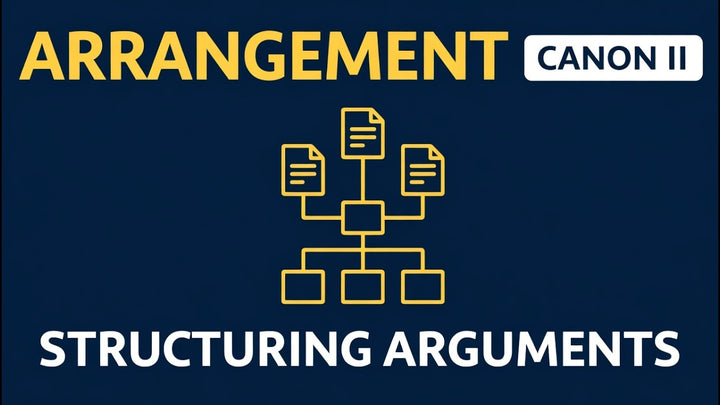
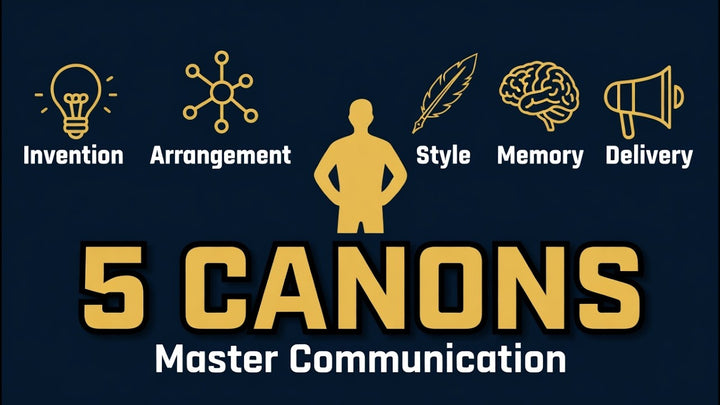
The five canons series: 1. Invention · 2. Arrangement · 3. Style · 4. Memory · 5. Delivery (you are here). For the overview of all five in one place, start with The Five Canons of Rhetoric.
Delivery is where persuasion becomes real
Once ideas are discovered, arranged, expressed with style, and stored in memory, they still have to be performed. The Romans used two names for this canon: pronuntiatio and actio. (The first looks like "pronunciation," but it meant the whole of delivery, not just how words are sounded.) Quintilian explains the pair: "Delivery is often styled action. But the first name is derived from the voice, the second from the gesture" (Institutio Oratoria 11.3).
The Rhetorica ad Herennium gives a compact definition: "Delivery is the graceful regulation of voice, countenance, and gesture" (Ad Herennium 1.3). Elsewhere it divides delivery into "Voice Quality and Physical Movement" (Ad Herennium 3.11). Ancient audiences did not read speeches. They experienced them, so delivery could decide how an argument was received.
The same words, three meanings

Consider two words: "I'm fine." Said with a relaxed smile, they reassure. Said through clenched teeth, they signal anger. Said quietly while looking away, they suggest sadness. The words are identical. The delivery changes the meaning.
Quintilian made the same observation two thousand years ago. If gesture and facial expression are "out of harmony with the speech, if we look cheerful when our words are sad, or shake our heads when making a positive assertion, our words will not only lack weight, but will fail to carry conviction" (Institutio Oratoria 11.3). When voice and body disagree with the words, audiences tend to believe the voice and body.

Foundations Series · Volume 3
How to Build a Better Argument
A practical visual guide to claims, evidence, structure, and objections.
Ancient orators treated delivery as a discipline
Aristotle noticed the gap early. In Book 3 of the Rhetoric he calls delivery a subject "of the greatest importance" that had "not yet been treated of by anyone" (Rhetoric 3.1). The Greek word he used, hypokrisis, was also the word for an actor's performance.
Later writers made up for the neglect. A famous story holds that the Athenian orator Demosthenes, asked what mattered most in oratory, answered delivery, then delivery again, then delivery a third time. Quintilian tells it this way: Demosthenes "gave the palm to delivery and assigned it second and third place as well, until his questioner ceased to trouble him" (Institutio Oratoria 11.3). It is reported by Roman writers centuries after Demosthenes, so read it as a well-traveled anecdote rather than a transcript.
Quintilian adds a second story in the same spirit. Demosthenes' great rival Aeschines, reading one of Demosthenes' speeches aloud to an audience on Rhodes, was met with admiration and replied, "What would you have said if you had heard him yourselves?" Whether or not it happened exactly that way, the point is that even a rival assumed the written text was only part of the speech.
Roman speakers trained their voices, practiced gestures, and studied posture. They learned to control pace: when to pause, when to raise the voice, when to slow down. Quintilian went so far as to say that "a mediocre speech supported by all the power of delivery will be more impressive than the best speech unaccompanied by such power."
The handbook broke the voice into trainable parts
The Ad Herennium treats the voice as something that can be analyzed and practiced. It names three aspects of voice quality: volume, stability, and flexibility. Volume is mostly a gift of nature. Stability, the ability to keep the voice strong and steady over a long speech, comes mostly from care and training. Flexibility, "the ability in speaking to vary the intonations of the voice at pleasure," comes from practice (Ad Herennium 3.11–13).
Flexibility is then divided into three tones. The conversational tone is relaxed and close to everyday speech, suited to explaining and telling the story. The tone of debate is energetic, suited to proving your case and answering the other side. The tone of amplification is reserved for moments meant to stir strong feeling. Mapped onto a modern talk, that is a calm explanation of the background, more energy when you make the case, and a single moment of emphasis near the end. A speaker who stays in one tone throughout is, in classical terms, using only a third of the instrument.
Delivery shapes credibility before the audience weighs the argument
Today the stage has expanded: presentations, podcasts, video essays, livestreams, interviews, and video calls. Each medium brings its own forms of delivery. The voice in a podcast, the pacing and editing of a video, the camera framing on a call, and the design of a slide all influence how a message is received.
Imagine two creators explaining the same idea. One speaks clearly, uses deliberate pacing, and keeps visual focus. The other rushes, mumbles, and looks distracted. Even if the argument is identical, the first will usually seem more credible. Delivery shapes perception before the audience has evaluated a single claim, which is why it is so closely tied to ethos.
Delivery directs attention

- Pauses signal importance and give an idea time to land.
- Changes in pace create emphasis. Slowing down tells the audience this part matters.
- Volume directs focus, and dropping your voice can draw a room in as well as raising it.
- Silence creates anticipation before a key point.
Without these, even strong arguments can feel flat.
Delivery transmits energy
Engagement is contagious. If a speaker seems disengaged, the audience disengages too. When someone speaks with conviction, attention rises. Delivery sends emotional signals, such as confidence, urgency, calm, and authority, and those signals shape how the content is interpreted.
Delivery can also mislead
Confidence can create an illusion of truth. A commanding voice can mask weak reasoning. Charisma can overshadow evidence. Audiences sometimes mistake performance for substance.
The ancients saw this clearly. Quintilian pointed to actors, who "succeed in securing a hearing even for the most worthless authors" (Institutio Oratoria 11.3). A persuasive delivery does not guarantee a sound argument.
So delivery should serve the message, not replace it. Strong delivery amplifies ideas. Weak delivery hides them. Manipulative delivery distracts from them. The goal is alignment: the voice should reinforce the argument, not compete with it. When you analyze a speech or video, try reading the transcript as well. If the case seems much weaker on the page, the delivery was doing a lot of the work.
A caution about a famous statistic
You may have seen the claim that communication is "7 percent words, 38 percent tone of voice, and 55 percent body language." Those figures come from small 1960s experiments by the psychologist Albert Mehrabian, which looked at how listeners judged a speaker's feelings when a single word conflicted with the tone or facial expression. They were never meant as a rule for all communication, and Mehrabian himself has cautioned against using them that way. Delivery matters enormously, but not because words only count for 7 percent.
In the digital age, algorithms deliver messages too
Delivery now extends beyond the speaker. Recommendation systems decide when a message appears, where it appears, and how often. The same video can reach millions of people or almost no one, depending on how a platform's system chooses to distribute it.

Modern rhetoric operates inside these distribution systems, and they shape persuasion as surely as a speaker's voice does. Timing, frequency, and placement were once the speaker's choices. Increasingly, they are the platform's. From Aristotle to TikTok traces how that shift changes the old categories.
What delivery looks like on a platform
For anyone publishing video or audio, this means delivery now includes choices the ancient handbooks never imagined, though they would recognize the logic behind them:
- The thumbnail and title are the first gesture. They are the posture you strike before you say a word, and they decide whether anyone stays to hear the argument.
- The opening seconds are the new exordium. On a scrolling feed, attention has to be won almost immediately, so the introduction's old job of securing attention is compressed into a sentence or two.
- Captions let the message survive without sound. Many people watch in places where they cannot turn the volume up, and a video that depends entirely on the voice loses them.
- Editing is pacing. Cuts, pauses, and on-screen emphasis do what a speaker's breath and silence once did.
None of this replaces the argument. It decides whether the argument gets a hearing at all.
Preparing delivery for a short talk
Say you have three minutes to update your department on a project. The content is ready. Here is delivery preparation that takes about fifteen minutes:
- Mark the pauses. In your notes, put a slash after the main claim and before the ask. Those are the two places to stop for a beat.
- Pick your pace. Most nervous speakers rush. Plan to slow down for the one number you most want remembered.
- Rehearse aloud once, standing up. Silent rehearsal does not train the voice.
- Decide where to look. On a video call, look at the camera for your opening and closing lines. In a room, find three friendly faces in different areas.
- Match the energy to the news. A setback calls for calm and steady, not upbeat. A win can carry more energy.
In writing, delivery shows up as layout: short paragraphs, clear headings, and white space. A wall of text is a delivery choice too.
Weak delivery and strong delivery look very different
Weak delivery looks like monotone speech, rushed explanations, flat pacing, a distracted presence, and messages that feel mechanical. Strong delivery looks like a clear voice, intentional pacing, purposeful pauses, a presence that supports the message, and ideas that feel alive in the moment they are heard.
Before you present, ask: Is my pacing clear? Does my voice guide attention? Am I using pauses deliberately? Does my energy match the message? Can the audience follow the rhythm of the argument? Delivery is where preparation meets performance.
A diagnostic for reading delivery in any message
When you meet a persuasive message, ask:
- How is this being delivered, and through what medium?
- What signals does the voice send?
- How does pacing create emphasis?
- What emotional cues are being transmitted?
- Does the performance support the argument, or distract from it?
Discovery finds ideas. Arrangement structures them. Style expresses them. Memory preserves them. Delivery brings them to life, turning preparation into presence, words into experience, and arguments into persuasion. Once you see it, you cannot unsee it.
The five canons series: 1. Invention · 2. Arrangement · 3. Style · 4. Memory · 5. Delivery (you are here). For the overview of all five in one place, start with The Five Canons of Rhetoric.
To keep going, browse all articles, explore structured lessons on the Courses page, or see the illustrated guides on the Guides page.
Foundations Series · Volume 3
How to Build a Better Argument
A practical visual guide to claims, evidence, structure, and objections. Opinion in. Case out.
Move from an initial opinion to a clear, well-supported case that can withstand fair scrutiny. Gather evidence that tests the claim, then treat serious objections fairly.
Sources and further reading
- Rhetorica ad Herennium, Book 1 (LacusCurtius, trans. H. Caplan)
- Rhetorica ad Herennium, Book 3, on delivery and memory (LacusCurtius, trans. H. Caplan)
- Quintilian, Institutio Oratoria, Book 11, Chapter 3, on delivery (LacusCurtius, trans. H. E. Butler)
- Aristotle, Rhetoric, Book 3, Chapter 1 (Perseus Digital Library, trans. J. H. Freese)
- Reclaiming Rhetoric, The Five Canons of Rhetoric: How to Build a Better Message
Frequently Asked Questions
What is delivery in rhetoric?
Delivery is the fifth canon of rhetoric: how a message is performed and received, including voice, pacing, gesture, facial expression, and today the medium and format.
What are pronuntiatio and actio?
The two Latin names for delivery. Quintilian explains that pronuntiatio refers to the voice and actio to gesture, and that both name the same canon.
Did Demosthenes really say delivery was the most important part of oratory?
The story is reported by Cicero and Quintilian centuries later. It is a famous anecdote that captures how seriously ancient speakers took delivery, but it is not a documented quotation.
Is it true that 93 percent of communication is nonverbal?
No. That figure comes from narrow 1960s experiments by Albert Mehrabian on judging feelings when words and tone conflicted. It does not apply to communication in general.
Can good delivery make a weak argument persuasive?
It can make a weak argument seem stronger, which is why it helps to check a transcript or written version. Strong delivery should amplify a sound argument, not substitute for one.
Does delivery matter in writing?
Yes. Layout, paragraph length, headings, and white space are the delivery of a written message.
How can I improve my delivery quickly?
Mark two or three planned pauses, slow down for your key point, rehearse aloud at least once, and match your energy to the content.
How do algorithms affect delivery?
Platforms decide when, where, and how often messages appear, so distribution systems now shape delivery alongside the speaker's own performance.
Reclaiming Rhetoric is independent and reader-supported.
If this helped, you can help keep it free.