Have you noticed how fast every problem sparks a flood of proposals? "We should do this." "We need to fix that." "Here's the plan." Everyone sees a better future, everyone is convinced their path is the right one, and the same challenge produces wildly different solutions. Usually not because anyone is reckless, but because people are weighing different outcomes, different costs, and different priorities.
The future has not happened yet, so we cannot see it directly. We can only imagine possibilities, weigh trade-offs, and argue for the wisest course of action. That process has a name: deliberative rhetoric.
This article, a companion to the Reclaiming Rhetoric video on deliberative rhetoric, covers the second of the three types of rhetoric: where it comes from, what ancient writers said it is about, the four questions every deliberative argument has to answer, and how to tell wise proposals from wishful ones.
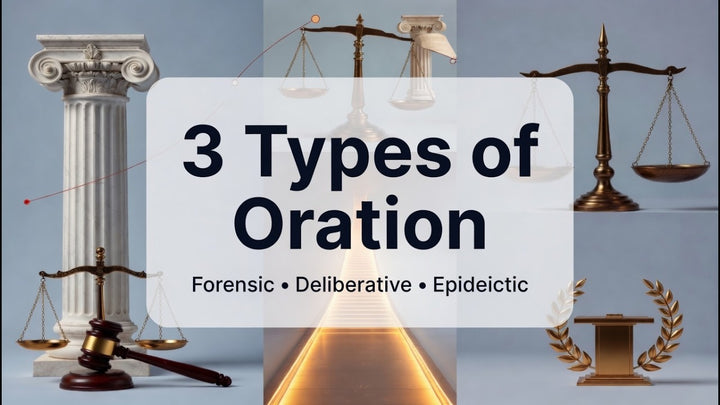
The three types of rhetoric series: The three types · Forensic · Deliberative (you are here) · Epideictic.
The rhetoric of the future
Deliberative rhetoric, also called political rhetoric, asks: What should we do? What is the best path forward? The word comes from the Latin deliberare, to weigh or consider carefully. In the ancient city, the assembly was where citizens argued not about what had already happened but about what the community should do next: which policy to adopt, which law to pass, whether to make war or peace.
Aristotle defines it by its audience, a judge "of things to come." Deliberative speech is "either hortatory or dissuasive," urging a course or warning against it, and its end is "the expedient or harmful" (Rhetoric 1.3). The Rhetorica ad Herennium says it "consists in the discussion of policy and embraces persuasion and dissuasion" (Ad Herennium 1.2).

At its core, deliberative rhetoric is about practical wisdom. Not judgment of the past, not celebration of values, but deciding what to actually do. It is the rhetoric of city councils and parliaments, but also of board meetings, product roadmaps, school committees, and the conversation you have when deciding whether to move, change jobs, or buy the house.
What we can deliberate about
Aristotle sets a sensible limit on deliberation. We only deliberate about "things which may possibly happen or not" (Rhetoric 1.4). Nobody debates whether the sun should rise tomorrow, and nobody holds a meeting about whether last year happened. Deliberation lives in the zone of real choice, where human action can change the outcome.
He also makes a subtler point: "men deliberate, not about the end, but about the means to the end" (Rhetoric 1.6). Most deliberative disputes are not about whether we want prosperity, safety, or health. Almost everyone does. They are about which path gets us there, and at what cost. When a disagreement about means gets mistaken for a disagreement about ends, people start treating opponents as enemies of the goal itself.
For the politics of his own day, Aristotle lists five main subjects of public deliberation: "ways and means, war and peace, the defence of the country, imports and exports, legislation" (Rhetoric 1.4). In modern language: budgets, foreign policy, security, trade, and law. It is remarkable how little that list has changed.
How deliberative rhetoric works: four questions
1. Consequences
What will really happen if we choose this path? What are the likely outcomes, what ripple effects will spread over time, and how long will they last? Because the future is unseen, deliberative arguments lean heavily on examples from the past. Aristotle says so directly: "Examples are most suitable for deliberative speakers, for it is by examination of the past that we divine and judge the future" (Rhetoric 1.9). The quality of a deliberative argument often depends on whether its examples really resemble the present case.
2. Costs and benefits
What will this cost in time, money, resources, or missed opportunities? Do the gains clearly outweigh the downsides? And who bears the costs while others enjoy the benefits? That last question is where many proposals quietly fail. A plan can be good on average and still unfair in its distribution.

3. Feasibility
Is this realistic given the constraints we face? Do we have the resources, the support, the timing? Do we have the political will or public buy-in to follow through? A brilliant plan that cannot be carried out is not a plan. It is a wish.
4. Priorities
What are we actually optimizing for? Which goals matter most right now, and what are we willing to trade to get there? Not every deliberative argument needs certainty, but it does need to be honest about what it values. People often argue past each other because they are weighing different priorities without saying so. One person is optimizing for cost, another for speed, a third for fairness, and all three think the others are being unreasonable.

Foundations Series · Volume 3
How to Build a Better Argument
A practical visual guide to claims, evidence, structure, and objections.
Advantage has two faces: security and honor
The Roman handbook adds a twist that keeps deliberative rhetoric from collapsing into pure calculation. "Advantage in political deliberation," it says, "has two aspects: Security and Honour" (Ad Herennium 3.2). Security covers safety, strength, and practical survival. Honour covers what is right and praiseworthy: wisdom, justice, courage, and restraint.
The handbook even shows how a speaker can set the two against each other, using the case of soldiers "surrounded by Carthaginians" who must decide what to do. The speaker who argues from security uses topics like "Nothing is more useful than safety" and "not even the gods help those who thoughtlessly commit themselves to danger." The speaker who argues from honour replies that "Virtue ought never to be renounced" and that pain or death is "more tolerable than disgrace and infamy" (Ad Herennium 3.8–9). Both are deliberative arguments about the future, but they rest on different priorities, and the real debate is over which should win.
The same book notes that deliberation comes in two shapes. Sometimes the choice is between two courses: "Does it seem better to destroy Carthage, or to leave her standing?" Sometimes it is among several, as when Hannibal, recalled from Italy, might weigh whether to stay, return home, or invade Egypt. That distinction is still useful. Many arguments are framed as a choice between two options when there are really more, and one quick way to improve a debate is to ask whether a third or fourth path has been left off the table.
Aristotle uses a famous example of the same tension. Achilles knew that avenging his friend Patroclus would cost him his own life. In expedient terms it was a terrible choice; in terms of honor it was the noblest one (Rhetoric 1.3). Deliberation is not only arithmetic. Every serious proposal carries a picture of what kind of community we want to be.
Who is speaking matters
Quintilian makes a point about deliberative speaking that is easy to forget in an age of data: "what really carries weight in deliberative speeches is the authority of the speaker. For he, who would have all men trust his judgment as to what is expedient and honourable, should both possess and be regarded as possessing genuine wisdom and excellence of character" (Institutio Oratoria 3.8).
This is ethos doing heavy lifting. Because no one can prove what the future holds, audiences have to decide whose judgment to trust. That cuts both ways. It means track record and honesty matter enormously in proposing anything. It also means a confident, credible speaker can carry a bad plan further than it deserves. When you evaluate a proposal, separate the two questions: do I trust this person, and does this plan actually work?
The warning: answering a proposal with the wrong standard
Deliberative rhetoric gets misread constantly. People treat it like a factual debate. Someone presents a plan for the future, and the response is "That's not true" or "That didn't work last time." That is not engaging with deliberative rhetoric. It is dodging the actual question.
Facts matter, of course. A plan built on false premises will fail. And past failures are relevant evidence, which is exactly why Aristotle says examples are the deliberative speaker's main tool. But "it didn't work last time" is the beginning of an argument, not the end. Was last time really similar? What was different? What would have to change? Deliberative rhetoric is not about what is true right now or what happened before. It is about what we should do next. Wrong standard, wrong response, wrong conclusion, in policy debates, campaign speeches, boardrooms, and family discussions alike.
The key shift: ask whether it will work
Instead of asking only "Is this true?", also ask:
- Will this actually work, and how do we know?
- What are the real consequences, including the unintended ones?
- What are the genuine costs and benefits, and who bears each?
- Is this feasible with the resources, support, and time we have?
- Are we optimizing for the right priorities, and have we said what they are?
- What is the alternative, including doing nothing?
Take a familiar workplace proposal: "We should move to a four-day week." A forensic reply ("the last pilot had problems") and an epideictic reply ("we are a hard-working team") both miss the deliberative question. The useful replies sound different. What happened to output and customer response in comparable trials? What does it cost, and who covers Fridays? Can we pilot it in one department first? Are we optimizing for retention, productivity, or well-being, and which matters most this year? Those questions do not settle the matter, but they move the discussion onto the ground where it can actually be settled.
That last question is often missing. Every proposal competes not with perfection but with the other options, including the status quo. A plan with real flaws may still be better than the alternatives, and a plan with no obvious flaws may simply not have been compared to anything.
Weak and strong deliberative rhetoric

Now flip the perspective. If you are making a deliberative argument, your responsibility is clarity: an honest assessment of consequences, realistic trade-offs, and clear priorities. When you propose what we should do, you are helping shape what the future becomes.
Weak deliberative rhetoric looks like vague promises, ignored downsides, overstated benefits, and wishful thinking dressed up as strategy. Strong deliberative rhetoric looks different: clear-eyed analysis, honest trade-offs, practical pathways, and arguments that can survive real-world pressure. Like a model bridge put under load before anyone builds the real one, a strong proposal invites testing. A weak one asks you to trust that it will hold.
Why deliberative rhetoric matters
Most of what communities, organizations, and families decide comes from deliberative argument: policy, strategy, collective action. Without good arguments about the future, we cannot solve problems or build anything together. And deliberative rhetoric depends on its siblings. It needs an honest account of what happened, which is the work of forensic rhetoric, and a shared sense of what matters, which is shaped by epideictic rhetoric. Get the future wrong, and you pay for it in the present.
Once you understand how deliberative arguments are built, you stop just reacting emotionally to proposals. You start evaluating them by the right standard. And once you see it, you cannot unsee it.
The three types of rhetoric series: The three types · Forensic · Deliberative (you are here) · Epideictic.
To keep going, browse all articles, explore structured lessons on the Courses page, or see the illustrated guides on the Guides page.
Foundations Series · Volume 3
How to Build a Better Argument
A practical visual guide to claims, evidence, structure, and objections. Opinion in. Case out.
Move from an initial opinion to a clear, well-supported case that can withstand fair scrutiny. Gather evidence that tests the claim, then treat serious objections fairly.
Sources and further reading
- Aristotle, Rhetoric, Book 1, Chapter 3, on the three kinds of speech (Perseus Digital Library, trans. J. H. Freese)
- Aristotle, Rhetoric, Book 1, Chapter 4, on the subjects of deliberation (Perseus Digital Library, trans. J. H. Freese)
- Aristotle, Rhetoric, Book 1, Chapter 6, on the good and the expedient (Perseus Digital Library, trans. J. H. Freese)
- Aristotle, Rhetoric, Book 1, Chapter 9 (Perseus Digital Library, trans. J. H. Freese)
- Rhetorica ad Herennium, Book 1, on the three kinds of causes and the types of issue (LacusCurtius, trans. H. Caplan)
- Rhetorica ad Herennium, Book 3, on deliberative causes, security and honour (LacusCurtius, trans. H. Caplan)
- Quintilian, Institutio Oratoria, Book 3, Chapters 7–11, on deliberative and epideictic oratory (LacusCurtius, trans. H. E. Butler)
- Reclaiming Rhetoric, The 3 Types of Rhetoric
Frequently Asked Questions
What is deliberative rhetoric?
Deliberative, or political, rhetoric is persuasion about the future: what we should do. Aristotle says it either urges or discourages a course of action and aims at what is expedient or harmful.
What are examples of deliberative rhetoric?
Policy debates, campaign speeches, legislative arguments, business strategy proposals, school board discussions, and personal decisions such as whether to move or change jobs.
What did Aristotle say people deliberate about?
Only things that may or may not happen and are within our power. He lists ways and means, war and peace, national defense, imports and exports, and legislation as the main public subjects.
Why do deliberative speakers use examples?
Because the future cannot be observed. Aristotle says examples suit deliberative speech because we judge the future by examining the past.
What are security and honor in deliberative rhetoric?
The Rhetorica ad Herennium divides advantage into security (safety and practical survival) and honor (what is right and praiseworthy). Many debates turn on which should come first.
Why does the speaker's character matter so much in deliberation?
Because no one can prove the future. Quintilian says the speaker's authority carries the most weight in deliberative speeches, so audiences must decide whose judgment to trust.
What makes a deliberative argument strong?
Honest consequences, realistic trade-offs, clear priorities, feasibility, and comparison with real alternatives, including doing nothing.
Reclaiming Rhetoric is independent and reader-supported.
If this helped, you can help keep it free.