"You always make plans for us without asking me."
"No, I don't. I asked you last weekend."
And just like that, the argument has changed. A few seconds ago, the disagreement was about this weekend: one person made plans that involved both of them without checking first. Now the disagreement is about the word always. Is it literally true? Can one counterexample disprove it? If the accused person can point to a Saturday three weeks ago when they did ask first, have they won?
They may have disproved always. That is not necessarily the same thing as disproving the problem the other person was trying to describe. A conversation can become extremely precise about one word while becoming less precise about the actual disagreement.
This article, a companion to the Reclaiming Rhetoric video, looks at what words like always and never can actually be doing in relationship conflict, what conversation researchers and relationship researchers have found about them, and why the most useful response is usually neither to ignore the exaggeration nor to let the whole conversation collapse into it.

Foundations Series · Volume 3
How to Build a Better Argument
A practical visual guide to claims, evidence, structure, and objections.
"Always" and "never" as extreme case formulations
Conversation analysts have a name for expressions like always, never, everyone, completely, and nothing: extreme case formulations. In a widely cited 1986 paper, the sociologist Anita Pomerantz examined how speakers use these maximal descriptions in ordinary talk, and argued that one of the things they do is help legitimize a claim: to make a complaint, accusation, or defense sound strong enough to warrant a response (Pomerantz, 1986).
The social psychologist Derek Edwards later extended this work. He showed how people build descriptions of events as recurring, typical, or characteristic, what he called script formulations (Edwards, 1994), and he examined how speakers in relationship counselling sessions described a partner's behavior as a pattern or as a one-off, and what each description did for their side of the story (Edwards, 1995). In a 2000 paper Edwards also noticed that extreme case formulations are often treated by listeners as not meant literally, and that speakers sometimes soften or retreat from them when challenged (Edwards, 2000).
The important point is not that always secretly means sometimes. It does not. If someone says something happens every time, that is a stronger claim than saying it happens often, and exaggeration can matter. But words like always are also doing interactional work beyond keeping an accurate count.
Imagine the original complaint again. The speaker may be trying to establish something larger than what happened this Saturday: This is not an isolated mistake. I believe this keeps happening. I want you to treat it as a recurring problem rather than one annoying afternoon. Sometimes always is doing the work of making a complaint count.

One sentence, three different claims
This becomes easier to see if we slow the sentence down. "You always make plans without asking me" can contain at least three different claims:
- The event claim. You made this particular plan without consulting me.
- The pattern claim. Similar things have happened repeatedly.
- The relationship interpretation. When decisions affect both of us, I do not feel my preferences are being adequately considered.
Those claims can support one another, but they are not interchangeable. Evidence that this weekend happened does not automatically prove a recurring pattern. Evidence of a recurring pattern does not automatically prove a sweeping judgment about someone's character. And one exception to the word always does not automatically erase either the current event or a broader pattern.
An incident can be evidence of a pattern. A pattern can inform a judgment about someone. But those are separate claims, and each needs its own support. This is the same move rhetoricians make in stasis theory: before you argue, figure out which question you are actually disagreeing about. A couple can agree on the facts of this weekend, disagree about whether it is a pattern, and disagree again about what the pattern means.
Take the counterexample seriously
Now give the other person the strongest version of their response: "That isn't true. Last weekend, I asked you before I invited anyone."
That matters. If the original claim is literally that this happens every single time, then one genuine counterexample is enough to disprove the absolute. That is not meaningless pedantry. Precision matters, especially when language starts moving from you did this toward this is the kind of person you are.
But then ask the next question. Does that counterexample prove there is no recurring problem? No. Maybe the person asked last weekend and failed to ask four other times recently. Maybe this weekend really is unusual. Maybe the two people do not even agree about what counts as consulting each other. Those are questions the conversation still has to answer.
A more useful response from the first person might be: "You're right, not always. But it has happened several times lately, including this weekend, and I want us to talk about that." Now the correction has improved the complaint instead of replacing it.
Correcting the absolute claim should help clarify the complaint, not become a substitute for addressing it.
What relationship research adds
The video focuses on what the words are doing in the conversation. It is worth adding what relationship researchers have said about this kind of opening, because their emphasis is a little different.
In the Gottman Institute's popular writing, always and never are treated as typical markers of criticism, which they distinguish from a complaint. A complaint addresses a specific behavior; criticism attacks the partner's character, and "words like always and never imply that the other person has a consistent and negative personality flaw" (The Gottman Institute). The suggested alternative is a "gentle start-up": describe the specific situation, say how you feel, and state what you need.
The underlying research is about how conflict conversations begin, not about one word. In a study of newlywed couples, Sybil Carrère and John Gottman found that coding just the first three minutes of a conflict discussion, including how harshly it started, predicted which couples later divorced (Carrère & Gottman, 1999; see also Gottman et al., 1998). Those studies measured overall negativity at the start of the conversation; they did not isolate the word always as the cause of anything.
So the two perspectives fit together. The Gottman framing warns that a global, character-level complaint tends to provoke defensiveness. The conversation-analytic framing explains why people reach for always in the first place: they are trying to get a pattern recognized. The practical answer to both is the same. Name the pattern directly, with evidence, rather than asking one adverb to carry it.

The trap of treating "always" as an alarm
There is another trap here. Once you start noticing words like always and never, it becomes tempting to treat them as diagnostic alarms. Someone says always, therefore they are manipulating you. Someone says never, therefore the argument is toxic. Someone exaggerates in frustration, therefore you have discovered some deep fact about their personality or the relationship that is much more than the language itself can establish.
People use extreme formulations for all kinds of reasons. They may be frustrated. They may be trying to establish recurrence. They may be dramatizing a point. They may genuinely believe their description is accurate. Context matters.
So the rhetorical question is narrower and more useful: What claim is this wording trying to make? The word matters. What people are doing with the word matters more. That is the same habit of mind behind any good rhetorical analysis: describe the move before you judge it.
Rebuilding the complaint so one word does not have to carry it
Once you separate the claims, the conversation becomes much easier to work with. Instead of "You always make plans without asking me," imagine:
This is the third time recently that plans involving both of us were made before we talked about them. I want us to check with each other first.
Now there is much less for one word to carry. There is a specific present event. There is a claimed pattern. And there is a requested change. The other person can respond to each one:
- "I don't think it has been three times. I remember one of those differently." Good. Now the pattern itself can be examined.
- "You're right that it's happened several times, but I didn't realize these plans felt like joint decisions to you." Now the disagreement is partly about expectations, which is a real and discussable issue.
- "You're right. I have been doing that. I'll check first." Now the argument actually reaches the behavior that started it.
The pattern no longer has to hide inside the word always. Notice too that the rebuilt version is close to what the Gottman materials recommend: a specific situation, a stated need, and a request for a positive action rather than a verdict on someone's character.
Precision versus escape hatches
This is also why accuracy and substance should not be treated as enemies. Asking someone to distinguish always from often is not automatically tone policing. If somebody makes an unfairly broad accusation, they can reasonably be asked to make it more precise.
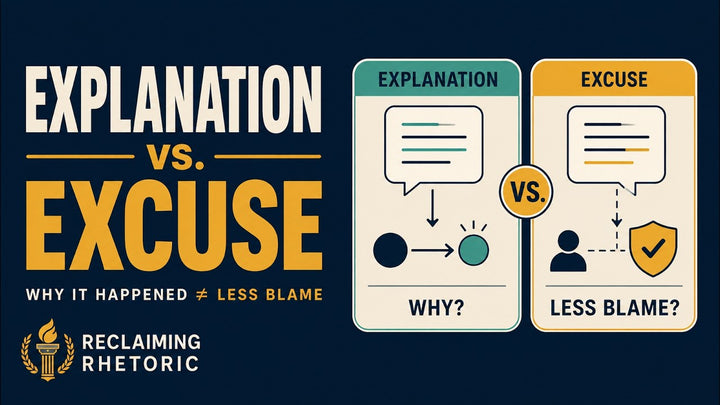
But demands for perfect wording can also become an escape hatch. If every complaint ends with ten minutes of debating whether always means mathematically every single time, the relationship may become extremely good at fact-checking adverbs and extremely bad at resolving recurring problems. It resembles the gap between an explanation and an excuse: both can be accurate, but only one moves the conversation toward repair.
Both things can be true at once. Someone can phrase a complaint unfairly and still be pointing toward a real problem. Someone can have a legitimate grievance and still make a broader accusation than the evidence supports.
Precision should help the conversation identify the problem, not determine whether someone is allowed to have one.
The other extreme words: "never," "everyone," "nothing"
The same analysis works for the other members of the family. "You never listen" usually bundles an event (you didn't listen just now), a pattern (this keeps happening), and an interpretation (I don't feel heard). "Everyone thinks you're being unreasonable" borrows the authority of a crowd, and it invites the obvious reply, "Who is everyone?", which again moves the argument away from the actual issue. "You did nothing to help" may really mean "you did much less than I expected and I didn't feel supported."
In each case, the extreme word is doing persuasive work: it raises the stakes enough that the complaint can't be waved off. And in each case, the most productive response is to translate it back into the claims it contains and address those, rather than either swallowing the exaggeration whole or using it to dismiss the person.
The listener can do this translation as well as the speaker. Instead of "That's not true, I listened yesterday," try: "It sounds like you're saying this has happened more than once and you're not feeling heard. Can you tell me about this time?" That response neither concedes a global accusation nor dodges the real complaint. It makes the pattern available for discussion.

A quick checklist for the next "you always"
If you are making the complaint:
- Name the specific event first: what happened this time.
- State the pattern as a pattern, with an honest count if you have one ("three times this month").
- Say what it means to you, as your interpretation rather than a verdict on their character.
- Ask for a concrete change going forward.
If you are hearing the complaint:
- Correct a genuinely false absolute, briefly, and then move on.
- Ask which events the person has in mind; take the pattern claim seriously.
- Separate "I disagree that this is a pattern" from "I disagree that this matters."
- Respond to the request, not just the adverb.
None of this is a script that guarantees a good conversation. It is a way to keep the disagreement attached to the things that can actually be discussed, decided, and changed. For a related habit, see how people disagree at work without saying "I disagree", which applies the same principle of making the actual position visible.
What this means for the sentence
Return one last time to the sentence: "You always make plans without asking me." One small word may be trying to carry several much larger ideas. This happened. This has happened before. And this means something about how you treat me. Those claims deserve different kinds of support.
An exception matters. A pattern matters. The interpretation matters. The answer is not to ignore the word always, but it is also not to let the entire disagreement collapse into whether somebody can produce one exception. A useful conversation does not have to choose between defending a person and addressing a pattern. It has to become precise enough to do both.
To keep going, browse all articles, explore structured lessons on the Courses page, or see the illustrated guides on the Guides page.
Foundations Series · Volume 3
How to Build a Better Argument
A practical visual guide to claims, evidence, structure, and objections. Opinion in. Case out.
Move from an initial opinion to a clear, well-supported case that can withstand fair scrutiny. Gather evidence that tests the claim, then treat serious objections fairly.
Sources and further reading
- Pomerantz, A. (1986). Extreme case formulations: A way of legitimizing claims. Human Studies, 9(2–3), 219–229
- Edwards, D. (1994). Script formulations: An analysis of event descriptions in conversation. Journal of Language and Social Psychology, 13(3), 211–247
- Edwards, D. (1995). Two to tango: Script formulations, dispositions, and rhetorical symmetry in relationship troubles talk. Research on Language and Social Interaction, 28(4), 319–350
- Edwards, D. (2000). Extreme case formulations: Softeners, investment, and doing nonliteral. Research on Language and Social Interaction, 33(4), 347–373
- Carrère, S., & Gottman, J. M. (1999). Predicting divorce among newlyweds from the first three minutes of a marital conflict discussion. Family Process, 38(3), 293–301
- Gottman, J. M., Coan, J., Carrère, S., & Swanson, C. (1998). Predicting marital happiness and stability from newlywed interactions. Journal of Marriage and the Family, 60(1), 5–22
- The Gottman Institute, "The Four Horsemen: Criticism"
- Reclaiming Rhetoric, Stasis Theory
Frequently Asked Questions
What does "you always" mean in an argument?
Usually it bundles three claims: a specific event, a claimed pattern, and an interpretation of what the pattern means. Separating them makes the disagreement easier to discuss.
What is an extreme case formulation?
A term from conversation analysis (Anita Pomerantz, 1986) for maximal words like always, never, everyone, and nothing, which speakers use to make a claim sound strong enough to warrant a response.
Does one counterexample disprove "you always"?
It disproves the literal absolute, but not necessarily the pattern or the current event. Both still need to be discussed.
Is saying "you always" a sign of a toxic relationship?
Not by itself. People use extreme words out of frustration, to stress a pattern, or because they believe it. Gottman's work warns that global, character-level criticism tends to provoke defensiveness, so it is worth rephrasing.
What should I say instead of "you always"?
Name the specific event, state the pattern with an honest count, say what it means to you, and ask for a concrete change.
How should I respond when my partner says "you never"?
Correct a genuinely false absolute briefly if you need to, then ask which situations they mean and respond to the underlying request.
Is asking someone to be precise just tone policing?
Not necessarily. Precision is reasonable, but it becomes an escape hatch if it replaces addressing the problem the person is raising.
Reclaiming Rhetoric is independent and reader-supported.
If this helped, you can help keep it free.