Why has the city's new bus redesign made commuting worse?
Before you answer, notice what has already happened. The question did not ask whether commuting became worse after the redesign. It treated that conclusion as an established fact. Answer "Because the new routes require too many transfers," and you have accepted the premise. Answer "Because buses arrive less frequently," and you have accepted it again, even if nobody has shown that the redesign actually made commuting worse overall.
Try another: Should taxpayers continue funding this failed program? You are invited to say yes or no, but the most important claim is hiding in the word failed. Or: Is the company incompetent or dishonest? It sounds like a choice, but both choices assume serious wrongdoing. A question can offer you several answers while hiding the choice that matters most: whether to accept the question as stated.
This article, a companion to the Reclaiming Rhetoric video, explains how loaded questions work, what the research on question wording shows, and a five-step method for answering a rigged question without sounding evasive.

Foundations Series · Volume 1
An Introduction to Rhetoric
A visual guide to persuasion, argument, and influence.
A question can be a miniature argument
Questions do more than request information. They can establish what the conversation is about, imply that something has already happened, define which cause deserves attention, introduce loaded language, narrow the available responses, and make challenging the question feel like avoiding it.
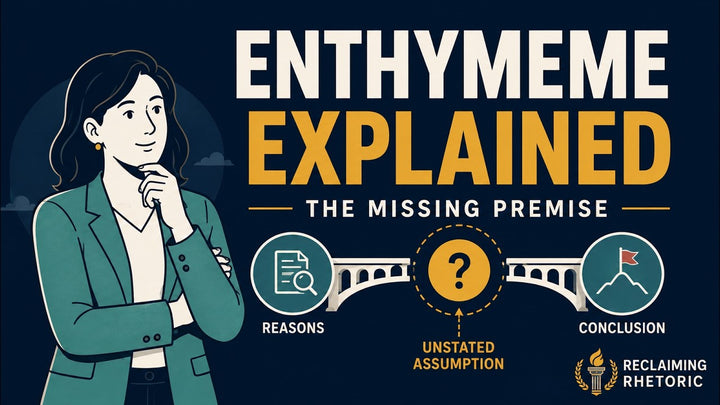
That is why a question is not always an empty container waiting for an answer. Sometimes it is a miniature argument with a question mark attached, and like an enthymeme, it gets much of its force from the premise it leaves unstated.
Hidden premises: presupposition
The first thing to look for is a presupposition, something the question quietly treats as already true.
- "When did you stop ignoring your customers?" presupposes that you were ignoring them.
- "How much money did the mayor waste?" presupposes that the spending was wasteful.
- "Why has the bus redesign made commuting worse?" presupposes that it has.
The familiar trap, Have you stopped doing X?, works because either answer preserves the premise. Say yes, and you appear to admit you did it before. Say no, and you appear to admit you are still doing it. The answers differ, but the assumption survives both. Logic textbooks call this the fallacy of the complex question or many questions: several questions are bundled into one, and a single answer is demanded for all of them.

What the research on wording shows
Research on eyewitness memory shows why this matters beyond clever word games.
In a classic 1974 study, Elizabeth Loftus and John Palmer showed people films of traffic accidents and then asked how fast the cars were going when they smashed, collided, bumped, hit, or contacted each other. The stronger the verb, the higher the speed estimates. In a second experiment, people who had been asked the smashed version were later more likely to report seeing broken glass, even though no broken glass appeared in the film (Loftus & Palmer, 1974). The question supplied language through which the event was reconstructed.
In follow-up work, Loftus showed that questions containing false presuppositions could also influence what people later remembered. In one experiment, participants who had been asked how fast a car was going "when it passed the barn," in a film with no barn, were later more likely to say they had seen one (Loftus, 1975). The question was not simply retrieving memory. It introduced information into the reconstruction of the event.
Wording brings values with it
The same principle matters outside the laboratory. Do you support government surveillance? directs attention differently from a question that emphasizes court approval, counterterrorism, metadata, or the content of private communications. The basic policy may be similar, but each wording brings different values to the front: security, oversight, privacy. A question can look factual while quietly deciding which considerations arrive with the facts. That is the territory of framing, and of Burke's terministic screens: the vocabulary of the question shapes what the answer can notice.
Controlling the answer space
Sometimes the manipulation is more visible because the question controls the answer space.
- Was the decision careless or corrupt?
- What matters more, safety or freedom?
- Should the company raise prices or reduce quality?
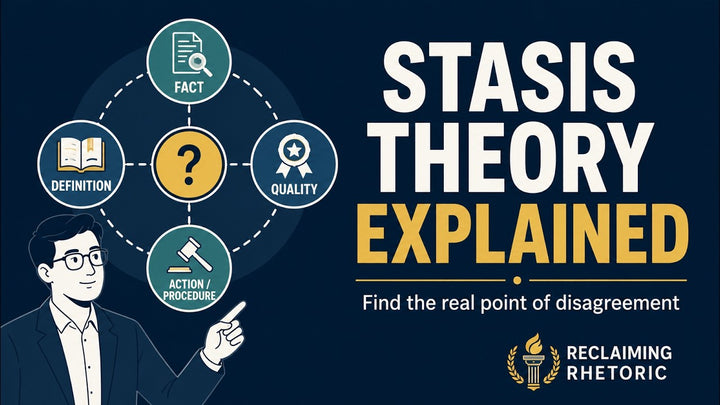
You have been given choices, but not necessarily the relevant ones. Maybe the decision was neither careless nor corrupt. Maybe safety and freedom are not mutually exclusive here. Maybe the company has other options. A forced choice is a stasis move in disguise: it settles the earlier questions (did something wrong happen?) by skipping straight to the later one (which kind of wrong?).
Even response scales can shape judgment. In a well-known 1985 study, Norbert Schwarz and colleagues asked people how much television they watched per day, using answer categories that covered either a low range or a high range of hours. People given the high-range scale reported watching considerably more. The categories suggested what was normal, and respondents used that cue to describe their own behavior (Schwarz et al., 1985). The choices underneath a question do not always merely record an opinion. Sometimes they help construct the frame in which the opinion is formed.

Order matters too
What you have just been asked affects what comes most easily to mind. Imagine a community survey about public transit. First: How often have delayed buses caused you problems? Then: How satisfied are you with the city's transportation system? The first question has placed one particular problem at the front of your mental inventory before you make the broader judgment. Reverse the order and the second answer may be approached differently.
Survey researchers have documented this kind of order effect. In one study, when students were asked about their dating frequency immediately before being asked about their general life satisfaction, the two answers were much more closely related than when the questions came in the reverse order (Strack, Martin & Schwarz, 1988). The answer belongs not only to the wording of the question but to the sequence in which questions arrive.
Rhetorical questions: claims in disguise
Then there are questions that are barely requests for information at all. Isn't it time for a change? Who could possibly oppose this? Do we really want to go backwards? These rhetorical questions function partly as assertions. Instead of saying "This policy is outdated," the speaker asks, "Isn't this policy outdated?" For a moment, you are invited to rehearse the conclusion yourself.
That does not mean rhetorical questions always persuade. Their effects depend on the argument, the audience, and the situation. Research by Richard Petty and colleagues found that rhetorical questions could make people think harder about a message when they were not otherwise very involved in it, which helps strong arguments and hurts weak ones, but could disrupt thinking when people were already highly involved (Petty, Cacioppo & Heesacker, 1981). The important point is that the grammatical form of a question can create the feeling of participation while still advancing a claim.
Why loaded questions are hard to resist
Questions create social pressure to answer. A direct answer feels cooperative. Challenging the premise can sound defensive. Asking for evidence can sound evasive. Widening the options can look like changing the subject.
If someone asks, "Why do you oppose accountability?" the easiest grammatical response begins explaining your opposition. But perhaps you do not oppose accountability at all. Perhaps you oppose one particular way of measuring it. To answer accurately, you have to interrupt the question before answering it.
A five-step method for answering a rigged question
- Identify the literal question. What are you actually being asked to explain, choose, or judge?
- Extract the hidden premise. Complete the sentence: This question makes sense only if… "Why has the redesign made commuting worse?" makes sense only if commuting actually became worse. "Should taxpayers keep funding this failed program?" makes sense only if the program has failed.
- Test that premise. Has it been demonstrated? By what measure? Compared with what? Over what period? Who is defining the key term? In the transit example: did average commute times increase? Did reliability decline? For every rider, or only on particular routes? Did some measures improve while others worsened?
- Widen the answer space. What legitimate possibility has been excluded? The redesign may have improved service in some neighborhoods and worsened it in others. The company may be neither incompetent nor dishonest. The policy may need revision rather than continuation or cancellation.
- Rewrite the question before answering it. Instead of "Why has the redesign made commuting worse?" ask, "How did commute times, reliability, transfers, and access change after the redesign, and which riders were most affected?" Now deterioration is one possible finding rather than a premise buried inside the question.
Likewise, "Should taxpayers continue funding this failed program?" becomes "What results has the program produced, and do those results justify continuing, revising, or ending it?" The disputed conclusion has been moved out of the background and back into the argument where it belongs.

Where loaded questions show up most
Loaded questions are especially common in a few settings, and knowing them helps you prepare.
- Interviews and press conferences. "Will you apologize for the delays?" presupposes that an apology is owed and that the delays are the speaker's doing. A prepared answer separates the two claims before addressing either.
- Polls and petitions. "Do you agree that the council should stop wasting money on this project?" invites agreement with a framing, not with a policy. The result may later be reported as public support for cancellation.
- Workplace reviews. "What's behind your recent lack of commitment?" asks you to explain a characterization rather than discuss the evidence for it.
- Online arguments. "Why do people like you always…?" combines a presupposition with a category, so any explanation concedes both.
In each case the same five steps apply. The only difference is how much time you have to run them, which is why the short responses below are worth having ready.
Short responses that work in real conversation
You do not need to deliver a lecture on presupposition every time this happens. In real conversation, a few short responses can do the work:
- "I don't accept the premise yet."
- "Before asking why, we need to establish whether."
- "Those aren't the only two options."
- "The word 'failed' is doing a lot of work there."
Those responses are not evasions. They move the discussion to the point that should have been established before the question was asked. Follow them with an actual answer to the rewritten question, and you will rarely look as though you are dodging.
Not every leading question is dishonest
There is an important warning. A focused or leading question is not automatically dishonest. Teachers guide students toward distinctions. Doctors ask targeted diagnostic questions. Attorneys use leading questions in cross-examination, where the rules expect them. Useful questions need structure.
The problem begins when the structure hides a controversial assumption, excludes legitimate answers, or presents persuasion as though it were neutral inquiry. The goal is not to become suspicious of every question. It is to notice when the question is quietly doing the work that the argument should have done openly. If you write surveys, interview questions, or meeting agendas, the same checklist applies in reverse: find your own hidden premises before your audience does.
Inspect the question before you answer it
Before you rush to answer, inspect the question. What has it already treated as true? What does its wording make easiest to think about? What possibilities has it excluded? And how would it sound if the disputed assumption were removed?
Sometimes the most accurate answer is not yes. It is not no. It is: I would not begin with that question.
To keep going, browse all articles, explore structured lessons on the Courses page, or see the illustrated guides on the Guides page.
Foundations Series · Volume 1
An Introduction to Rhetoric
A visual guide to persuasion, argument, and influence. See how messages work.
A clear, visual introduction to the choices inside a message: credibility, emotion, reasoning, and timing, and how to tell them apart in something you have already read or watched.
Sources and further reading
- Loftus, E. F., & Palmer, J. C. (1974). Reconstruction of automobile destruction. Journal of Verbal Learning and Verbal Behavior, 13(5), 585–589
- Loftus, E. F. (1975). Leading questions and the eyewitness report. Cognitive Psychology, 7(4), 560–572
- Schwarz, N., Hippler, H.-J., Deutsch, B., & Strack, F. (1985). Response scales: Effects of category range on reported behavior and comparative judgments. Public Opinion Quarterly, 49(3), 388–395
- Strack, F., Martin, L. L., & Schwarz, N. (1988). Priming and communication: Social determinants of information use in judgments of life satisfaction. European Journal of Social Psychology, 18(5), 429–442
- Petty, R. E., Cacioppo, J. T., & Heesacker, M. (1981). Effects of rhetorical questions on persuasion. Journal of Personality and Social Psychology, 40(3), 432–440
- Reclaiming Rhetoric, How Framing Changes What You Believe
Frequently Asked Questions
What is a loaded question?
A question that smuggles in an assumption, so that any direct answer accepts it. "When did you stop ignoring your customers?" presupposes you were ignoring them.
What is the complex question fallacy?
Bundling several questions into one and demanding a single answer, as in "Have you stopped doing X?", where yes and no both concede the hidden premise.
What did Loftus and Palmer find?
People who were asked how fast cars "smashed" into each other gave higher speed estimates than those asked about cars that "hit" or "contacted," and were later more likely to falsely recall broken glass.
Can answer options bias a survey?
Yes. Response categories can signal what is normal, and question order can change what comes to mind, both of which can shift answers.
How do you answer a loaded question?
Name the hidden premise, ask whether it has been shown, widen the options, and answer a rewritten version of the question.
Is challenging the premise of a question evasive?
Not if you then answer the fair version. Phrases like "Before asking why, we need to establish whether" move the discussion to where it should start.
Are leading questions always manipulative?
No. Teachers, doctors, and lawyers use structured questions legitimately. The problem is a hidden contested assumption presented as neutral inquiry.
Reclaiming Rhetoric is independent and reader-supported.
If this helped, you can help keep it free.