You have probably watched it happen. A clearly weak argument circulates, and people you respect, people who are educated, careful, and perfectly capable of reasoning, accept it. Not because they are uninformed. Not because they are careless. They simply believe it.
It seems like it should be impossible. Shouldn't intelligence protect us from bad arguments? Often it doesn't. And under some conditions, intelligence makes people better at defending the beliefs they already hold, including the wrong ones.
This article, a companion to the Reclaiming Rhetoric video on why smart people believe bad arguments, walks through what research and the rhetorical tradition say about the problem: confirmation bias, motivated reasoning, identity, packaging, complexity, and story. Then it turns to the practical part, the questions that put distance between a message and your reaction to it.
The problem is not intelligence. It is how reasoning works
Human beings do not evaluate arguments in a neutral vacuum. We evaluate them inside a context: our beliefs, our experiences, our identities, our communities. All of these shape how an argument feels before we analyze how it works. That first reaction usually arrives long before careful reasoning begins, and careful reasoning often ends up serving the reaction rather than checking it.
Rhetoricians have known this for a long time. Aristotle built his account of persuasion on three kinds of proof, the speaker's character, the audience's emotional state, and the argument itself, precisely because he knew that audiences do not judge arguments as disembodied logic (see ethos, pathos, and logos). An argument is always received by someone, somewhere, for some reason. Lloyd Bitzer's idea of the rhetorical situation makes the same point from the other side: what counts as persuasive depends on the audience and the constraints they bring.

Confirmation bias: an old observation with modern evidence
Confirmation bias is the tendency to notice and value evidence that supports what we already believe, and to overlook or discount evidence that challenges it. The observation is centuries old. In 1620 Francis Bacon wrote that "the human understanding when it has once adopted an opinion (either as being the received opinion or as being agreeable to itself) draws all things else to support and agree with it" (Novum Organum I.46).
Bacon illustrated it with a story. A man was shown pictures hung in a temple of sailors who had made vows to the gods and then escaped shipwreck, and was asked whether he now acknowledged the power of the gods. He replied with a question: "where are they painted that were drowned after their vows?" The survivors were on the wall. The drowned, who made the same vows, were not counted. Much of what passes for strong evidence is a wall of survivors.
The capital punishment study
A classic modern demonstration came in 1979. Charles Lord, Lee Ross, and Mark Lepper recruited 48 undergraduates who either supported or opposed capital punishment, then showed them two studies, one apparently supporting deterrence and one apparently undermining it (Journal of Personality and Social Psychology 37(11), 1979). Both groups read the same mixed evidence. Both rated the study that agreed with them as more convincing and better conducted, and found flaws in the one that disagreed. And instead of moving toward each other, the two groups reported becoming more confident in their original positions.
That is the part worth sitting with. Mixed evidence should moderate a view. For many participants it hardened it, because each side used its reasoning skills to accept the friendly study and pick apart the unfriendly one. If an argument challenges your worldview, your mind starts searching for flaws, even if the reasoning is identical to an argument you would have accepted from your own side.
Motivated reasoning: working backward from the conclusion
Motivated reasoning happens when we begin with a conclusion and work backward to justify it. Instead of asking, "Is this argument true?" the mind quietly asks, "Can I defend this?" Evidence becomes ammunition. Logic becomes strategy.
The psychologist Ziva Kunda's influential 1990 review in Psychological Bulletin made an important qualification ("The Case for Motivated Reasoning"). People do not simply believe whatever they want. They reach the conclusions they prefer only when they can build a justification that seems reasonable, even to themselves. That is exactly why intelligence does not protect us. The more skilled you are at constructing reasonable-looking justifications, the more conclusions you can reach this way.
When sophistication makes it worse
Political scientists Charles Taber and Milton Lodge tested this with arguments about affirmative action and gun control (American Journal of Political Science 50(3), 2006). They found three linked effects: people rated arguments that matched their prior attitudes as stronger, spent more effort counterarguing the ones they disagreed with, and, when free to choose what to read, sought out confirming arguments. Polarization was strongest among participants with the strongest prior attitudes and the most political knowledge. Knowing more gave people more tools to defend what they already thought.
The most famous version of the claim comes from Dan Kahan and colleagues' "motivated numeracy" experiment (Behavioural Public Policy 1, 2017). Participants interpreted the same table of numbers framed either as a skin-cream trial or as a gun-control policy. On the neutral skin-cream version, people who were better with numbers got the right answer more often. On the gun-control version, highly numerate people were more likely to get it right when the answer matched their politics, so the gap between partisans grew with numeracy.
An honest caveat belongs here. That specific pattern has not held up cleanly. A preregistered replication published in Cognition in 2021 (doi 10.1016/j.cognition.2021.104768) and a 2023 study in PNAS using a large US probability sample (doi 10.1073/pnas.2301491120) did not find that numeracy amplified partisan bias. The broad finding, that people evaluate evidence more harshly when it threatens their side, is well supported. The narrower claim, that numerical skill makes the bias worse, is contested. It is a useful reminder that even arguments about bias deserve the scrutiny we are recommending.

Foundations Series · Volume 2
How to Analyze Any Argument
A visual guide to claims, evidence, assumptions, and reasoning.
Reasoning may be built for arguing, not for truth
Why would reasoning work this way? Hugo Mercier and Dan Sperber proposed a provocative answer: the function of human reasoning is argumentative. Reasoning evolved, they suggest, "to devise and evaluate arguments intended to persuade" (Behavioral and Brain Sciences 34(2), 2011). On that view, confirmation bias is not a glitch in a truth-seeking machine. It is what you would expect from a machine built to win arguments. In their words, "Skilled arguers, however, are not after the truth but after arguments supporting their views."
Their theory has a hopeful side that is easy to miss. If reasoning is lazy and biased when we reason alone, it works much better when people with different views evaluate each other's arguments. Groups that genuinely argue, rather than simply agree, tend to catch errors individuals miss. That is a very old idea in rhetoric: the practice of arguing both sides, in utramque partem, was a standard exercise in ancient schools precisely because it trained people to see the strongest case against their own.
Identity: when accepting an argument costs you something
Many beliefs are tied to belonging: political tribes, cultural groups, professional communities, shared values. If accepting an argument threatens your standing in a group you care about, rejecting it becomes psychologically safer, even if the argument is sound. Beliefs rarely exist alone. They live inside social networks, and changing one can mean renegotiating relationships.

This is why a fact-check that is technically perfect can backfire socially. If the correction arrives from a source coded as "the other side," the listener is being asked to accept not just a fact but a defeat. Aristotle observed that we are more easily persuaded by speakers we regard as good and well-disposed toward us. The flip side is that we resist speakers we see as hostile, regardless of their evidence. A good argument delivered as an attack on someone's group often fails for reasons that have nothing to do with the argument.
Packaging: bad arguments often look like good ones
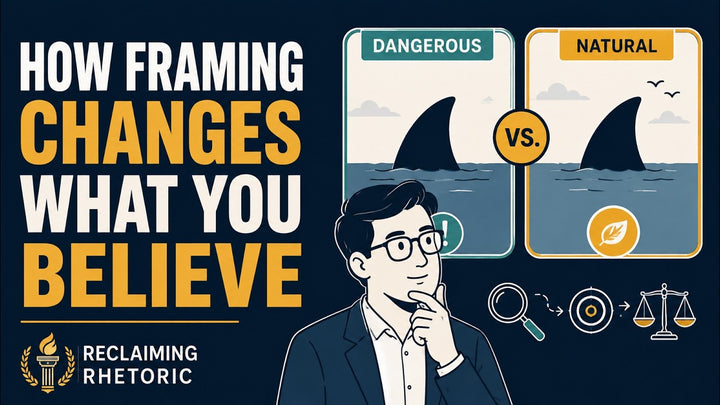
Bad arguments are frequently presented in very persuasive ways: strong confidence, emotional stories, impressive statistics, polished delivery. All of these create the feeling of credibility, even when the reasoning underneath is weak. Persuasion is never only about logic. It is also about presentation, and the classical canons of style and delivery exist because presentation changes reception.
Notice how many of these signals are signals of ethos, borrowed credibility. A lab coat, a title, a confident tone, a chart with error bars. None of these is evidence on its own, but each tells the audience, "you can trust this." Smart people are not immune to these signals. In fact, people who respect expertise may be especially responsive to things that look like expertise.
Complexity and shortcuts
Modern problems are complicated: economic systems, public health, technology, climate, law. No individual can master every field, so we rely on shortcuts: credible voices, trusted institutions, simplified explanations. These shortcuts are not a failure of reason. They are necessary. You cannot personally verify the safety of every bridge you cross or the dosage of every medicine you take.
But shortcuts create openings. A weak argument that borrows the appearance of a trusted source can travel a long way before anyone checks it. The rhetorical question to ask is not "should I trust experts?" but "is this actually the expert claim, or something wearing its clothes?"
Stories: the simpler story often wins
Humans understand the world through narrative, through stories with clear causes, clear villains, and clear heroes. Real problems rarely work that way. Reality is messy, multi-causal, and uncertain. Bad arguments often win because they offer a simpler, more satisfying story, even when the story is wrong.
Bacon's shipwreck painting is a story problem as much as an evidence problem. "These people vowed and were saved" is a complete, emotionally satisfying narrative. "Some people who vowed were saved and some were not, and we do not know the rates" is not a story at all. When you notice an explanation that is unusually tidy, that is a good moment to ask what has been left off the wall.
Believing a bad argument does not make someone stupid
Here is the key point. Believing a bad argument does not mean someone is unintelligent. It means they are human. Everyone is vulnerable to persuasive framing. Everyone uses mental shortcuts. Everyone reasons inside emotional and social contexts. Rhetoric does not bypass intelligence. It works through it.
That framing matters practically, too. If your explanation for why someone believes something is "they are stupid," you have no strategy for talking with them, and you have quietly exempted yourself from the same forces. If your explanation is "they reasoned well from a starting point I don't share, inside a community I don't belong to," you have something to work with, and a reason to check your own starting points.
Rhetorical literacy: the habit of pausing

Learning how arguments work does not make you immune to persuasion. Nothing does. But it gives you tools. You begin to notice patterns: emotional triggers, logical shortcuts, authority signals, narrative framing. Instead of reacting instantly, you pause, and you ask better questions:
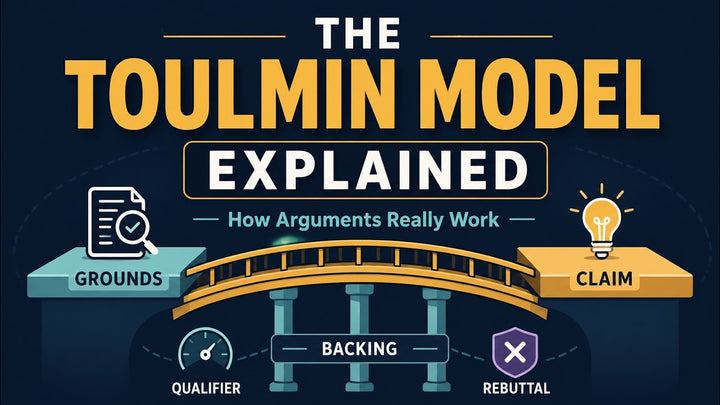
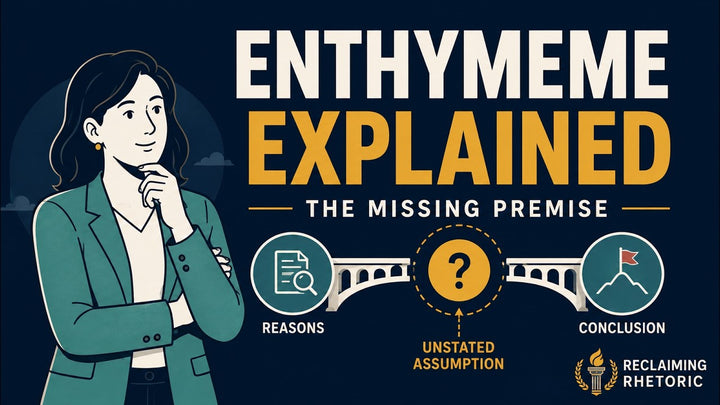
- What assumptions does this argument rely on? Most arguments rest on an unstated premise. Name it, and ask whether you would accept it on its own.
- What evidence is missing? Bacon's question: where are the drowned sailors? What would you expect to see if the claim were false?
- Is the emotional reaction justified? Emotion is not the enemy of reasoning. Ask whether the feeling fits the facts, or whether it arrived first and the facts were recruited afterward.
- Who benefits if I believe this? A claim can be true and still serve someone's interests, but knowing who benefits tells you where to look harder.
- What alternative explanations exist? If you can only think of one explanation, you probably have not looked.
Two more questions are worth adding for your own beliefs. Would I accept this reasoning if it pointed to the opposite conclusion? And what kind of evidence would change my mind? If the honest answer to the second is "nothing," you are no longer evaluating an argument. You are defending a position.
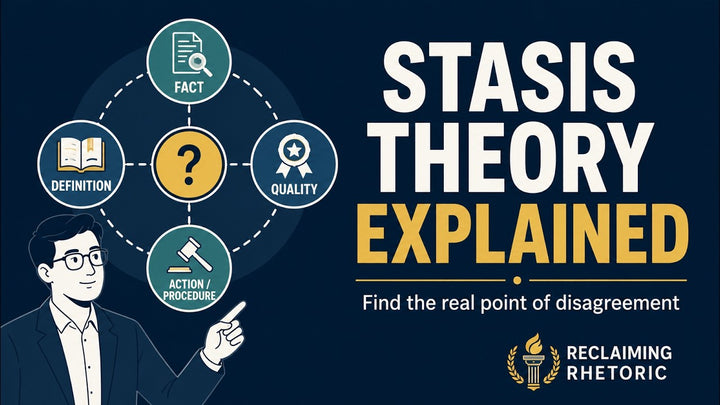
It also helps to ask what kind of argument you are facing. A claim about what happened, a proposal about what to do, and a speech about what to value call for different tests. People often believe bad arguments, or reject good ones, because they apply the wrong test. That is the subject of the companion piece on the three types of rhetoric. For a full step-by-step method, see how to do a rhetorical analysis.
Distance is the skill
These questions slow persuasion down. They create distance between the message and your reaction to it, and that distance is powerful, because persuasion moves fastest when we do not notice it, when arguments feel obvious, natural, self-evident. Once you begin analyzing rhetoric, those moments become visible. You see how arguments are constructed, how they appeal to emotion, how they borrow credibility, and how they simplify complexity.
Smart people do not avoid bad arguments because they are smarter. They avoid them because they examine arguments differently. They question the framing, inspect the reasoning, and stay curious about their own assumptions. Critical thinking begins not with certainty but with awareness. Persuasion is in headlines, advertisements, political speeches, social media, and casual conversation. The question is never whether it is happening. The question is whether you recognize it. If you are new to the field, what rhetoric is, from Aristotle to TikTok is a good place to start.
To keep going, browse all articles, explore structured lessons on the Courses page, or see the illustrated guides on the Guides page.
Foundations Series · Volume 2
How to Analyze Any Argument
A visual guide to claims, evidence, assumptions, and reasoning. Stop reacting. Start diagnosing.
A visual method for seeing where an argument actually works, and where it does not. Name the claim, test the evidence, and find the assumption holding it all together.
Sources and further reading
- Francis Bacon, Novum Organum, Book I, aphorism 46 (Wikisource, trans. Spedding, Ellis, and Heath)
- Lord, C. G., Ross, L., & Lepper, M. R. (1979). Biased assimilation and attitude polarization. Journal of Personality and Social Psychology, 37(11), 2098–2109
- Kunda, Z. (1990). The case for motivated reasoning. Psychological Bulletin, 108(3), 480–498
- Taber, C. S., & Lodge, M. (2006). Motivated skepticism in the evaluation of political beliefs. American Journal of Political Science, 50(3), 755–769
- Kahan, D. M., Peters, E., Dawson, E. C., & Slovic, P. (2017). Motivated numeracy and enlightened self-government. Behavioural Public Policy, 1(1), 54–86
- Preregistered replication of the motivated numeracy effect, Cognition (2021)
- Study of numeracy and politically motivated reasoning in a large US probability sample, PNAS (2023)
- Mercier, H., & Sperber, D. (2011). Why do humans reason? Arguments for an argumentative theory. Behavioral and Brain Sciences, 34(2), 57–74
- Reclaiming Rhetoric, Rhetorical Appeals: Ethos, Pathos, and Logos
Frequently Asked Questions
Why do smart people believe bad arguments?
Because reasoning happens inside a context of prior beliefs, identity, emotion, and trust. Intelligence helps people build justifications, and that skill can be used to defend a belief as easily as to test it.
What is confirmation bias?
The tendency to notice, seek out, and value evidence that supports what you already believe while discounting evidence against it. Francis Bacon described it in 1620; modern studies such as Lord, Ross, and Lepper (1979) documented it experimentally.
What is motivated reasoning?
Reasoning that starts from a preferred conclusion and works backward to justify it. Research suggests people reach preferred conclusions only when they can build a justification that seems reasonable, which is why skilled reasoners are not immune.
Does being more intelligent make bias worse?
Sometimes. Taber and Lodge found polarization strongest among the most politically knowledgeable. The specific claim that numerical skill amplifies partisan bias, from Kahan and colleagues, has not replicated cleanly in later studies.
Is it irrational to rely on experts and shortcuts?
No. Nobody can verify everything personally. The risk is that weak arguments can borrow the look of expertise, so the useful question is whether a claim really comes from the source it appears to.
How can I avoid believing bad arguments?
Pause before reacting and ask: what does this assume, what evidence is missing, is my emotional reaction justified, who benefits, and what other explanations exist? Then ask what evidence would change your mind.
What does rhetoric have to do with critical thinking?
Rhetoric studies how arguments are built and why they persuade. Knowing those patterns makes it easier to see the framing, credibility signals, and story structure behind a claim.
Reclaiming Rhetoric is independent and reader-supported.
If this helped, you can help keep it free.