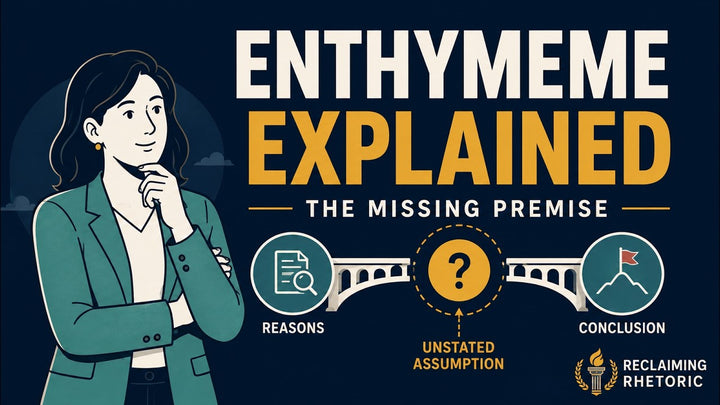
Picture an argument online. One person posts a statistic. Another says the source is biased. Someone replies with a personal story, and someone else questions everyone's motives. Within minutes the conversation is no longer about the original issue at all. It is about intelligence, identity, hypocrisy, tone, and who can produce the most humiliating screenshot.
We often say the problem is that people no longer know how to argue. A classical rhetorician would describe the problem more precisely. No one identified the actual point of disagreement. No one decided which audience mattered. No one arranged the case. No one answered the strongest objection. Everyone started speaking before they had finished thinking.
To argue like a classical rhetorician is not to sound ancient. It is to build persuasion deliberately. This article, a companion to the Reclaiming Rhetoric video on arguing like a classical rhetorician, translates the classical method into eight practical steps you can use in a meeting, an email, a school board session, or a comment thread, along with the ethical warning the ancient teachers always attached to it.
More than ethos, pathos, and logos
For many people, classical rhetoric begins and ends with three words: ethos, pathos, and logos. Those concepts matter, but they are only one part of a much larger method. Aristotle defined rhetoric as "the faculty of discovering the possible means of persuasion in reference to any subject whatever" (Rhetoric 1.2).
The key word is discovering. A classical rhetorician is not hunting for a universal trick that works on everyone. The question is always particular: given this issue, this audience, and these circumstances, what means of persuasion are actually available?
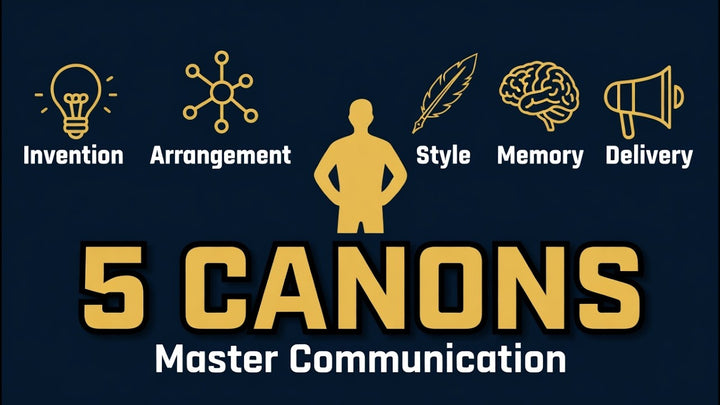
Later teachers organized that discovery into the five canons: invention, arrangement, style, memory, and delivery. The Roman handbook known as the Rhetorica ad Herennium divided the speech itself into six parts: "the Introduction, Statement of Facts, Division, Proof, Refutation, and Conclusion" (Ad Herennium 1.4). The details vary between writers, but the principle is remarkably consistent. An argument is a process, not a pile of evidence followed by an opinion.

Step 1: Find the actual point of disagreement
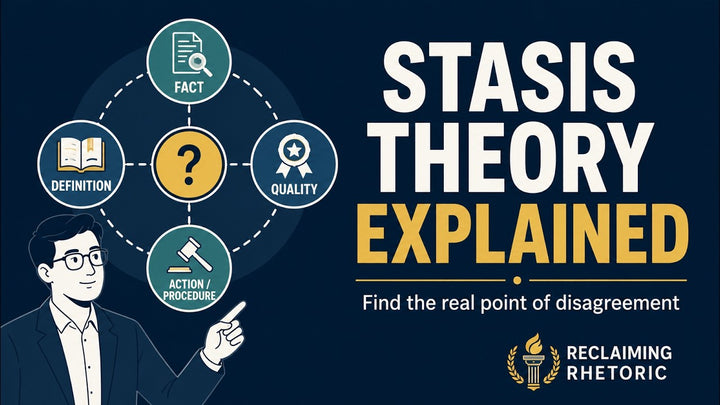
Before building any argument, ask: what are we really arguing about? Classical stasis theory was designed for exactly this. Quintilian explains that the Greek term stasis was thought to derive from the fact that "it is on it that the first collision between the parties to the dispute takes place" (Institutio Oratoria 3.6). Find the point of collision and you have found the real argument.
The tradition typically sorted disputes into four kinds:
- Fact: Did something happen? Is the claim true?
- Definition: What should we call this? What category does it belong to?
- Quality: Is it good, harmful, justified, serious, or important?
- Procedure or action: What should be done, and who should decide?
The kind of disagreement determines the kind of argument you need. Imagine a school district debating whether students may use generative AI for assignments. One person says, "Students are already using it." That is a claim of fact. Another says, "Using AI to write an assignment is plagiarism." That is partly a dispute of definition. A third says, "AI prevents students from learning to think." That is a judgment of quality and consequence. A fourth says, "Schools should permit it only when students disclose how they used it." That is a proposal about action.
All four people appear to be arguing about AI. They may actually be standing at four different points in the argument, talking past each other. The classical move is to stop and complete two sentences: We agree that ___. We disagree about ___. Until you can fill in both blanks, you may not have one argument. You may have several, all happening at once.
Step 2: Invent the arguments that are available
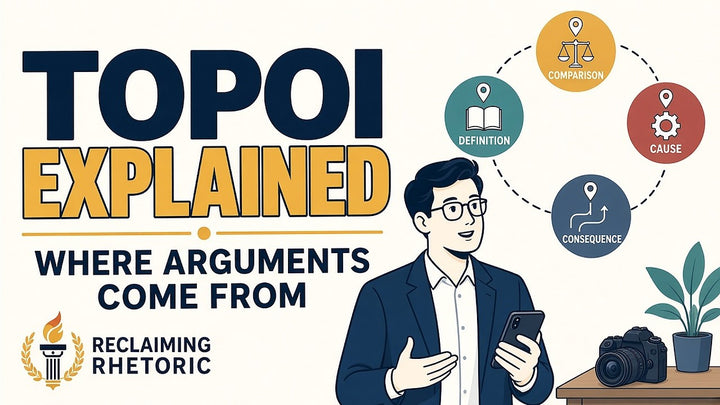
In classical rhetoric, invention does not mean inventing facts. It means discovering the arguments the case makes available. This is where Aristotle's three proofs become useful, as questions rather than labels.
Logos asks: what claim am I making, what reasons support it, what evidence establishes those reasons, and what assumptions connect the evidence to the conclusion? (The Toulmin model is a modern tool for exactly this question.)
Ethos asks: what does this argument reveal about my judgment? Do I appear informed, fair, and honest about uncertainty? Do I show goodwill toward the people I am trying to persuade? Credibility is not merely something you bring into the room. You build it or destroy it through the choices you make inside the argument.
Pathos asks: what does this audience fear losing, and what do they hope to protect? Which emotions genuinely belong to this issue? In the AI debate, a parent may fear that a child will stop learning. A teacher may worry that genuine student work will become impossible to evaluate. A student may fear being punished for using a tool no one clearly prohibited. An administrator may worry about rules that teachers cannot realistically enforce. Each concern is real, and each calls for a different emphasis.
A classical rhetorician does not choose one proof like a button on a menu. They build a case in which reasoning, credibility, and appropriate emotion reinforce one another.
Then test the other side
This may be the most valuable classical habit and the rarest one online. Before presenting your case, ask what the strongest intelligent objection to it would be. Not the silliest objection. Not the easiest comment to screenshot. The strongest one. If your argument collapses as soon as the other side is stated fairly, you did not have a strong argument. You had an argument that had been protected from contact.

Foundations Series · Volume 3
How to Build a Better Argument
A practical visual guide to claims, evidence, structure, and objections.
Step 3: Decide who must make the judgment
A weak argument begins with what do I want to say? A rhetorical argument begins with who has to make a judgment? In the ancient world, different audiences made different kinds of decisions. A jury judged what happened in the past. An assembly decided what should happen in the future. A ceremonial audience weighed what deserved praise or blame. That division gave us the three types of rhetoric, and it is still a useful way to ask what your listeners are actually being asked to decide.
Modern audiences are more complicated, because the person directly answering you may not be the audience that matters most. Suppose you speak at a school board meeting about the AI policy. The loudest critic in the room may not be persuadable. Your real audience may be undecided board members, parents watching from home, teachers who will have to enforce the rule, and students who will see a clipped section of the meeting later.

Online, the audience gets stranger still. The person replying to your post is one audience. The hundreds reading silently are another. A supervisor copied on an email may matter more than the person it is addressed to. A recommendation algorithm may decide which part of your argument circulates at all. So before you argue, ask: Who can make the decision? Who can influence it? What do they already believe? What do they need explained? What would make them stop listening?
If your goal is to persuade undecided parents, humiliating your loudest opponent may earn applause while accomplishing almost nothing. This is the core insight of the rhetorical situation: persuasion is addressed to an audience capable of acting, not simply to whoever is shouting.
Step 4: Arrange the case
A pile of strong points is not yet a strong argument, because order changes how information is received. The canon of arrangement gives each part of the speech a job. Using the six parts from the Ad Herennium:
- Introduction. Gain attention, establish relevance, and create enough goodwill for the audience to keep listening. The Ad Herennium says the aim is hearers who are "attentive, receptive, and well-disposed." In the AI debate, do not open by accusing one side of wanting children to cheat or the other of fearing technology. Begin with the shared problem: schools need rules that protect learning while acknowledging that these tools already exist.
- Statement of facts. What technology are we actually discussing? How are students using it? What rules already exist? What remains unclear?
- Division. Identify exactly what is agreed and what is contested. The handbook describes this as making "clear what matters are agreed upon and what are contested." The question is not whether AI exists. It is under what conditions students may use it without misrepresenting the work as entirely their own.
- Proof. Present your reasons and evidence.
- Refutation. Answer the strongest relevant objection. If you support limited AI use with disclosure, address the real concern that disclosure rules may be hard to enforce.
- Conclusion. Recap the case, clarify what is at stake, and show what judgment should follow.
You do not need to reproduce that structure mechanically. A six-minute video or a three-paragraph email cannot look like a Roman courtroom speech. But the jobs still exist. The audience still needs orientation, context, a clear issue, support, an answer to resistance, and a reason to care about the conclusion. If any of those is missing, your argument has a hole where one of the six parts should be.

Step 5: Choose the style the situation requires
Arguing like a classical rhetorician does not mean saying "Thus, good citizens, it is incumbent upon us." Classical teachers cared intensely about language that fit the subject, the audience, and the occasion. Aristotle put it simply: style is proportionate when "neither weighty matters are treated offhand, nor trifling matters with dignity" (Rhetoric 3.7). The Latin tradition called this decorum, and it is the heart of the canon of style.
The modern lesson: be plain when the audience needs clarity. Repeat when an idea needs emphasis. Use an analogy when someone needs a mental model. Use emotion when the stakes genuinely involve emotion. Do not use complexity to perform intelligence, and do not use simplicity to hide missing reasoning. Style should make the argument easier to grasp, not make the speaker look important.
Steps 6 and 7: Master the material and control the delivery
The canon of memory once meant more than memorizing sentences. It meant possessing the case well enough to speak, adapt, answer objections, and respond when the situation changed. The modern equivalent: know your evidence, know where it came from, know what it actually establishes, know its limits, and know what you will say when someone asks the question you were hoping to avoid.
The canon of delivery once emphasized voice, gesture, expression, and presence. Those still matter. But modern delivery also includes the title, the thumbnail, the opening sentence, the length, the visual layout, the caption, the platform, the timing, the accessibility, and the fifteen-second clip that circulates without the five minutes that came before it. The same argument delivered as a forty-page report, a six-minute video, a short social clip, and an angry reply under someone else's post is not rhetorically the same argument. The words may match. The audience, context, pace, and available interpretation do not.
Step 8: Remember that technique does not supply character
Here is the warning the classical teachers never left out. A carefully invented, arranged, styled, and delivered argument can still be dishonest. Quintilian, following the Roman statesman Cato, described the ideal orator as "a good man, skilled in speaking," and insisted that the first quality mattered most (Institutio Oratoria 12.1). The underlying point holds today: eloquence separated from judgment can become a weapon.
The modern version is straightforward. Do not clip away the context that weakens your claim. Do not present uncertainty as certainty because confidence performs better online. Do not answer the weakest version of the opposing argument. Do not confuse making someone look foolish with helping an audience reach a sound judgment. Refutation is not the rhetorical name for dunking on someone. It is the discipline of showing that your position can survive the strongest relevant challenge.
The goal of rhetoric is not merely to win the exchange. It is to improve the quality of judgment available to the audience.
A classical checklist for modern arguments
Before you post, speak, publish, present, or reply, run through these questions:
- What is the actual point of disagreement?
- Who must make the judgment?
- What forms of proof are available?
- What does this audience already know and value?
- In what order should they encounter the case?
- What is the strongest objection?
- What style fits this occasion?
- How will the medium change the message?
- What am I refusing to do, even if it might help me win?
That is the classical method translated into modern practice. You do not need a toga, Latin terminology, or sentences fit for a marble monument. You need to discover before you declare. Find the dispute. Study the audience. Build the proofs. Arrange the case. Answer the objection. Choose the style. Control the delivery. And remember that persuasion carries responsibility.
The modern world rewards speed. Classical rhetoric offers a different advantage: deliberateness. Do not begin by asking, "How do I defeat this person?" Ask, "What does this audience need in order to judge well?" Then build the argument that helps them do it.
The five canons series: 1. Invention · 2. Arrangement · 3. Style · 4. Memory · 5. Delivery. For the overview of all five in one place, start with The Five Canons of Rhetoric.
To keep going, browse all articles, explore structured lessons on the Courses page, or see the illustrated guides on the Guides page.
Foundations Series · Volume 3
How to Build a Better Argument
A practical visual guide to claims, evidence, structure, and objections. Opinion in. Case out.
Move from an initial opinion to a clear, well-supported case that can withstand fair scrutiny. Gather evidence that tests the claim, then treat serious objections fairly.
Sources and further reading
- Aristotle, Rhetoric, Book 1, Chapter 2, on the definition of rhetoric and the three proofs (Perseus Digital Library, trans. J. H. Freese)
- Aristotle, Rhetoric, Book 3, Chapter 7, on propriety of style (Perseus Digital Library, trans. J. H. Freese)
- Rhetorica ad Herennium, Book 1, on the six parts of a discourse (LacusCurtius, trans. H. Caplan)
- Quintilian, Institutio Oratoria, Book 3, Chapter 6, on stasis, the basis of a case (LacusCurtius, trans. H. E. Butler)
- Quintilian, Institutio Oratoria, Book 12, Chapter 1, on the orator as "a good man, skilled in speaking" (LacusCurtius, trans. H. E. Butler)
- Reclaiming Rhetoric, The Five Canons of Rhetoric
Frequently Asked Questions
What does it mean to argue like a classical rhetorician?
It means building persuasion deliberately: locating the real disagreement, choosing your audience, discovering arguments, arranging them, fitting the style to the occasion, and answering the strongest objection.
What is stasis theory?
A classical method for finding the point where a dispute actually turns. Disputes are usually sorted into questions of fact, definition, quality, and procedure or action.
What are the six parts of a classical argument?
The Rhetorica ad Herennium lists Introduction, Statement of Facts, Division, Proof, Refutation, and Conclusion.
Are ethos, pathos, and logos the whole of classical rhetoric?
No. They are Aristotle's three artistic proofs, used during invention. Classical rhetoric also includes stasis, arrangement, style, memory, delivery, and the three types of speech.
What is decorum in rhetoric?
Fitting your language to the subject, audience, and occasion. Aristotle warned against treating weighty matters offhand or trifling matters with dignity.
Why answer the strongest objection rather than the weakest?
Because refuting a weak version persuades no one who holds the real view. Showing that your case survives the best objection is what earns trust.
Who said the orator should be "a good man, skilled in speaking"?
Quintilian adopted the definition from Cato the Elder in Book 12 of the Institutio Oratoria, insisting that good character comes first.
Reclaiming Rhetoric is independent and reader-supported.
If this helped, you can help keep it free.