Have you noticed how quickly a speech, a eulogy, or even a single social media post can make a whole room feel the same thing? Pride, outrage, inspiration, grief. Suddenly everyone knows what to cheer for and what to condemn, and everyone senses what the group now stands for.
And yet no new facts were proven. No plan was proposed. Something else happened: a powerful shaping of what we value, what we celebrate, and what we reject. That process has a name: epideictic rhetoric (pronounced roughly ep-ih-DIKE-tik).
This article, a companion to the Reclaiming Rhetoric video on epideictic rhetoric, closes the series on the three types of rhetoric. It explains what epideictic is, how ancient writers taught it, the four moves it makes, why it is so often dismissed, and how to tell real praise from empty flattery or performative outrage.
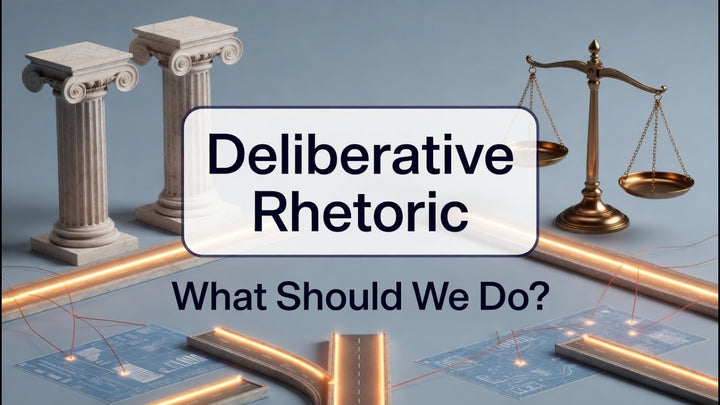
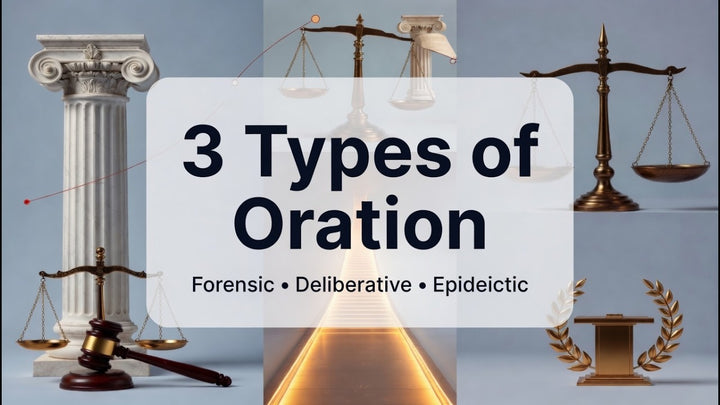
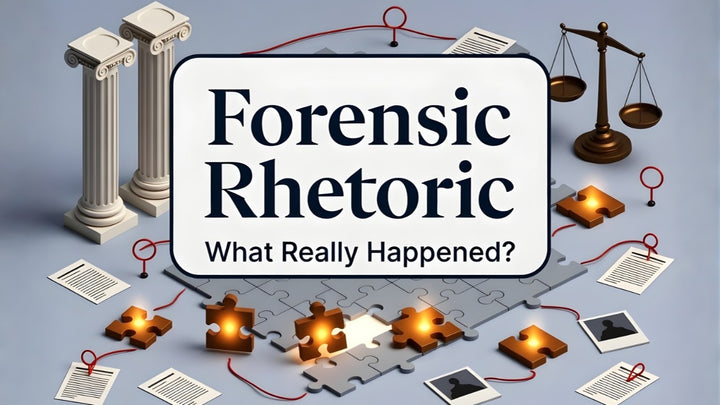
The three types of rhetoric series: The three types · Forensic · Deliberative · Epideictic (you are here).
The rhetoric of the present
Epideictic rhetoric, also called ceremonial or demonstrative rhetoric, asks: What should we value? What deserves praise, and what deserves blame? The word comes from a Greek verb meaning to display or show forth. In Greece and Rome these were the speeches given at funerals, victory celebrations, festivals, and civic ceremonies, not to prove what happened or decide what to do next, but to show a community who it is and what it stands for.
Aristotle says epideictic "has for its subject praise or blame," that its end is "the honorable and disgraceful," and that its time is "most appropriately the present," although speakers often recall the past and look to the future (Rhetoric 1.3). Its audience is the spectator rather than the judge. The Rhetorica ad Herennium puts it simply: "The epideictic kind is devoted to the praise or censure of some particular person" (Ad Herennium 1.2).

Quintilian thought the label itself was revealing: "The term epideictic seems to me however to imply display rather than demonstration" (Institutio Oratoria 3.4). Epideictic speech does not mainly prove. It holds something up so the community can see it. At its core, epideictic rhetoric is the public display and reinforcement of what a community holds dear.
Epideictic was never just decoration
Because epideictic speeches were often occasions for fine language, it is tempting to treat them as ornamental. The ancients did not. Quintilian points out that Roman practice gave praise and blame "a place in the practical tasks of life. For funeral orations are often imposed as a duty on persons holding public office" (Institutio Oratoria 3.7). A eulogy was a civic act.
The most famous example is the funeral oration Thucydides gives to Pericles for the Athenians who died in the first year of the Peloponnesian War. It praises the dead, but much more than that, it praises Athens: "Our constitution does not copy the laws of neighboring states; we are rather a pattern to others than imitators ourselves" (Thucydides 2.37). The speech tells the living who they are, so that the sacrifice of the dead has a meaning.
Pericles also names the central risk of the genre. Praise works, he says, only so long as listeners can persuade themselves "of their own ability to equal the actions recounted: when this point is passed, envy comes in and with it incredulity" (Thucydides 2.35). Overpraise breaks the spell. Epideictic has to be believable to be powerful.
How epideictic rhetoric works: four moves
1. Praise and blame
What deserves celebration? What deserves condemnation? Which virtues or vices are being held up as examples? The Ad Herennium gives speakers a practical map of what can be praised: "External Circumstances, Physical Attributes, and Qualities of Character" (Ad Herennium 3.10). Birth, upbringing, wealth, and fortune; strength, health, and beauty; and above all wisdom, justice, courage, and self-control. The same headings, reversed, provide the materials of blame.
2. Shared identity
What story are we telling about who we are? What ideals bind the group together? Aristotle quotes Socrates on a point every speechwriter knows: "it is not difficult to praise Athenians among Athenians" (Rhetoric 1.9). Epideictic usually starts from values the audience already holds, and strengthens them. That is its power and its danger. It can bind a community together around its best ideals or around its worst prejudices.

3. Amplification
How is the speaker making certain values feel bigger, more vivid, more emotionally charged? Aristotle singles out amplification as the epideictic tool: it "is most suitable for epideictic speakers, whose subject is actions which are not disputed, so that all that remains to be done is to attribute beauty and importance to them" (Rhetoric 1.9). He lists the standard techniques: showing that someone was the only one, or the first, or one of few to do something, and comparing them with famous figures. These are the moves of every award introduction and every obituary.
This is also where style does its most visible work. Rhythm, imagery, repetition, and elevated language are how a speaker turns an ordinary fact into a shared emotion.
4. Alignment
How is the message reinforcing or reshaping the community's sense of right and wrong? What new standard of behavior is being quietly set? How does it invite the audience to feel part of something larger? Here epideictic quietly turns toward action.

Foundations Series · Volume 1
An Introduction to Rhetoric
A visual guide to persuasion, argument, and influence.
Praise is advice in disguise
Aristotle noticed that epideictic and deliberative rhetoric are closely related. "Praise and counsels have a common aspect," he writes, "for what you might suggest in counseling becomes encomium by a change in the phrase." His advice to speakers: "if you desire to praise, look what you would suggest; if you desire to suggest, look what you would praise" (Rhetoric 1.9). To praise someone for generosity is to say, implicitly, "be generous."
Lincoln's address at Gettysburg in 1863 is a perfect example. It begins as a dedication, and then refuses to be one: "we can not dedicate—we can not consecrate—we can not hallow—this ground." The soldiers have already done that. "The world will little note, nor long remember what we say here, but it can never forget what they did here." Then the praise turns into a charge: "It is for us the living, rather, to be dedicated here to the unfinished work" (Gettysburg Address, Bliss copy). In fewer than three hundred words, honoring the dead becomes a call about what the living must do next.
Epideictic also turns up inside the other two types. The Ad Herennium observes that "if epideictic is only seldom employed by itself independently, still in judicial and deliberative causes extensive sections are often devoted to praise or censure" (Ad Herennium 3.15). A prosecutor paints the defendant's character; a politician praises the voters before asking them to back a plan. Listening for the epideictic passages inside a forensic or deliberative speech tells you a lot about what the speaker thinks will actually move the audience.
Spin: the dark side of praise and blame
Aristotle was candid about how epideictic can mislead. Speakers can relabel qualities to suit their purpose: "the choleric and passionate man may be spoken of as frank and open, the arrogant as magnificent and dignified," the foolhardy as courageous, "the recklessly extravagant as liberal" (Rhetoric 1.9). Run the move the other way and the frank become rude, the dignified arrogant, the brave reckless.

Amplification works in both directions too. The same tools that enlarge a real achievement can inflate a trivial one, and the same tools that sharpen justified blame can turn a small fault into a scandal. Much of what we call spin, branding, or outrage is epideictic technique applied without restraint. That is not a reason to distrust all praise and blame. It is a reason to notice when the lens is doing more work than the thing under it.
The warning: answering epideictic with the wrong standard
Epideictic rhetoric gets misread constantly. People treat it like a factual claim or a policy proposal. Someone delivers a moving tribute or a sharp cultural critique, and the response is "That's not accurate" or "What's your solution?" That is not engaging with epideictic rhetoric. It is missing the point.
Facts still matter; a eulogy built on lies is a bad eulogy. But the central question of epideictic is not "is this true?" or "will this work?" It is "is this worth honoring, and is it being honored rightly?" Epideictic rhetoric is about what we should value and who we should become. Wrong standard, wrong response, wrong conclusion, at graduations, award ceremonies, memorials, rallies, in advertising, and in heated comment sections.
The key shift: ask what is being valued
Instead of asking "Is this true?" or "Will this work?", ask:
- What values is this reinforcing?
- What, or who, is being praised or blamed?
- What shared identity is being strengthened, and who is outside it?
- How is emotion being used to amplify those values?
- What is this quietly asking me to do?
These questions reveal the real power of an epideictic message: not its logic, but its ability to shape what a community believes and stands for. Advertising is a good place to practice. Many ads barely describe the product. They praise a kind of person, adventurous, caring, successful, and invite you to see yourself in that portrait.
Or listen to an ordinary retirement speech. "For thirty years, she was the first one in and the last one out. She trained half the people in this room. There is no one who knows this place better." Every sentence is amplification: first, half the room, no one better. Nothing in it is a policy, and not much of it could be fact-checked. But by the end, everyone listening has been reminded what this workplace claims to value, and has been invited, without a word of instruction, to live up to it.
Weak and strong epideictic rhetoric
Now flip the perspective. If you are making an epideictic argument, your responsibility is resonance: authentic values, genuine emotion, and a clear moral vision. When you define what deserves praise or blame, you help shape the shared identity of everyone listening.
Weak epideictic rhetoric looks like empty flattery, performative outrage, and superficial praise with no substance, or, as Pericles warned, praise so inflated that nobody believes it. Strong epideictic rhetoric looks different: deeply felt values, specific and credible praise, honest blame, and language that moves people toward better ideals.
Completing the trilogy
Without a shared sense of what we value, forensic arguments about the past have no meaning and deliberative arguments about the future have no direction. We need all three. Past, future, present. Truth, wisdom, values. Three timeless ways human beings persuade one another.
Once you understand how these arguments are built, you stop getting pulled into the wrong fight. You start seeing every speech, every ad, and every debate for what it really is. And once you see it, you cannot unsee it.
The three types of rhetoric series: The three types · Forensic · Deliberative · Epideictic (you are here).
To keep going, browse all articles, explore structured lessons on the Courses page, or see the illustrated guides on the Guides page.
Foundations Series · Volume 1
An Introduction to Rhetoric
A visual guide to persuasion, argument, and influence. See how messages work.
A clear, visual introduction to the choices inside a message: credibility, emotion, reasoning, and timing, and how to tell them apart in something you have already read or watched.
Sources and further reading
- Aristotle, Rhetoric, Book 1, Chapter 3, on the three kinds of speech (Perseus Digital Library, trans. J. H. Freese)
- Aristotle, Rhetoric, Book 1, Chapter 9, on praise, blame, and amplification (Perseus Digital Library, trans. J. H. Freese)
- Rhetorica ad Herennium, Book 1, on the three kinds of causes and the types of issue (LacusCurtius, trans. H. Caplan)
- Rhetorica ad Herennium, Book 3, on epideictic causes (LacusCurtius, trans. H. Caplan)
- Quintilian, Institutio Oratoria, Book 3, Chapters 1–5, on the kinds of oratory (LacusCurtius, trans. H. E. Butler)
- Quintilian, Institutio Oratoria, Book 3, Chapter 7, on praise and blame (LacusCurtius, trans. H. E. Butler)
- Thucydides, History of the Peloponnesian War 2.35–46, Pericles' Funeral Oration (Perseus Digital Library, trans. R. Crawley)
- Abraham Lincoln, Gettysburg Address, Bliss copy (Wikisource)
- Reclaiming Rhetoric, The 3 Types of Rhetoric
Frequently Asked Questions
What is epideictic rhetoric?
Epideictic, or ceremonial, rhetoric is the rhetoric of praise and blame. It focuses on the present and asks what a community should honor or reject.
How do you pronounce epideictic?
Roughly ep-ih-DIKE-tik. The word comes from a Greek verb meaning to display or show forth.
What are examples of epideictic rhetoric?
Eulogies, funeral orations, award and graduation speeches, anniversary tributes, commemorations, much cultural commentary, and a great deal of advertising.
Is epideictic rhetoric just emotional?
It uses emotion deliberately, but its purpose is to shape shared values. Judging it as if it were a factual claim or a policy proposal misses what it is doing.
What is amplification?
Making something seem greater or more significant, for example by showing someone was the first, the only, or one of few to act, or by comparing them with famous figures. Aristotle calls it the characteristic epideictic tool.
How is epideictic related to deliberative rhetoric?
Aristotle says praise and advice share a common aspect: praising a quality implicitly urges it. The Gettysburg Address turns a dedication into a call to action.
What makes epideictic rhetoric weak?
Empty flattery, performative outrage, relabeling vices as virtues, and praise so inflated the audience stops believing it.
Reclaiming Rhetoric is independent and reader-supported.
If this helped, you can help keep it free.