Have you noticed how quickly people reach for "That's not true," "Here's what really happened," or "That's misinformation"? Everyone sounds certain. Everyone has evidence. Everyone has a version of events. And yet the same situation can produce completely different conclusions, not necessarily because anyone is lying, but because they are selecting, interpreting, and framing the past.
Once something has happened, we cannot access it directly. We can only access the evidence, and the arguments built from it. That process has a name: forensic rhetoric.
This article, a companion to the Reclaiming Rhetoric video on forensic rhetoric, goes deep on the first of the three types of rhetoric. It covers where forensic rhetoric comes from, the four moves every forensic argument makes, how ancient teachers mapped the possible disagreements, and how to tell strong forensic reasoning from weak.
The three types of rhetoric series: The three types · Forensic (you are here) · Deliberative · Epideictic.
The rhetoric of the past
Forensic rhetoric asks three questions: What happened? What is true? Who is responsible? The word comes from the Latin forensis, "of the forum." In Rome the forum was where public argument happened: lawsuits, prosecutions, political accusations. People stood before an audience and argued about past events, what occurred, why it happened, and who should be held accountable.
Aristotle called this kind of speech judicial and defined it by its audience: a judge "of things past." Forensic speech, he says, is "either accusatory or defensive," and its end is "the just or the unjust" (Rhetoric 1.3). The Rhetorica ad Herennium gives the Roman version: "The judicial is based on legal controversy, and comprises criminal prosecution or civil suit, and defence" (Ad Herennium 1.2).
At its core, forensic rhetoric is about judgment. Not prediction, not values, but evaluation: taking incomplete information and forming a conclusion about what is true. The courtroom is its classic home, but the same reasoning runs through investigations, journalism, historical writing, scientific post-mortems, insurance claims, and the argument at the dinner table about who left the door unlocked.

Why the past needs arguments
It can seem odd that the past should need persuasion at all. Either it happened or it did not. But Aristotle saw why the past is argumentative ground. In his discussion of which kinds of proof suit which kinds of speech, he says enthymemes, the reasoned arguments of rhetoric, "are most suitable for forensic speakers, because the past, by reason of its obscurity, above all lends itself to the investigation of causes and to demonstrative proof" (Rhetoric 1.9).
Obscurity is the key word. Nobody in the jury box saw the crime. The historian did not attend the treaty negotiation. The manager did not watch the project go wrong in real time. Everyone is reconstructing, and reconstruction means choosing which fragments matter and how they connect. That is not a flaw in forensic reasoning. It is its job.
How forensic rhetoric works: four moves
1. Evidence
Documents, testimony, data, records, physical traces: anything that points to what happened. But evidence does not speak for itself. It must be selected, organized, and interpreted. Some evidence gets emphasized, some minimized, some ignored entirely.
Aristotle split the materials of proof into two kinds. Some are found by the speaker's art, the reasoning and appeals covered under invention and the three artistic proofs. Others already exist and only need to be used. He calls these "inartificial" proofs and says they "properly belong to forensic oratory," listing five: "laws, witnesses, contracts, torture, oaths" (Rhetoric 1.15). The last two are a sobering reminder of how ancient courts worked. The broader point holds: even "hard" evidence has to be argued. Aristotle spends the rest of the chapter showing how a speaker can make a witness, a contract, or even a law look more or less reliable.
2. Interpretation
Facts rarely explain themselves. They need context, connection, and a story. Forensic rhetoric builds narratives from fragments, turning scattered pieces into a coherent account. A text message, a timestamp, and a bank transfer are three facts. "She knew before the meeting and moved the money anyway" is an interpretation that ties them together.

This is why two honest people can look at the same record and tell different stories. The thread that connects the pins on the board is not itself on the board. It is supplied by the person arguing, which is why it deserves the closest scrutiny.
3. Causality and motive
Why did this happen? What led to the outcome? Was it intentional, accidental, preventable? Assigning cause is how you assign responsibility. Aristotle defines injustice in a way that puts intention at the center: "Let injustice, then, be defined as voluntarily causing injury contrary to the law" (Rhetoric 1.10). He then sorts the causes of human action. Some things happen by chance, nature, or compulsion; others from habit or desire, rational or irrational. The accuser, he says, should examine which motives the opponent had; the defendant should show which were absent.
The Romans had a famous shortcut for motive. Cicero, defending Sextus Roscius on a charge of murdering his father, reminds the court that the respected judge Lucius Cassius used to ask in every case cui bono, "who benefited?" (Cicero, Pro Roscio Amerino 84). It is still one of the most useful forensic questions, provided you remember that benefiting from something is not the same as causing it.

Foundations Series · Volume 2
How to Analyze Any Argument
A visual guide to claims, evidence, assumptions, and reasoning.
4. Standards of proof
How sure do we need to be? Modern legal systems formalize the answer. Many criminal courts require proof "beyond a reasonable doubt." Many civil courts use a "preponderance of the evidence," meaning more likely than not. Outside the courtroom, we work with probabilities: likely, plausible, possible. Not every forensic argument needs certainty.
People often argue past each other because they are using different standards without realizing it. One person says "there's no proof" and means no proof beyond reasonable doubt. Another says "it obviously happened" and means more likely than not. They may agree about the evidence and still disagree about the conclusion, because they never agreed on the bar.
Mapping the disagreement: the theory of issues
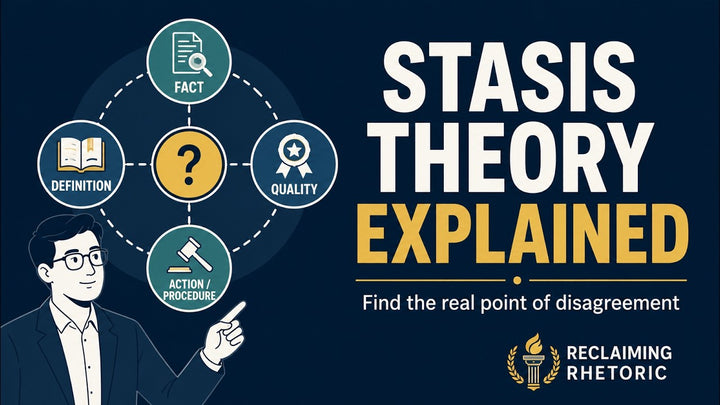
Ancient teachers developed a tool for figuring out exactly what a forensic dispute is about. The Greeks called it stasis; Quintilian explains that "The Greeks call this essential basis στάσις" (Institutio Oratoria 3.6), and Latin writers called it the status or issue. The Ad Herennium puts it precisely: "The Issue is determined by the joining of the primary plea of the defence with the charge of the plaintiff" (Ad Herennium 1.11.18). In other words, find the exact point where accusation and defense collide.
The handbook names three types of issue: "Conjectural, Legal, and Juridical." A conjectural issue is about the facts. Its example comes from the Trojan War stories: Ajax, after his madness, kills himself in the forest; Ulysses is found near the body, drawing a bloodied sword from it; Teucer, Ajax's brother, accuses Ulysses of murder. "Here the truth is sought by conjecture," the author writes. "The controversy will concern the fact." A legal issue is about what a law or document means. A juridical issue concedes the act but argues over whether it was right or justified.
Later teachers commonly arranged these into a sequence of questions, which still works as a checklist for any dispute about the past:
- Fact: Did it happen? Who did it?
- Definition: What should we call what happened? Was it theft or borrowing, a lie or a mistake?
- Quality: Was it justified, excusable, or more or less serious than claimed?
- Procedure: Is this the right place, time, or process to judge it?
Aristotle noticed the same pattern in practice: a defendant may admit the act and dispute its name, but "will never admit that the act is unjust" (Rhetoric 1.3). Knowing which question is actually in dispute saves enormous time. Two people arguing about whether something happened, when both privately accept that it did and really disagree about whether it was wrong, will never resolve anything.
The warning: answering a forensic claim with the wrong standard
Forensic rhetoric gets misread constantly. People treat it like a values debate or a policy fight. Someone presents solid evidence about what happened, and the response is "Even if that's true, it's not a big deal," or "You're just trying to make them look bad." That is not engaging with forensic rhetoric. That is dodging the question.
Those replies may be relevant later. Whether something is a big deal is a question of quality or of values. Whether someone has a motive for raising it is fair to ask. But neither answers whether it happened. Forensic rhetoric is not about what should have happened, and not about how you feel about the conclusion. It is about what did happen. Wrong standard, wrong response, wrong conclusion. The mistake shows up in news coverage, political scandals, comment sections, family arguments, and workplace blame games.
The key shift: ask how it is being argued as true
Instead of asking only "Is this true?", also ask how it is being argued as true:
- What evidence is being selected, and what is being left out?
- What interpretation is being applied to it?
- What causes are being emphasized, and which alternatives are ignored?
- What standard of proof is being assumed?
- Which issue is really in dispute: fact, definition, quality, or procedure?
Try it on a familiar kind of story. A company announces that a data breach "affected a small number of accounts" and was "quickly contained." Each phrase is a forensic claim. Small compared to what? Contained by when, and measured from the breach or from its discovery? Which logs were checked, and who checked them? Is the dispute about whether data was taken (fact), whether it counts as a "breach" under the law (definition), or whether the company acted reasonably (quality)? None of these questions assumes the company is lying. They simply make the argument show its work.
These questions reveal the structure of the argument, not just its conclusion. They are the forensic core of rhetorical analysis.
Weak and strong forensic rhetoric

Now flip the perspective. If you are making a forensic argument, your responsibility is clarity: accurate evidence, fair interpretation, careful reasoning. Once you claim something is true, you are shaping how others understand reality.
Weak forensic rhetoric looks like cherry-picked evidence, overstated certainty, missing context, and assumptions presented as fact. Strong forensic rhetoric looks different: transparent reasoning, acknowledged uncertainty, clear connections between evidence and conclusion, and arguments that can withstand scrutiny. A good test is whether the argument tells you what evidence would change its conclusion. Strong forensic arguments can answer that. Weak ones cannot.
Why forensic rhetoric is the foundation
Most of what we believe about the world comes from forensic arguments: history, news, investigations, legal decisions, scientific findings about what caused what. Without a shared understanding of what actually happened, you cannot make wise decisions about the future, which is the territory of deliberative rhetoric. And you cannot even agree on what to honor in the present, the territory of epideictic rhetoric. Get the past wrong, and everything built on top of it wobbles.
Once you understand how forensic arguments are built, you stop simply accepting conclusions. You start examining how they were constructed. And once you see it, you cannot unsee it.
The three types of rhetoric series: The three types · Forensic (you are here) · Deliberative · Epideictic.
To keep going, browse all articles, explore structured lessons on the Courses page, or see the illustrated guides on the Guides page.
Foundations Series · Volume 2
How to Analyze Any Argument
A visual guide to claims, evidence, assumptions, and reasoning. Stop reacting. Start diagnosing.
A visual method for seeing where an argument actually works, and where it does not. Name the claim, test the evidence, and find the assumption holding it all together.
Sources and further reading
- Aristotle, Rhetoric, Book 1, Chapter 3, on the three kinds of speech (Perseus Digital Library, trans. J. H. Freese)
- Aristotle, Rhetoric, Book 1, Chapter 9 (Perseus Digital Library, trans. J. H. Freese)
- Aristotle, Rhetoric, Book 1, Chapter 10, on injustice and motives (Perseus Digital Library, trans. J. H. Freese)
- Aristotle, Rhetoric, Book 1, Chapter 15, on inartificial proofs (Perseus Digital Library, trans. J. H. Freese)
- Rhetorica ad Herennium, Book 1, on the three kinds of causes and the types of issue (LacusCurtius, trans. H. Caplan)
- Quintilian, Institutio Oratoria, Book 3, Chapter 6, on the basis or issue (LacusCurtius, trans. H. E. Butler)
- Cicero, Pro Roscio Amerino 84, Latin text
- Reclaiming Rhetoric, The 3 Types of Rhetoric
Frequently Asked Questions
What is forensic rhetoric?
Forensic, or judicial, rhetoric is persuasion about the past: what happened, what is true, and who is responsible. Aristotle says it is either accusatory or defensive and aims at the just or unjust.
Why is it called forensic?
From the Latin forensis, "of the forum," the public space in Rome where legal cases and public accusations were argued.
Is forensic rhetoric only used in court?
No. It appears wherever people reconstruct past events: journalism, history, investigations, workplace reviews, scientific explanations of causes, and everyday disputes.
What is stasis theory?
An ancient method for locating the exact point of disagreement. The Ad Herennium names conjectural (fact), legal, and juridical (justification) issues; later teachers often used fact, definition, quality, and procedure.
What did Aristotle mean by inartificial proofs?
Evidence that exists before the speech and only has to be used, such as laws, witnesses, and contracts, as opposed to arguments the speaker invents.
What does cui bono mean?
"Who benefited?" Cicero credits the Roman judge Lucius Cassius with asking it in every case. It points to motive, which is evidence but not proof.
How can I tell strong forensic rhetoric from weak?
Strong forensic arguments show their evidence, acknowledge uncertainty, connect evidence to conclusion clearly, and say what would change their mind. Weak ones cherry-pick and overstate.
Reclaiming Rhetoric is independent and reader-supported.
If this helped, you can help keep it free.