We're sorry for any inconvenience this may have caused.
It contains the word sorry. It sounds calm, professional, and carefully reviewed. And almost nothing in it tells you what actually happened. Who caused the problem? What was lost? Why is the harm only something that may have occurred? What responsibility is being accepted? What is going to happen now?
Some apologies fail because they sound defensive or insincere. Others fail for a more interesting reason: they sound exactly like apologies, but they have removed almost everything an apology is supposed to do. This article, a companion to the Reclaiming Rhetoric video, looks at why apologies fail even when they sound right, the grammar of the non-apology, and five questions for judging any apology you hear or need to make.
What an apology is supposed to do
An apology is not a magic phrase that erases an offense. It is an attempt to repair a damaged relationship between an action, the person responsible for it, and the person who was harmed. That usually requires more than regret.
Research on apologies has identified several recurring components. In one widely cited set of studies, Roy Lewicki, Beth Polin, and Robert Lount tested six: an expression of regret, an explanation of what went wrong, an acknowledgment of responsibility, a declaration of repentance, an offer of repair, and a request for forgiveness (Lewicki, Polin & Lount 2016). Apologies containing more of the components were generally judged more effective, and two stood out as the most important: acknowledging responsibility and offering repair.
Not every apology needs every element in the same order. But those two are remarkably practical, because they are exactly the parts a defensive statement tends to leave out.

Anatomy of a hollow apology
Imagine a software company releases an update that accidentally deletes some customers' locally stored work. The company responds: "We're sorry for any inconvenience this may have caused."
Notice how much rhetorical work that sentence does to protect the company:
- "Inconvenience" reduces lost work to a mild disruption.
- "May have caused" makes an established consequence sound hypothetical.
- No actor appears. The files apparently disappeared, but no one seems to have done anything.
Now compare: "We released an update that deleted locally saved drafts for some customers. Our testing process failed to catch the problem, and we are responsible. We are working to recover affected files, refunding customers who lost work, and changing the testing process before the next release."
That apology is not better because it is longer. It is better because responsibility becomes visible. It names the act, names the actor, names the harm, and names the repair.

Foundations Series · Volume 2
How to Analyze Any Argument
A visual guide to claims, evidence, assumptions, and reasoning.
The grammar of the non-apology
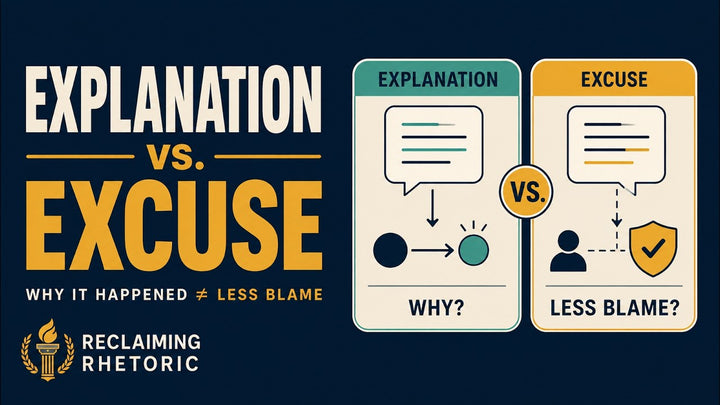
Once you start listening for it, the non-apology has a recognizable grammar. Each move keeps the sound of contrition while quietly relocating the problem.
- "I'm sorry if anyone was offended." The word if makes the harm conditional.
- "Mistakes were made." The passive construction makes the actor disappear.
- "I'm sorry you felt ignored." Now the problem is your feeling rather than my conduct.
- "That was never my intention." Intent may explain an action, but it does not erase its effects.
- "I'm sorry, but you have to understand how much pressure I was under." The apology turns into a defense mid-sentence.
"Mistakes were made" has a famous history in American politics. In his 1987 State of the Union address, Ronald Reagan said of the Iran arms affair, "we did not achieve what we wished, and serious mistakes were made in trying to do so" (Reagan Library transcript). It is a useful example precisely because it is mixed: moments earlier he had also said, "It did not work, and for that I assume full responsibility." The same passage both claims responsibility and lets the specific errors drift free of any named agent. That is how real apologies usually work. They are rarely all hollow or all sincere, which is why you have to read them sentence by sentence.
Why the order matters
Context can matter. Sometimes it matters enormously. But sequence matters too. If the explanation arrives before responsibility has been accepted, it can sound less like context and more like an escape route. "I was under pressure, the instructions were unclear, and I'm sorry" lands very differently from "I did this, it was wrong, and here is what was going on, not as an excuse but so you understand what I'm changing."
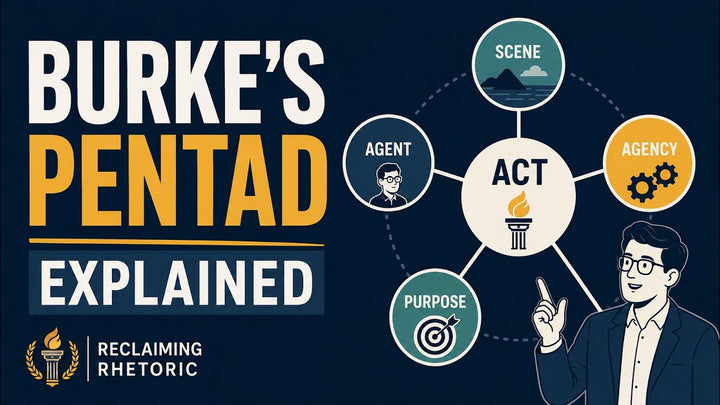
This is where Burke's pentad becomes a useful lens. A defensive apology often lets the scene (pressure, circumstances, confusion) explain the act so that the agent fades into the background. A reparative apology keeps the agent in view.
Whose discomfort is the apology about?
Another reason apologies fail is that they focus on the speaker's discomfort instead of the other person's harm. A defensive apology is organized around questions like these:
- How do I get out of this?
- How do I restore my reputation?
- How do I make this conversation end?
A reparative apology asks different questions:
- What did I actually do?
- What did this cost the other person?
- What can I repair?
- What needs to change?
The distinction is especially important in public apologies, where a statement can look like an apology while functioning primarily as reputation management. The question is not simply whether the speaker expresses regret. It is what the regret is organized around. A public statement that devotes three paragraphs to the organization's values and one clause to the people affected has told you where its attention is. That is also an ethos problem: an apology that protects the speaker's image at the expense of naming the harm usually damages the very credibility it was trying to save.

Timing: fast is not the same as responsive
We often assume the fastest apology is automatically the best. Sometimes immediate acknowledgment is essential, especially when people need practical information or protection. But an apology can also arrive too quickly.
If someone tells you that your behavior hurt them and you immediately say, "I'm sorry, can we move on?", the apology may function as a way of ending the conversation before you understand the harm. Sometimes the better sequence is:
- Listen.
- Describe what you understand.
- Accept responsibility.
- Apologize.
- Then discuss repair.
A fast apology is not necessarily a responsive one. Timing in rhetoric is about fit, not speed, which is the subject of the Reclaiming Rhetoric article on kairos.
Repair: where the words start to cost something
Repair is where an apology stops being only language. If the software company deleted people's work, a generic discount may not address the actual harm. Repair might mean file recovery, refunds, direct support, an honest explanation of the technical failure, and changes to the release process.
The repair should correspond to the harm:
- If you make a false accusation publicly, a private apology does not fully repair it.
- If you break someone's trust repeatedly, another beautifully written statement may matter less than what you do afterward.
- If an organization's process caused the harm, repair includes changing the process, not just compensating this round of victims.
Repair also has a time dimension. Some harms can be fixed in a day; others, like broken trust, are repaired only through a pattern of behavior over months. An apology that promises instant restoration of trust is promising something the speaker cannot deliver alone. A more honest version names the first concrete step and accepts that the rest will be judged by what follows.

Five questions for any apology
When you hear an apology, or when you need to make one, try these five questions:
- What exactly happened? Is the act named plainly, or blurred into "an incident" or "inconvenience"?
- Who is accepting responsibility? Is there an actor in the sentence?
- What harm does the apology show that it understands? Does it describe the cost to the other person, or only the speaker's regret?
- What repair is being offered? Does it correspond to the harm?
- What will change? Is there a concrete commitment, or only a promise to "do better"?
An apology can sound polished and fail all five. Another can be brief and answer them directly. These are the same skills you use in any rhetorical analysis: attending to what a text names, what it hides, and who it is really addressed to. Apologies are also a close cousin of forensic rhetoric, since they are fundamentally arguments about a past act and who is accountable for it.
Rewriting a hollow apology, step by step
It helps to practice on a small, everyday case. Suppose a team lead forgot to credit a colleague's work in a presentation to senior management, and the colleague found out afterward. Here is a first draft many people would write:
Sorry if you felt left out of the presentation. Things were really hectic that week and it was never my intention to take credit.
Run it through the five questions. What happened? Not named; "left out" is vague. Who is responsible? No one; "things were hectic." What harm is understood? Only the colleague's feeling, and that only conditionally. What repair? None. What will change? Nothing. The draft contains three of the non-apology moves in two sentences.
Now a revision:
I presented your analysis to the leadership team without crediting you. That was wrong, and it was my responsibility. It meant the people who make decisions about your projects did not see your work. I've emailed the group to correct the record and name you as the author, and from now on I'll put contributor names on the first slide.
The revision is not more emotional. It is more specific. It names the act, owns it, describes the actual cost (visibility with decision-makers, not hurt feelings), makes a repair that matches the harm (a correction to the same audience), and commits to a concrete change. Notice, too, that the busy week has disappeared. If the colleague asks why it happened, the context can come later, after responsibility has already been accepted.
Public apologies and private apologies
Public apologies add a complication: they usually have more than one audience. A company apologizing after a data breach is speaking to affected customers, to regulators, to investors, to journalists, and to its own employees at the same time. Each audience wants something different, and legal caution often pulls the language toward vagueness.
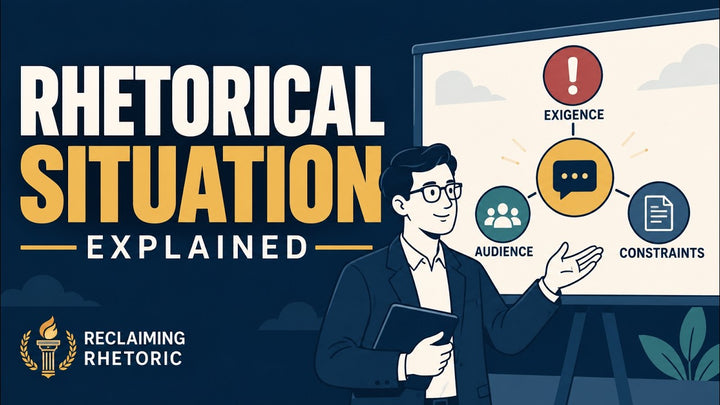
That is one reason public apologies so often drift toward the passive voice and the hypothetical mood. It is also why a careful reader should ask which audience a given sentence is really written for. "We take the security of our customers' data seriously" is addressed to the reputation. "If you received a notice, change your password and here is a free credit-monitoring code" is addressed to the people harmed. In the rhetorical situation of a public apology, the constraints are real, but they do not excuse leaving the injured party out of their own apology.
Private apologies are simpler in one sense and harder in another. There is only one audience, but that audience knows exactly what happened. Vagueness that might survive a press release usually fails at the kitchen table.
An apology does not purchase forgiveness
Here is the final distinction. A good apology does not purchase forgiveness. Saying the right words does not obligate the other person to restore trust, reconcile immediately, or reassure you that everything is fine.
The person apologizing controls the acknowledgment, the repair, and the change that follows. The person who was harmed controls what happens to forgiveness and trust. An apology that demands absolution ("I said I was sorry, what more do you want?") has quietly turned back into a request about the speaker's comfort.
An apology is not proven by the presence of the word sorry. It is proven by what the speaker is willing to name, what they are willing to own, what they understand about the harm, and what they are prepared to change. So the next time an apology sounds polished but somehow feels empty, do not ask only, "Did they say they were sorry?" Ask what the apology made visible, what it kept hidden, and what changed after the words were over.
To keep going, browse all articles, explore structured lessons on the Courses page, or see the illustrated guides on the Guides page.
Foundations Series · Volume 2
How to Analyze Any Argument
A visual guide to claims, evidence, assumptions, and reasoning. Stop reacting. Start diagnosing.
A visual method for seeing where an argument actually works, and where it does not. Name the claim, test the evidence, and find the assumption holding it all together.
Sources and further reading
- Roy J. Lewicki, Beth Polin, and Robert B. Lount Jr., "An Exploration of the Structure of Effective Apologies," Negotiation and Conflict Management Research 9, no. 2 (2016): 177–196
- Ronald Reagan, Address Before a Joint Session of Congress on the State of the Union, January 27, 1987 (Ronald Reagan Presidential Library)
- Reclaiming Rhetoric, Burke's Pentad Explained
- Reclaiming Rhetoric, How to Do a Rhetorical Analysis
Frequently Asked Questions
Why do some apologies fail even when they say sorry?
Because they omit the parts that do the work: naming what happened, accepting responsibility, showing an understanding of the harm, offering repair, and committing to change.
What makes an apology effective?
Research by Lewicki, Polin, and Lount found that acknowledging responsibility and offering repair were the most important of six common apology components.
What is a non-apology?
A statement that sounds like an apology but avoids responsibility, for example "I'm sorry if anyone was offended" or "mistakes were made."
Why is "mistakes were made" criticized?
The passive voice removes the actor, so the sentence admits that errors happened without saying who made them.
Is it wrong to explain why something happened?
No. Context can matter a great deal. But an explanation offered before responsibility is accepted can sound like an excuse rather than an account.
Should an apology always be immediate?
Not always. Quick acknowledgment is often essential, but an apology that rushes past listening can end the conversation before the harm is understood.
Does a good apology mean I will be forgiven?
No. The person apologizing controls acknowledgment, repair, and change. The person who was harmed decides about forgiveness and trust.
Reclaiming Rhetoric is independent and reader-supported.
If this helped, you can help keep it free.