Imagine you break someone's window. You say, "I broke it because I was angry and threw a rock." That explains what happened. It probably does not excuse you.
Now imagine you say, "I broke it because I slipped, fell, and crashed through it." Same grammatical structure, very different judgment about responsibility. And a third version: "I broke it because a child was trapped inside a dangerously hot car." Again, you have explained why the window was broken, but now you may be making a stronger claim: that breaking the window was the right thing to do.
Explanation, excuse, justification. All three can begin with the same word, because, but they do very different rhetorical work. This article, a companion to the Reclaiming Rhetoric video, separates the three, shows why they are so easy to confuse, and offers four questions that settle the argument better than fighting over the label.

Foundations Series · Volume 3
How to Build a Better Argument
A practical visual guide to claims, evidence, structure, and objections.
What an explanation does
An explanation tells us something about why an action or outcome occurred. Crucially, explaining an action does not automatically defend it.
- "I insulted him because I wanted to embarrass him." That is a perfectly understandable explanation of motive. It also makes the behavior look worse.
- "I ignored the deadline because I forgot." That explains the failure. It does not do much to reduce responsibility.
- "I lied because I wanted the promotion." Highly explanatory. Not especially exculpatory.
So when somebody responds to a reason by saying, "That's just an excuse," the first question should be: is the speaker actually asking to be excused, or simply telling you what caused the behavior? Those are different speech acts. One describes a causal story. The other asks the listener to change a judgment.
Explanations are also what we demand when something goes wrong. Investigators, managers, teachers, and doctors all need to know why before they can prevent a repeat. If every reason were heard as an excuse, nobody could ever safely tell the truth about what happened, and nobody could learn from it.
What an excuse does
An excuse answers a different question. It does not merely ask, Why did this happen? It asks, Given why this happened, how blameworthy is the person who did it?
An excuse generally accepts that something went wrong, but argues that the actor deserves less blame because some relevant condition limited responsibility. Maybe they lacked important information. Maybe the outcome was accidental. Maybe they had very little control. Maybe they were coerced. Maybe they had no reasonable alternative. That is why judgments about excuses so often turn on questions like these:
- What did the person know?
- What did they intend?
- Could they control what happened?
- Could they reasonably have acted differently?
- Did they, or should they, have foreseen the outcome?
Those details do more than fill in the causal story. They affect how responsibility is assigned.

A good excuse is not a bad word
In everyday conversation, excuse has become almost synonymous with evasion: "Stop making excuses." "No excuses." "That's a convenient excuse." But some excuses are completely legitimate.
Suppose you promised to meet someone at 6:00. You leave with plenty of time. At 5:45, a major accident shuts down the only road between you and your destination. That circumstance explains your lateness, but it also does something more: it gives us a reason to reduce the amount of blame we assign to you.
Compare: "I was late because I left the house twenty minutes after I was supposed to." Also an explanation. But this time it does not reduce responsibility very much. Both statements answer why. Only one significantly changes what we think about blame. A genuine excuse is not automatically a bad excuse; it is a claim about responsibility that can be true or false, strong or weak, and it deserves to be tested rather than dismissed.
Justification: the third answer
Return to the broken window and the child trapped in a hot car. The speaker may not be saying, "I did something wrong, but please blame me less." The argument may be, "Given the emergency, breaking the window was permissible."
That is a different kind of claim. A justification challenges whether the act should count as wrongful under the circumstances. An excuse generally leaves the wrongness of the act in place but reduces the actor's culpability. So we now have three separate questions:
- Explanation: Why did it happen?
- Excuse: Was the actor less blameworthy?
- Justification: Was the action actually permissible?
Those questions can overlap, but collapsing them into one produces a lot of unnecessary arguments.
An old distinction with a long history
None of this is new. Aristotle opens Book 3 of the Nicomachean Ethics with exactly this concern. In H. Rackham's translation:
Virtue however is concerned with emotions and actions, and it is only voluntary feelings and actions for which praise and blame are given; those that are involuntary are condoned, and sometimes even pitied.
He goes on to examine what makes an act involuntary, singling out compulsion and certain kinds of ignorance, which are close cousins of the conditions people still cite when they offer an excuse (Nicomachean Ethics 3.1).
In the twentieth century, the philosopher J. L. Austin made the distinction between excuses and justifications central to his 1956 presidential address to the Aristotelian Society, "A Plea for Excuses." Roughly: in a justification, we accept responsibility but deny the act was bad; in an excuse, we admit the act was bad but deny full, or any, responsibility (Austin, 1957). Sociologists Marvin Scott and Stanford Lyman built a similar distinction into their influential 1968 paper "Accounts," which treats excuses and justifications as two kinds of talk people use to explain untoward behavior to others (Scott & Lyman, 1968).
The legal tradition draws a version of the same line, which is one reason this topic sits so close to forensic rhetoric, the rhetoric of judging past actions. In the terms of stasis theory, an excuse or justification usually concedes the facts and moves the dispute to the question of quality: given what happened, how should we judge it?
Why "I'm explaining, not excusing" starts fights
That helps explain why "I'm explaining, not excusing" is such a common flashpoint. The sentence can be sincere and still leave something unresolved.
Suppose someone says, "I snapped at you because I had been awake for twenty hours." Maybe they are only trying to describe what happened. But that information also changes the context. Extreme exhaustion may affect control, patience, attention, and judgment. So even if the speaker does not intend to ask for reduced blame, the explanation may naturally influence how much blame the listener assigns.
Context does not sit harmlessly beside responsibility. Context can change how we interpret intention, agency, foreseeability, control, and character. An explanation does not automatically excuse. But an explanation can contain facts that genuinely matter to an excuse. That is why the listener hears a request even when the speaker insists none was made, and why the speaker feels accused of something they never claimed.

Four questions to ask instead of arguing over the label
When a disagreement starts collapsing into "That's an explanation" versus "No, that's an excuse," stop arguing over the label and ask more precise questions.
- Does this information actually explain what happened? Is the causal story plausible? Is it complete, or is one convenient cause standing in for several?
- Does it change whether the action itself was wrong? If so, you may be dealing with a justification, and the argument is about the act, not the actor.
- Does it change how much control, knowledge, intention, or reasonable choice the actor had? If so, it may provide a legitimate excuse or some degree of mitigation.
- What responsibility remains anyway? Whatever the answers above, what still needs to be done?
Notice that none of these questions requires you to decide in advance whether the speaker is sincere. They move the conversation from motive-guessing to claims that can actually be checked.
Reduced blame is not zero obligation
That final question is especially important because reduced blame does not necessarily eliminate obligation. The traffic accident may excuse your lateness; you may still owe someone a phone call. A genuine misunderstanding may reduce your blame for saying something offensive; you may still need to correct the harm. You may have made an understandable mistake and still need to repair what the mistake caused.
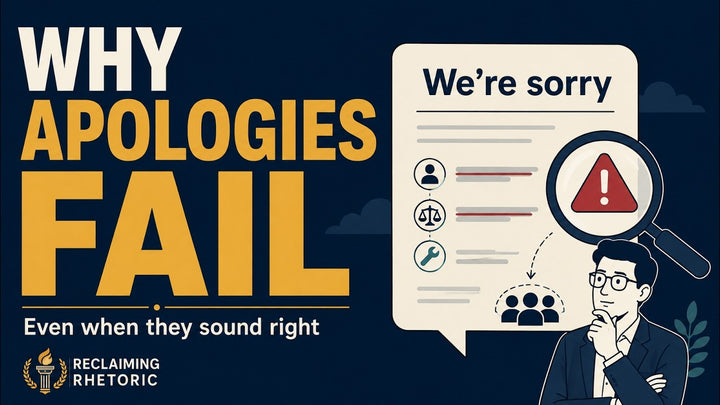
This is where discussions of accountability often go wrong. One side treats context as though it automatically erases responsibility. The other treats any mention of context as an attempt to escape responsibility entirely. Both moves are too simple. It is also why so many public apologies misfire: they lead with the explanation and never reach the repair. If you want to see how that plays out, why apologies fail walks through the pattern.
Two opposite errors
There are really two opposite errors.
The first is using every causal factor as a shield. "I was stressed." "I had a difficult week." "That's how I was raised." Those facts may explain behavior. They do not automatically excuse it.
The opposite error is pretending circumstances should never matter. If a person did not know something, could not control something, was forced into a situation, or had no reasonable alternative, those facts belong in an accurate judgment of responsibility. Ignoring them does not make accountability stronger. It can make accountability less accurate.
Both errors share a shortcut: they decide the conclusion first and then classify the reason to fit it. If you have already decided someone is to blame, every reason sounds like an excuse. If you have already decided they are not, every criticism sounds like a refusal to understand.

Explanations and excuses in public statements
The same structure appears constantly in organizational and political communication. A company explains an outage by pointing to an unprecedented spike in demand. A public official explains a missed deadline by pointing to a supplier's failure. A team lead explains a bad quarter by pointing to the market.
Each may be true. Each is also doing rhetorical work. Read them with the three questions in mind. Is the statement merely explaining, or is it quietly asking for reduced blame? Is it implying the decision was actually correct given the circumstances? And, most revealingly, does it say what the speaker will do now? A statement that offers a cause, implies an excuse, and stops there has told you a great deal about what it hopes you will conclude. If you want a full method for reading statements like these, see how to do a rhetorical analysis.
Using the distinction on yourself
The distinction is just as useful when you are the one who made the mistake. Try separating your response into the three parts deliberately:
- Explain plainly: "Here is what happened and why." Keep it short and factual.
- Claim mitigation only where it is real: "I didn't know the file had been updated." If the condition genuinely limited your responsibility, say so once, without leaning on it.
- Name what remains: "I should have checked, and here is what I'm doing to fix it."
Labeling the parts yourself takes away the listener's need to guess which one you meant. It also signals that you understand the difference, which is often the strongest evidence of good faith you can offer. That signal is a form of ethos: credibility built not by claiming blamelessness but by showing sound judgment about blame.
Understanding is not absolving
The useful question is not simply, Is that an excuse? Ask instead: What does that explanation actually change? Does it explain the behavior without reducing blame? Does it legitimately reduce blame? Does it show that the action was justified? And what responsibility remains after all of that is taken into account?
An explanation tells us how we got here. An excuse argues that the actor deserves less blame for getting us here. A justification argues that, under the circumstances, the action itself was permissible. Sometimes one sentence contains pieces of all three.
So when someone tells you why something happened, do not assume that understanding the cause requires surrendering judgment. Understanding and absolving are different acts. You can understand why something happened and still decide what responsibility remains.
To keep going, browse all articles, explore structured lessons on the Courses page, or see the illustrated guides on the Guides page.
Foundations Series · Volume 3
How to Build a Better Argument
A practical visual guide to claims, evidence, structure, and objections. Opinion in. Case out.
Move from an initial opinion to a clear, well-supported case that can withstand fair scrutiny. Gather evidence that tests the claim, then treat serious objections fairly.
Sources and further reading
- Aristotle, Nicomachean Ethics 3.1 (Perseus Digital Library, trans. H. Rackham)
- Austin, J. L. (1957). A plea for excuses. Proceedings of the Aristotelian Society, 57, 1–30
- Scott, M. B., & Lyman, S. M. (1968). Accounts. American Sociological Review, 33(1), 46–62
- Reclaiming Rhetoric, Why Apologies Fail (Even When They Sound Right)
- Reclaiming Rhetoric, Stasis Theory
Frequently Asked Questions
What is the difference between an explanation and an excuse?
An explanation says why something happened. An excuse argues that, because of why it happened, the person deserves less blame. An explanation can make behavior look better, worse, or no different.
What is the difference between an excuse and a justification?
An excuse admits the act was wrong but claims reduced responsibility. A justification claims the act was not wrong under the circumstances, such as breaking a window to rescue a child.
Is every excuse a bad excuse?
No. Accidents, coercion, missing information, and lack of control can genuinely reduce blame. The question is whether the condition is real and relevant, not whether it is labeled an excuse.
Why does "I'm explaining, not excusing" cause arguments?
Because context such as exhaustion or stress can affect how much blame listeners assign, even when the speaker did not intend to ask for leniency.
Who first distinguished excuses from justifications?
Aristotle discussed voluntary and involuntary action in Nicomachean Ethics Book 3. J. L. Austin's "A Plea for Excuses" and Scott and Lyman's 1968 "Accounts" made the modern distinction influential.
Does a valid excuse remove responsibility completely?
Not necessarily. Reduced blame can coexist with remaining obligations, such as calling ahead, correcting a harm, or repairing what a mistake caused.
How should I explain my own mistake without sounding like I'm making excuses?
Explain briefly, claim mitigation only where it is real, and name what you will do now. Separating the parts yourself removes the guesswork.
Reclaiming Rhetoric is independent and reader-supported.
If this helped, you can help keep it free.