A friend texts you: "You have to try this new restaurant. The chef trained in Italy. The pasta made me cry, and it's only $15 a plate." Before you finish reading, you are half planning to go. Maybe you are already checking the hours.
Pause for a second and notice what just happened. That was not only a recommendation. It was a persuasive argument, and it worked on you in three different ways at once. "The chef trained in Italy" is credibility: someone with expertise made this food. "The pasta made me cry" is emotion: this is an experience worth feeling something about. "Only $15 a plate" is reasoning: the value makes sense, so going would be smart. Three reasons. One decision.
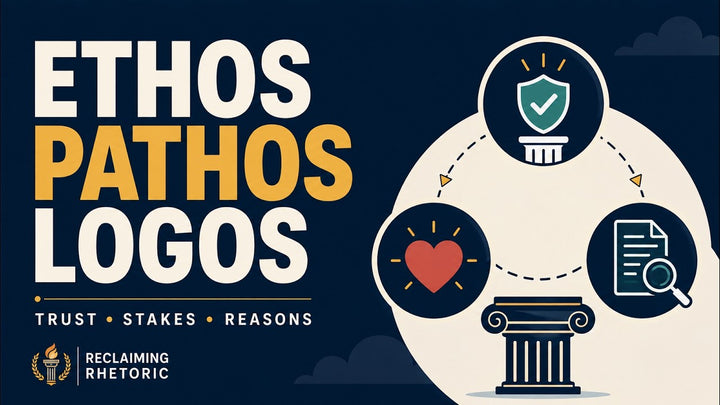
Those three reasons have names. They are the rhetorical appeals: ethos, pathos, and logos. This article, a companion to the Reclaiming Rhetoric video on the appeals, explains each one, where it came from, why it works, how it gets misused, and how the three combine. Once you see them, you cannot unsee them.
Every persuasive message draws on the same three appeals
Aristotle described these patterns more than 2,300 years ago. In Book 1 of his Rhetoric, he says the proofs a speaker can build are "of three kinds. The first depends upon the moral character of the speaker, the second upon putting the hearer into a certain frame of mind, the third upon the speech itself, in so far as it proves or seems to prove" (Rhetoric 1.2).
Later teachers attached three Greek words to those three proofs, and the shorthand stuck:
- Ethos is credibility. Why should I trust you?
- Pathos is emotion. Why should I care?
- Logos is reasoning. Why does this make sense?
What is remarkable is not that Aristotle noticed these patterns. It is that every persuasive message you meet today, from a charity appeal to a software landing page, still runs on some combination of them. The media changed. The ingredients did not. If you want the bigger picture of what rhetoric is and why it matters, start with What Is Rhetoric? From Aristotle to TikTok.
One caution before going further. The Purdue Online Writing Lab notes that these terms are often flattened in modern teaching: logos originally referred to the content and structure of the speech itself, ethos to how the speech reflected the speaker's character, and pathos to the audience's sensibilities more generally, not only to raw emotion (Purdue OWL). Keep that richer sense in mind. The appeals are not three separate tricks. They are three angles on one act of communication: speaker, audience, and message.
Ethos persuades through character, not just credentials
In ancient Greece, if you wanted to persuade a jury or an assembly, you had to establish your character first. Before your argument, you had to show why you were worth listening to. Your reputation mattered. Your track record mattered. The word ethos means character, and as an appeal it names the persuasive power of who is speaking.
Aristotle took this seriously. He rejected writers who claimed a speaker's worth adds nothing to persuasion, and went further: "moral character, so to say, constitutes the most effective means of proof" (Rhetoric 1.2). He also insisted that ethos should come from the speech itself, from how a speaker reasons and presents themselves, not only from a reputation brought into the room.
Why ethos works
We cannot fact-check everything. We do not have the time or the expertise. So we use credibility as a shortcut. We trust certain voices and dismiss others, sometimes before we hear what they are saying. That shortcut is often sensible. You trust a pilot to fly the plane without checking the physics yourself.
Where ethos shows up today
- A doctor in a white coat in a medicine ad. The coat signals expertise. That is borrowed authority.
- A verification badge on a social profile. A platform has vouched for the account. That is institutional credibility.
- "Nine out of ten dentists recommend." That is expert consensus, offered as a reason to trust.
- A celebrity endorsement. The celebrity is not an expert, but fame transfers a feeling of credibility.
- "As a teacher..." or "As a parent..." That is lived experience, offered as a reason to listen.
- Author bios, credentials in an email signature, and the experience section of a professional profile. All ethos.
Ethos explains why two people can say exactly the same thing and get completely different reactions.

How ethos goes wrong
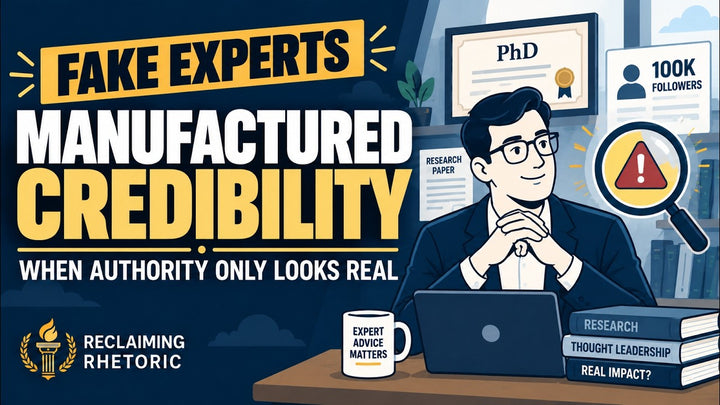
Ethos can be borrowed, bought, or faked. An actor can wear the white coat. A famous athlete can endorse a financial product. A real expert in one field can speak confidently far outside it. So the key question is not "Is this person credible?" It is "What makes this person or source credible on this specific topic?"

Foundations Series · Volume 1
An Introduction to Rhetoric
A visual guide to persuasion, argument, and influence.
Pathos persuades because emotion moves people to act
Pathos comes from a Greek word for suffering or experience. Over time it came to mean emotion, and as an appeal it names the persuasive power of making an audience feel something. Emotion matters in persuasion for a plain reason: it moves us. It turns agreement into action.
Aristotle saw this clearly: "the judgements we deliver are not the same when we are influenced by joy or sorrow, love or hate" (Rhetoric 1.2). The Roman orators built whole careers on it. Cicero was famous for emotional closing appeals, and Quintilian, the great Roman teacher of rhetoric, described the moment a judge is finally moved: "When those tears, which are the aim of most perorations, well forth from his eyes, is he not giving his verdict for all to see?" (Quintilian, Institutio Oratoria 6.2). The classical principle was simple: move the emotions and you move the audience.
Where pathos shows up today
- Animal-welfare charity ads with slow footage of shelter animals and a sad song. Guilt and compassion drive the donation.
- A political ad showing a worried parent watching a child sleep. Fear mixes with the instinct to protect.
- Athletic brand campaigns of people pushing past their limits. You are not buying shoes. You are buying the feeling of becoming better.
- Before-and-after transformation ads. Hope and desire do the work.
- A headline written to make you angry. Outrage gets shared, so outrage gets written.

That last example is measurable. A study of more than half a million social media messages about political issues found that each additional moral-emotional word in a post increased its spread by about 20 percent (Brady et al., PNAS, 2017). Emotion is not a side effect of the attention economy. It is one of its engines.
Why pathos works, and why it is not automatically manipulation
Emotions create urgency. They cut through the slow, careful part of thinking, and we remember emotional messages longer than neutral ones. That makes pathos powerful and easy to abuse.
But pathos is not automatically manipulation. Compassion is real. Caring is persuasive for good reasons. If someone tells you about real suffering, feeling something is not being tricked. It is being human. An argument about a famine that leaves you completely unmoved has arguably failed to communicate the truth.
So the question is not "Is this emotional?" It is "Is this emotion helping me see clearly and think carefully, or is it clouding my judgment and rushing me toward a decision I might regret?" Proportion is the test. Does the size of the feeling match the size of the facts?
Logos persuades through reasons that can be checked
Logos comes from the Greek word for word, reason, or account. As an appeal it names the persuasive power of a well-reasoned case: facts, data, evidence, and steps that follow from one another.
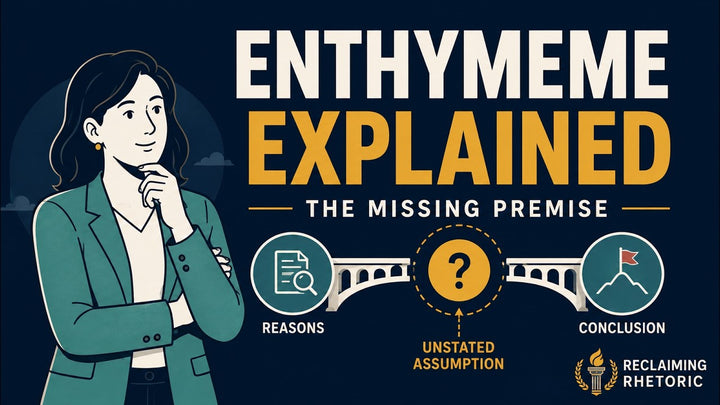
Aristotle's system is built around this kind of proof. The Stanford Encyclopedia of Philosophy summarizes the opening of the Rhetoric this way: rhetoric conceived as a counterpart of dialectic is centered on proofs, and those proofs are enthymemes, rhetorical arguments. Aristotle criticized earlier handbooks for neglecting argument and focusing instead on emotions and techniques for "speaking outside the subject." So while he called character perhaps the most effective proof, he treated reasoned argument as the backbone of the art.
In Athens, a case needed logical structure. If A is true, and B follows from A, then B must be true. The goal was to make the conclusion feel inevitable, not because of who is speaking or how anyone feels, but because it simply follows.
Where logos shows up today
- "Saves teams 10 hours a week on average." Quantified benefits feel concrete and measurable.
- Side-by-side comparison charts. Everything the competitor offers, plus more. You are making the rational choice.
- "Studies show" and "research indicates." Appeals to evidence and science.
- Step-by-step guides. A leads to B leads to C.
- A simple pros-and-cons list. Weighing the reasons on each side.
Why logos works
We want to see ourselves as rational. We want our decisions to rest on reasons, not impulses or blind trust. Logos supplies the justification. It lets us say, "I'm not being impulsive. This actually makes sense."
How logos goes wrong
Logos can mislead as easily as the other appeals. Statistics can be cherry-picked: show the data that helps and leave out the data that does not. Correlation can be presented as causation: two things happen together, so one must cause the other. And an argument can sound rigorous, full of numbers and confident steps, without being true.
Scale makes this worse. Researchers at MIT found that false stories on Twitter were 70 percent more likely to be retweeted than true ones (MIT News, 2018). Being shared is not the same as being right. The question for logos is "Does this reasoning hold up when I examine it, or does it just sound smart?"
The strongest persuasion layers all three appeals
In practice, the three appeals rarely work alone. The most effective persuasion layers them so that each covers the others' weaknesses.

Take a job interview. Your résumé is ethos: credentials, experience, proof you can do the job. Your visible enthusiasm is pathos: they can see you care about the work. The fit between your skills and the role is logos: you are the sensible choice. With all three strong, you get the offer. Missing one, the case gets weaker. A brilliant candidate who seems indifferent, or an enthusiastic one with no relevant experience, both struggle.
Or take a parent telling a child not to run into the street. Ethos: I'm your parent and I know better. Pathos: I love you and I don't want you hurt. Logos: cars are fast and you could be hit. Three appeals. One message. Maximum persuasion.
Go back to the restaurant text. If your friend had sent only the price, you might shrug. Only the emotion, and you might wonder whether they were exaggerating. Only the chef's training, and you might not care. Together, they made a case that was hard to resist.
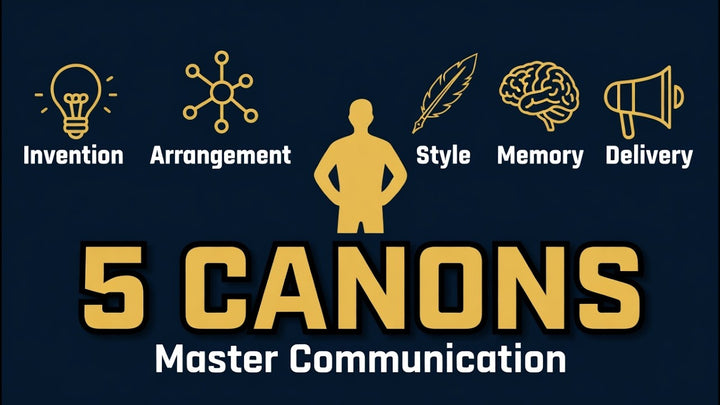
This is also why the appeals matter for your own writing. When an argument feels weak, ask which appeal is missing. A data-heavy report might need one human example. An emotional appeal might need a source. A strong argument from an unknown writer might need a sentence explaining why the writer knows the subject. Building a case this way is the work of invention, the first of the five canons of rhetoric.
Spotting the appeals turns persuasion into something you can evaluate
Next time someone tries to persuade you, in an ad, a headline, a post, or a conversation, run three quick checks:
- Are they establishing credibility? That is ethos. Ask whether they are credible on this specific topic.
- Are they making me feel something? That is pathos. Ask whether the feeling is proportionate to the facts.
- Are they giving me reasons? That is logos. Ask whether the reasons hold up when examined.
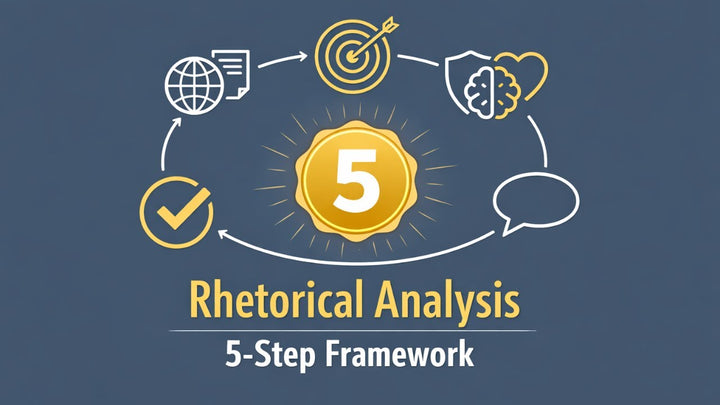
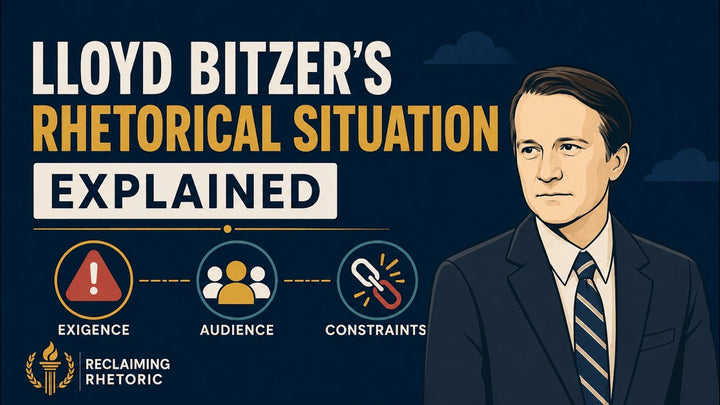
These checks are the heart of the third step in our five-step rhetorical analysis framework. The framework adds what the appeals alone cannot tell you: who the audience is, what situation prompted the message, and whether the appeals fit that situation. That last question is the subject of Lloyd Bitzer's rhetorical situation.
None of this means you should distrust every appeal. Trusting a real expert is reasonable. Being moved by a real tragedy is human. Following good evidence is the point. The goal is not to resist persuasion. It is to choose it with your eyes open. These are not tricks. They are how persuasion works, and now you can see the pattern.
For more on the series, browse all articles, take a structured course on the Courses page, or start with the illustrated introduction on the Guides page.
Foundations Series · Volume 1
An Introduction to Rhetoric
A visual guide to persuasion, argument, and influence. See how messages work.
A clear, visual introduction to the choices inside a message: credibility, emotion, reasoning, and timing, and how to tell them apart in something you have already read or watched.
Sources and further reading
- Aristotle, Rhetoric, Book 1, Chapter 2 (Perseus Digital Library, trans. J. H. Freese)
- Christof Rapp, "Aristotle's Rhetoric," Stanford Encyclopedia of Philosophy
- Purdue Online Writing Lab, "Aristotle's Rhetorical Situation"
- Quintilian, Institutio Oratoria, Book 6, Chapter 2 (LacusCurtius, trans. H. E. Butler)
- William J. Brady et al., "Emotion shapes the diffusion of moralized content in social networks," PNAS (2017)
- MIT News, "Study: On Twitter, false news travels faster than true stories" (2018)
Frequently Asked Questions
What are the three rhetorical appeals?
Ethos, pathos, and logos. Ethos persuades through the speaker's credibility and character, pathos through the audience's emotions, and logos through reasoning and evidence.
Who came up with ethos, pathos, and logos?
Aristotle described the three kinds of proof in his Rhetoric in the fourth century BCE. The Greek labels became the standard shorthand for those three proofs.
What is an example of ethos?
A doctor in a white coat recommending a medicine, "nine out of ten dentists recommend," or a writer opening with "As a teacher for twenty years..." Each asks you to trust the message because of who stands behind it.
What is an example of pathos?
A charity ad showing an animal in need, a campaign that makes you feel inspired, or a headline written to make you angry. Each works by making you feel something that pushes you toward action.
What is an example of logos?
Statistics, comparison charts, research citations, and step-by-step reasoning, such as "saves teams 10 hours a week on average."
Which appeal is the most important?
It depends on the audience and situation. Aristotle called the speaker's character perhaps the most effective proof, while building his system around reasoned argument. In practice, the strongest persuasion combines all three.
Is using pathos manipulative?
Not by itself. Emotion is manipulative when it is out of proportion to the facts or is used to rush a decision. When the emotion fits the situation, it helps the audience understand what is at stake.
How can logos be misleading?
Through cherry-picked statistics, correlation presented as causation, missing context, or reasoning that sounds rigorous but rests on a false premise.
Are there other rhetorical appeals besides these three?
Many teachers add kairos, the timing and setting of a message, and telos, its purpose. These are not appeals in the same sense, but they shape how the three appeals land.
How do I identify the appeals in a text?
Ask three questions: Where is the text building credibility? Where is it trying to make me feel something? Where is it giving reasons or evidence? Then ask whether each one holds up.
Reclaiming Rhetoric is independent and reader-supported.
If this helped, you can help keep it free.