You know what to say. You just don't know how to say it. Or you know how to say it, but you are standing there blanking on what comes next. Or worse: you nailed the content, the delivery fell flat, and no one remembers a word.
This happens because most of us think communication is one thing. It is not. It is five.
The ancient world worked out a complete system for turning an idea into a powerful speech. It is called the five canons of rhetoric: invention, arrangement, style, memory, and delivery. This article, a companion to the Reclaiming Rhetoric video on the canons, walks through each stage, shows where it appears in modern writing and speaking, and helps you find the one you are neglecting.
The five canons are stages of one process, not five separate skills
The canons were formalized by Roman teachers who inherited and extended Greek rhetorical theory. Quintilian, writing in the first century CE, put it plainly: "The art of oratory, as taught by most authorities, and those the best, consists of five parts: invention, arrangement, expression, memory, and delivery or action" (Institutio Oratoria 3.3). Expression is the older translation of what we now call style.
Think of the canons as stages. Each one builds on the last. Skip one, and your message weakens. The framework is old. The process is not. It is still the backbone of strong conference talks, campaign speeches, and every well-designed presentation you have seen, whether or not the speaker knew the names.
- Invention gives you substance: what to say.
- Arrangement gives you structure: in what order.
- Style gives you clarity and impact: in what words.
- Memory gives you ownership: how deeply you know it.
- Delivery gives you presence: how the audience experiences it.
If you are new to rhetoric as a whole, What Is Rhetoric? From Aristotle to TikTok covers the foundations. Here, the focus is on building.
Invention means discovering arguments, not making things up
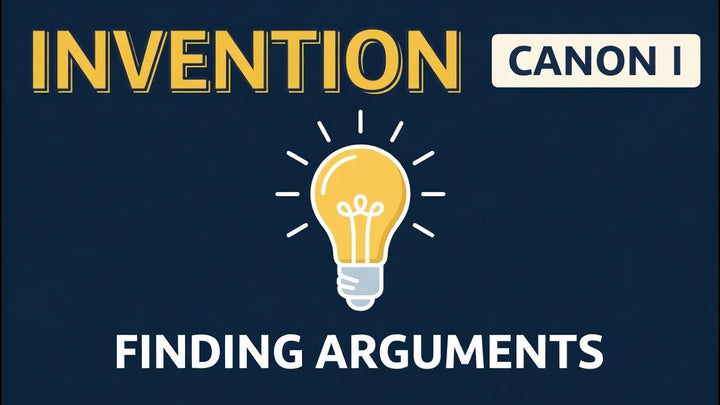
Invention is where you figure out what to say. The word can mislead. Invention does not mean inventing facts. It comes from the Latin inventio, finding. It means discovering your arguments, finding your evidence, and deciding which appeals to use.
In classical rhetoric, this was the research and brainstorming phase. You would ask three questions. What is my goal? Who is my audience? What will persuade them? Then you would decide which of the three rhetorical appeals to emphasize. Do I need credibility? Emotion? Logic? Usually all three, but in what balance?
What invention looks like today
- Outlining your ideas before drafting.
- Gathering data, examples, and quotations.
- Listing the objections a skeptical reader will raise.
- Writing one sentence that states what you actually want the audience to think or do.
Most people skip this stage. They start writing immediately, and that is why their message wanders. Invention is where you get clear. A useful test: if you cannot state your main point in one sentence, you are not ready to arrange anything yet.
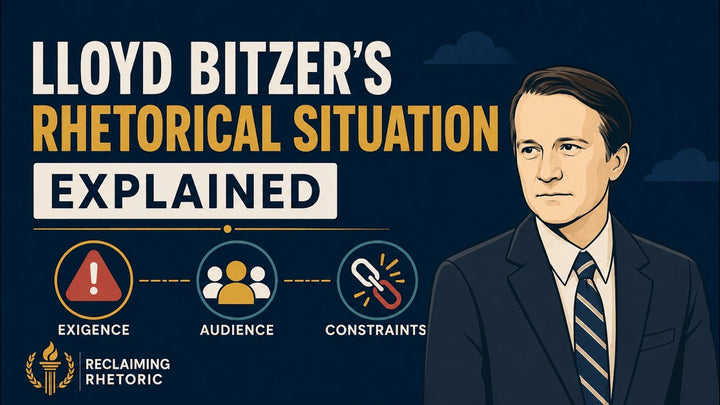
Invention also depends on the situation you are speaking into. What prompted the message, who can act on it, and what limits you face all shape which arguments are available. That is the subject of Bitzer's rhetorical situation, and it is the best place to start inventing.

Foundations Series · Volume 3
How to Build a Better Argument
A practical visual guide to claims, evidence, structure, and objections.
Arrangement decides what the audience meets first, and that changes the effect
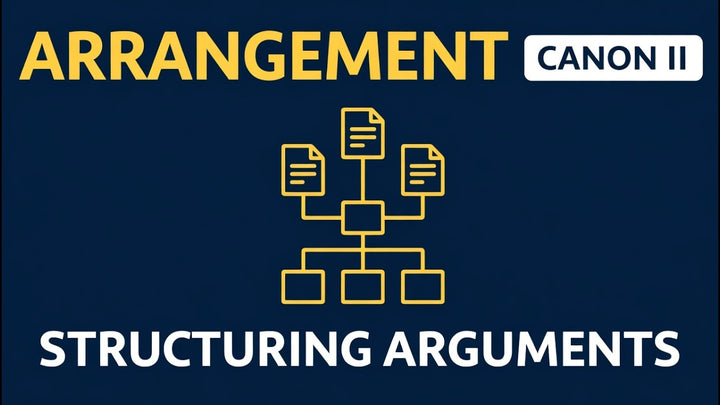
Now you know what to say. Arrangement is deciding the order. The Greeks called this taxis, the ordering of ideas for maximum impact. Classical speeches followed recognizable structures: an introduction to win attention and goodwill, a statement of the facts, the proof, a response to counterarguments, and a strong conclusion.

Here is the key insight: the same information in a different order produces a completely different effect. Lead with your weakest point, and you lose people before they hear your best argument. Bury your conclusion in the middle, and no one remembers it. Arrangement is strategic structure.
What arrangement looks like today
- The problem-solution format: name the pain, then offer the fix.
- The story-lesson-application arc: tell it, draw the point, show how to use it.
- The classic teaching pattern: tell them what you will say, say it, tell them what you said.
- A short email: lead with the point, support it, close with the ask.
Arrangement is how you guide someone through your argument so they arrive where you intended. A reader who gets lost will not blame your structure. They will just stop reading.
Style is a precision tool, not decoration
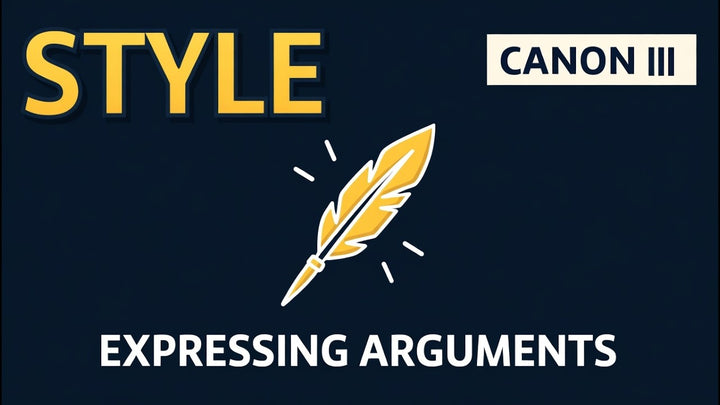
You know what to say. You know the order. Now: how do you say it? Style is word choice, tone, rhythm, and the personality of your message. Quintilian's "expression" covers all of it.
The Greeks and Romans built a whole taxonomy of rhetorical devices: metaphor, repetition, parallelism, rhetorical questions. These were not ornaments. They were tools with jobs:
- A metaphor makes an abstract idea concrete.
- Repetition makes an idea stick.
- Parallelism makes a sentence feel inevitable.
- A rhetorical question invites the audience to finish the thought themselves.
Consider "I have a dream" versus "I have a goal." Same meaning. Completely different effect. Martin Luther King Jr. built the 1963 March on Washington speech on that repeated phrase, which he had developed in earlier sermons and speeches (King Institute, Stanford). The repetition is what the world remembers.
Or take John F. Kennedy's inaugural line: "ask not what your country can do for you, ask what you can do for your country" (National Archives). That is chiasmus, a reversed structure that makes the idea feel balanced and complete.
Style shows up in small places too. "We should probably meet" and "Let's meet" carry the same information. One is tentative. One is direct. That difference is style, and it changes how the reader responds.
Here is the warning. Style without substance is noise. You still need invention and arrangement. Style is the polish, not the foundation.
Memory is internalization, and it frees you to adapt
This canon surprises people. Memory? In the ancient world, speeches were not read. They were performed, often for hours, and the speaker had to carry the whole structure in their head.
So orators developed memory techniques. Quintilian tells the famous origin story. The poet Simonides stepped out of a banquet moments before the hall collapsed, and because he "remembered the order in which the guests had been sitting," he could identify each of the dead (Institutio Oratoria 11.2). From that insight came the method of loci, often called the memory palace. Choose a familiar building, such as "a spacious house divided into a number of rooms," place each point of your speech in a different room, and walk through the building in your mind as you speak.

You may hear that the phrase "in the first place" comes from this technique, the first place in your mental palace. It is a lovely story and a good mnemonic, but treat it as folk etymology rather than settled history.
The memory palace still works
The technique is not just a classroom curiosity. A 2017 study in Neuron compared world-class memory athletes with matched controls: the athletes recalled an average of 70.8 of 72 words versus 39.9 for controls. Then ordinary participants trained in the method of loci for 30 minutes a day over 40 days. They improved significantly more than control groups, and the gains persisted four months later (Dresler et al., 2017).
Why memory matters even with notes
Even if you read from notes today, memory still matters, because memory is not only recall. It is internalization. If you know your message so deeply you could reconstruct it without notes, you are free to adapt, to respond to questions, and to be present with your audience instead of glued to your script.
Memory is what separates someone reading slides from someone communicating. It looks like preparation: rehearsing until the structure feels natural, and knowing your key points so well you can improvise around them. It is the difference between "I need to check my notes" and "let me tell you."
Delivery decides how the audience experiences every other choice
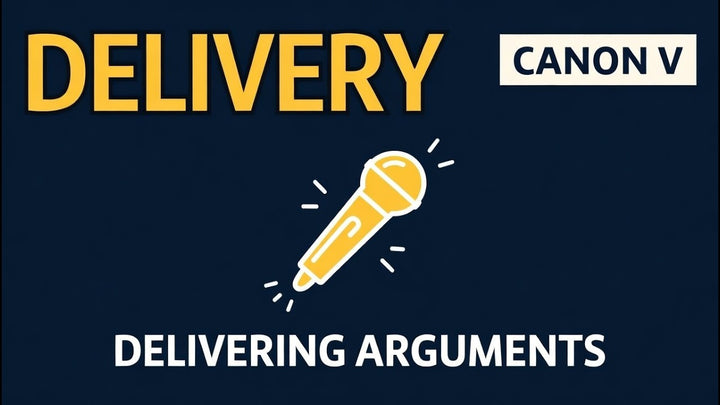
You have figured out what to say, how to structure it, how to phrase it, and you have internalized it. Now comes the moment of truth: saying it. Delivery is everything that happens when you open your mouth. Your voice. Your pacing. Your gestures. Your eye contact.
Aristotle saw its weight early. In Book 3 of the Rhetoric he calls delivery a subject "of the greatest importance" that had "not yet been treated of by anyone" (Rhetoric 3.1). Quintilian treated delivery and action as one canon for the same reason: communication is physical.
The same words delivered differently produce completely different results. "I'm fine" said with a smile? You are fine. "I'm fine" said through clenched teeth? You are not fine. Delivery is how your audience experiences your message.
Delivery on the page and on screen
Delivery matters even in writing. A wall of text versus a message broken into clear paragraphs with headings is a delivery choice. It is how the reader experiences your words on the page. In a presentation, delivery is your tone, your body language, and whether you look at the audience or at your slides. In a video, it is pacing, visuals, and how you guide attention.

A useful way to think about it: delivery is the final 20 percent that makes or breaks the other 80. It cannot rescue an empty argument. It can sink a good one.
Running one small message through all five canons shows how they connect
The canons can sound grand, as if they belong only to inaugural addresses. They work just as well on a short request. Imagine you want to ask your team lead to move a weekly status meeting from Monday morning to Tuesday afternoon.
Invention. Start with the goal and the audience. Your lead cares about the project staying on schedule and about the team not resenting another change. What will persuade them? Evidence that Monday meetings start before anyone has updates, a sense that the change costs little, and the credibility of having talked to the team first. Now you have reasons, not just a preference.
Arrangement. Decide the order. Lead with the request in one sentence, so your lead knows what is being asked. Follow with the strongest reason. Address the obvious objection, that changing meetings is disruptive. Close with a specific, easy next step.
Style. Choose plain, direct words. "Could we move the status meeting to Tuesday at 2?" works better than "I was wondering if it might possibly make sense to think about maybe revisiting the timing." One sounds like a plan. The other sounds like an apology.
Memory. If you raise this in person, know your two reasons cold. When your lead asks a follow-up question, you can answer it instead of scrolling back through your notes.
Delivery. In writing, keep it to a few short paragraphs with the request on the first line. In person, pick a calm moment, not the middle of a deadline. The same request lands differently at 9 a.m. on a crisis day than at 3 p.m. on a quiet one.
Five stages, a few minutes of thought, and a message that is far more likely to get a yes. That is the point of the canons. They are not ceremony. They are a checklist that turns good intentions into effective communication.
Most weak communication comes from one neglected canon
Most people focus on one or two canons and wonder why their communication falls flat. They spend hours on style, polishing every word, but skipped invention, so the argument is thin. Or they have brilliant ideas and poor delivery, so no one pays attention. Or they arrange everything beautifully but never internalized it, so they read robotically.
The five canons work as a system. Miss one, and you weaken the whole message. So ask yourself which canon you are neglecting:
- Invention: Are you winging it instead of finding your best arguments?
- Arrangement: Are you hoping people will follow scattered thoughts?
- Style: Are you using flat, forgettable language when a precise phrase would stick?
- Memory: Are you reading word for word because you never internalized the material?
- Delivery: Is great content arriving through a poor presentation?
Most of us have a weak link. The canons show you where it is. They also work in reverse: when you analyze someone else's argument, the canons give you a checklist for what they did well and where they cut corners.
Communication is not magic. It is a process, and the same process that built the great speeches of history still works. Whether you are writing an email, giving a presentation, recording a video, or making your point in a conversation, you are already using the five canons. The only question is whether you use them deliberately.
To keep going, browse all articles, explore structured lessons on the Courses page, or see the illustrated guides on the Guides page.
Foundations Series · Volume 3
How to Build a Better Argument
A practical visual guide to claims, evidence, structure, and objections. Opinion in. Case out.
Move from an initial opinion to a clear, well-supported case that can withstand fair scrutiny. Gather evidence that tests the claim, then treat serious objections fairly.
Sources and further reading
- Quintilian, Institutio Oratoria, Book 3, Chapter 3 (LacusCurtius, trans. H. E. Butler)
- Quintilian, Institutio Oratoria, Book 11, Chapter 2, on memory (LacusCurtius, trans. H. E. Butler)
- Aristotle, Rhetoric, Book 3, Chapter 1 (Perseus Digital Library, trans. J. H. Freese)
- Martin Dresler et al., "Mnemonic Training Reshapes Brain Networks to Support Superior Memory," Neuron (2017)
- National Archives, President John F. Kennedy's Inaugural Address (1961)
- Martin Luther King, Jr. Research and Education Institute, "I Have a Dream"
Frequently Asked Questions
What are the five canons of rhetoric?
Invention, arrangement, style, memory, and delivery. Together they describe the full process of creating and presenting a persuasive message, from finding arguments to performing them.
Who created the five canons of rhetoric?
They grew out of Greek rhetorical theory and were formalized by Roman teachers. Cicero and the anonymous Rhetorica ad Herennium describe them, and Quintilian called them the five parts of the art of oratory.
What is invention in rhetoric?
Invention is discovering what to say: your purpose, your audience, your arguments, your evidence, and which appeals to emphasize. It means finding, not making things up.
What is arrangement in rhetoric?
Arrangement is the order of your ideas. The Greeks called it taxis. The same content in a different order produces a different effect, so structure is a persuasive choice.
What is style in rhetoric?
Style is how you phrase the message: word choice, tone, rhythm, and devices such as metaphor, repetition, parallelism, and chiasmus.
What is the memory canon, and does it still matter?
Memory originally meant memorizing a speech, often with the method of loci. Today it means internalizing your material so you can adapt and stay present with your audience instead of reading.
What is the memory palace technique?
You picture a familiar building and place each point you want to remember in a different room, then walk through it mentally. Research on memory athletes shows the method can greatly improve recall.
What is delivery in rhetoric?
Delivery is how the message reaches the audience: voice, pacing, gesture, eye contact, and, in writing, layout and formatting.
Do the five canons apply to writing as well as speaking?
Yes. Writers invent, arrange, and style their work, internalize it through revision, and deliver it through formatting, headings, and design.
Which canon is most important?
None works alone. Weak invention leaves you with nothing to say, and weak delivery means no one hears it. Most problems come from the one canon a person neglects.
Reclaiming Rhetoric is independent and reader-supported.
If this helped, you can help keep it free.