You can have a great idea, strong evidence, and clear reasoning, and still lose the room. If the message is poorly organized, people will not follow it. They get lost, they lose interest, or they miss the point entirely.
Persuasion is not only about what you say. It is also about how the message unfolds: the order, the progression, the structure. Classical rhetoric called that structure arrangement, and it is the second of the five canons of rhetoric.
This article, a companion to the Reclaiming Rhetoric video on the second canon, explains the classical six-part speech, why order changes meaning, how structure can be used to mislead, and how to arrange your own messages on purpose.
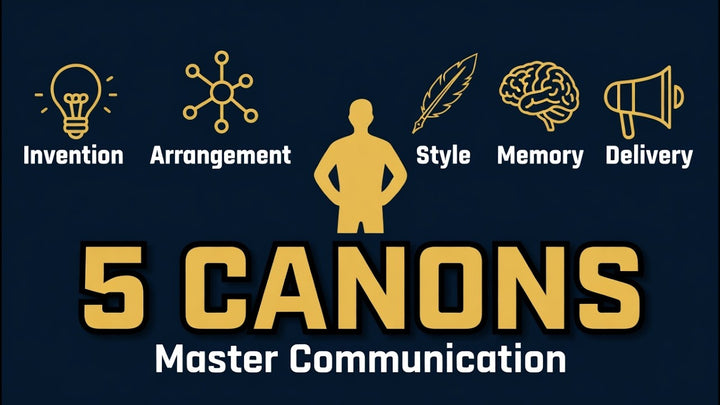
The five canons series: 1. Invention · 2. Arrangement (you are here) · 3. Style · 4. Memory · 5. Delivery. For the overview of all five in one place, start with The Five Canons of Rhetoric.
Arrangement is the architecture of persuasion
Once an argument has been discovered through invention, it still has to be organized. Ideas must go in the right order. Evidence must appear at the right moment. The whole message has to lead the audience from beginning to end without losing them.

The Greeks called this taxis, and the Romans dispositio. The Rhetorica ad Herennium, a Roman handbook from the first century BCE, defines it as "the ordering and distribution of the matter, making clear the place to which each thing is to be assigned" (Ad Herennium 1.3).
Greek and Roman speakers understood something we often forget: the same information can produce completely different results depending on the order in which it appears. Open with confusion and the audience disconnects. Reveal your strongest point too early and the rest feels like repetition. Bury your conclusion in the middle and no one remembers it.

Foundations Series · Volume 3
How to Build a Better Argument
A practical visual guide to claims, evidence, structure, and objections.
The classical speech had six parts, each with a job
Roman teachers settled on a standard structure for a persuasive speech. The Ad Herennium lists it plainly: "the Introduction, Statement of Facts, Division, Proof, Refutation, and Conclusion" (Ad Herennium 1.4). Here is what each part does, with the Latin names you will see in textbooks.

1. Introduction (exordium): win attention and goodwill
The introduction captures attention, establishes the topic, and prepares the audience to listen. The Ad Herennium says that by it "the hearer's mind is prepared for attention." Before persuasion can begin, attention has to be secured, and a listener who distrusts you will not hear the rest.
2. Statement of facts (narratio): explain the situation
Next comes background. What happened? What is the context? What problem exists? This section orients the audience. Without it, they struggle to understand why the argument matters at all.
3. Division (divisio or partitio): preview the road
The division previews the argument: which points will be made and which issues addressed. It works like a road map. People follow arguments far more easily when they know where the path is going.
4. Proof (confirmatio): make the case
This is the heart of the speech, where evidence appears, examples are presented, and reasoning is developed. Its impact depends on placement. Strong evidence builds momentum. Weak evidence placed carelessly breaks it.
5. Refutation (refutatio): answer the other side
Here the speaker addresses opposing views: counterarguments, objections, and alternative interpretations. Ignoring opposition rarely convinces anyone. Responding to it shows confidence and intellectual honesty, and it raises credibility.
6. Conclusion (peroratio): leave them with the point
Finally, the message crystallizes. The speaker summarizes the argument, reinforces the main idea, and leaves the audience with something memorable. Roman conclusions often also made a final emotional appeal, saving the strongest emphasis for the end, because the last moments shape what people remember.
If you have read our guide to rhetorical analysis, you will notice these parts are also useful for taking someone else's speech apart: find where the introduction ends, where the proof begins, and whether the refutation is real or a straw man.
The handbook's advice on ordering your proofs
The Roman handbooks did not stop at the six parts. They also gave advice on how to order the arguments inside the proof. The Ad Herennium recommends placing "the strongest arguments" at the beginning and at the end, and putting arguments of medium force in the middle, where weaker points that would not stand alone can support one another (Ad Herennium 3.10.18).
Its reasons are practical. Right after the facts are stated, the listener is waiting to see whether the case can be proved at all, so a strong argument should come immediately. And because "what has been said last is easily committed to memory," the speaker should finish by leaving a very strong argument fresh in the listener's mind. The handbook compares this to arranging soldiers for battle, and the later teacher Quintilian connected it to Homer's description of Nestor placing his weakest troops in the middle of the line, which is why it is sometimes called the Homeric or Nestorian order.
The six-part plan was a model, not a law
It is worth knowing that even the ancients disagreed about how many parts a speech needs. Aristotle, writing centuries before the Roman handbooks, was blunt: "A speech has two parts. It is necessary to state the subject, and then to prove it" (Rhetoric 3.13). Everything else, in his view, was optional and depended on the situation.
The Ad Herennium itself makes room for flexibility. It describes two kinds of arrangement: one that follows the principles of the art, meaning the standard six parts, and one "accommodated to particular circumstances," where the speaker reorders, shortens, or drops parts because the situation demands it (Ad Herennium 3.9.16–17). If the audience is already exhausted by the other side's case, for instance, it may be wiser to skip the introduction and begin with a strong argument.
That is the right way to treat the classical structure today. It is not rigid. Modern communication uses many variations of the same principle:
- Problem, then solution. Name the pain, then offer the fix.
- Story, then lesson. Tell it, then draw the point.
- Question, then answer. Raise the puzzle, then resolve it.
- Cause, then consequence. Show what happened, then what follows from it.
Even a simple work email usually has a structure: opening context, the key point, supporting detail, and a clear request. Different forms, same principle. Order shapes understanding.
Written messages often put the point first
Speech and writing reward slightly different arrangements. A listener in a room usually hears the whole speech, so a speaker can build toward a strong close. A reader skims, gets interrupted, and may stop after the first few lines. That is why news writing developed the inverted pyramid, putting the most important facts at the top and the background lower down, and why many workplaces teach people to write the bottom line up front.
This is not a break with classical arrangement but an application of it. The question has always been what this particular audience needs first. A busy reader needs the request in the opening sentence. A skeptical committee may need the facts before it will accept any request at all. Arrangement is a decision about the audience, not a template.
Why order changes what people understand and remember
Arrangement works because we take in spoken and written arguments one piece at a time. Each new point is interpreted in light of what came before. When the structure is clear, following the argument feels effortless. When it is chaotic, understanding collapses, and the audience starts spending its attention on figuring out where you are instead of what you mean.
Memory research points the same way. In list-learning experiments, people tend to recall items from the beginning and end of a sequence better than items in the middle, a pattern psychologists call the serial position effect. A speech is not a word list, and the effect does not dictate any single structure, but it helps explain an old piece of rhetorical advice: do not bury what matters most in the middle.
Structure can also mislead, often invisibly
Because order influences interpretation, arrangement is powerful, and that power can be abused. Important information can be delayed until attention has faded. Weak points can be tucked between strong ones. Evidence can be buried. A misleading claim can appear first, with the context that undercuts it arriving later, after the first impression has set.
You can see arrangement working quietly all around you:
- Headlines frame the whole story before you read a single paragraph, and many readers never get past them.
- Political speeches use the opening to define the narrative that everything else must fit.
- Advertising shows the problem first, so the product can arrive as the solution.
- Terms and conditions put the cost or the catch far from the headline offer.
None of these tactics require a false statement. They work by sequence alone. That is why noticing arrangement is part of reading critically, not just part of writing well.
Arranging a short proposal on purpose
Suppose you are writing to your manager to propose that your team try no-meeting Wednesday afternoons for one month. A scattered version mentions the idea in the third paragraph, after a long complaint about calendars. Here is an intentional arrangement, mapped loosely onto the classical parts:

- Introduction: one sentence that states the request and signals it is low-risk: a one-month trial.
- Statement of facts: the situation in two lines, for example that the team averaged a certain number of meeting hours last week and that focused work keeps slipping to evenings.
- Division: "Three reasons, and one concern I have already thought about."
- Proof: the three reasons, strongest last.
- Refutation: the obvious objection (urgent issues will wait) and your answer (an exceptions rule for anything time-critical).
- Conclusion: the specific ask, a start date, and how you will report back.
Same content as the scattered version. Very different chance of a yes. Once the order is set, style decides how each sentence sounds.
Weak arrangement and strong arrangement look very different
Weak arrangement looks like scattered ideas, repeated points, evidence appearing at random, and arguments that circle without direction. Strong arrangement looks different: a clear beginning, logical progression, purposeful emphasis, and a path the audience can follow.
Before you finalize any message, ask yourself:
- What must the audience understand first?
- What evidence should appear early, and what should build to the end?
- Which objections must be addressed, and where?
- What one idea should they remember most, and is it in a place they will remember?
Good arguments fail when they are badly arranged. Structure your message intentionally.
A diagnostic for reading the structure of any message
When you meet a persuasive message, ask:
- What appears first?
- What appears last?
- What is emphasized?
- What is delayed?
- What is omitted?
These questions reveal the architecture behind the argument, and once you see that architecture, you begin to understand how persuasion is built. Invention finds the argument. Arrangement shapes how it unfolds, turning ideas into structure, structure into understanding, and understanding into persuasion. Once you see it, you cannot unsee it.
The five canons series: 1. Invention · 2. Arrangement (you are here) · 3. Style · 4. Memory · 5. Delivery. For the overview of all five in one place, start with The Five Canons of Rhetoric.
To keep going, browse all articles, explore structured lessons on the Courses page, or see the illustrated guides on the Guides page.
Foundations Series · Volume 3
How to Build a Better Argument
A practical visual guide to claims, evidence, structure, and objections. Opinion in. Case out.
Move from an initial opinion to a clear, well-supported case that can withstand fair scrutiny. Gather evidence that tests the claim, then treat serious objections fairly.
Sources and further reading
- Rhetorica ad Herennium, Book 1 (LacusCurtius, trans. H. Caplan)
- Rhetorica ad Herennium, Book 3 (LacusCurtius, trans. H. Caplan)
- Aristotle, Rhetoric, Book 3, Chapter 13 (Perseus Digital Library, trans. J. H. Freese)
- Quintilian, Institutio Oratoria, Book 3, Chapter 3 (LacusCurtius, trans. H. E. Butler)
- Reclaiming Rhetoric, The Five Canons of Rhetoric: How to Build a Better Message
- Reclaiming Rhetoric, How to Do a Rhetorical Analysis
Frequently Asked Questions
What is arrangement in rhetoric?
Arrangement is the second canon of rhetoric: deciding the order and structure of a message. The Greeks called it taxis and the Romans dispositio.
What are the six parts of a classical speech?
Introduction (exordium), statement of facts (narratio), division (divisio or partitio), proof (confirmatio), refutation (refutatio), and conclusion (peroratio), as listed in the Rhetorica ad Herennium.
Did every ancient rhetorician use six parts?
No. Aristotle said a speech really has two essential parts: stating the case and proving it. Other parts were added or dropped depending on the situation.
Why does the order of an argument matter?
Each point is interpreted in light of what came before, and people tend to remember beginnings and endings best. The same content in a different order can produce a very different effect.
Can arrangement be manipulative?
Yes. Delaying key information, burying weak evidence, or leading with a misleading claim can shape interpretation without any false statement. Noticing order is part of critical reading.
What modern structures come from arrangement?
Problem-solution, story-lesson, question-answer, and cause-consequence are all arrangement patterns. So is the common email structure of context, point, detail, and request.
Where should my strongest point go?
Usually not buried in the middle. Many speakers open with a clear statement of the claim and save the strongest proof or the most memorable line for the end.
How do I practice arrangement?
Write each main point on a separate card, then try different orders and ask which version a skeptical reader would follow most easily and remember best.
Reclaiming Rhetoric is independent and reader-supported.
If this helped, you can help keep it free.