Most people think persuasion begins when you start speaking. The words come out, the argument is delivered, and the audience reacts. But persuasion actually starts much earlier: before the speech, before the slide deck, before the first sentence is written.
It starts with a question. What should I say?
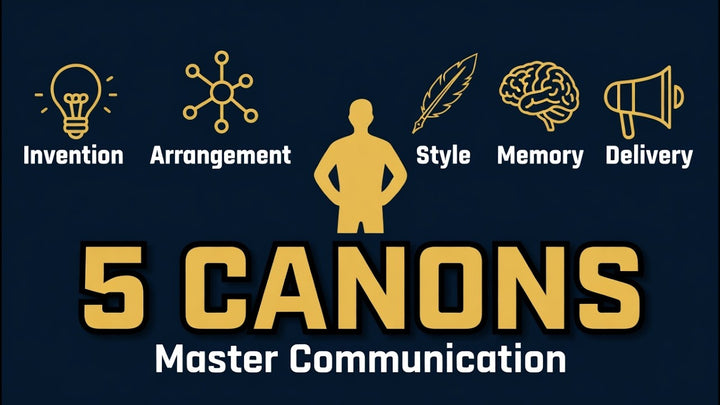
That moment has a name. Classical rhetoric called it invention, and it is the first of the five canons of rhetoric. This article, a companion to the Reclaiming Rhetoric video on the first canon, explains what invention is, how it works in practice, and how to spot when an argument skipped it.
The five canons series: 1. Invention (you are here) · 2. Arrangement · 3. Style · 4. Memory · 5. Delivery. For the overview of all five in one place, start with The Five Canons of Rhetoric.
Invention means finding arguments, not making them up
The word misleads modern readers. Invention comes from the Latin inventio, from the verb invenire, "to come upon" or "to find." In rhetoric it never meant fabricating facts. It meant discovering material: the arguments, evidence, and appeals that already exist in a situation but have not yet been gathered and put to work.
The ancient handbooks are clear about this. The Rhetorica ad Herennium, a Roman textbook from the first century BCE whose author is unknown, lists the five faculties a speaker needs and then defines the first: "Invention is the devising of matter, true or plausible, that would make the case convincing" (Ad Herennium 1.3).
Aristotle framed the whole art the same way. "Rhetoric then may be defined," he wrote, "as the faculty of discovering the possible means of persuasion in reference to any subject whatever" (Rhetoric 1.2). You will often see that phrase translated as "the available means of persuasion." Either way, the key word is discovering. Rhetoric, in Aristotle's view, starts as a search.
Cicero thought the stage important enough that one of his earliest works on rhetoric is simply titled De Inventione, "On Invention."
Think like a lawyer preparing a case

Picture a lawyer the week before trial. They do not walk into court and improvise. They investigate. They gather facts, examine evidence, interview witnesses, and anticipate what the other side will say. They look for the arguments that will hold up under scrutiny and set aside the ones that will not.
That is invention. Before persuasion can happen, the material of persuasion has to be found. It is no accident that so much classical rhetoric grew out of courtrooms: a speaker who had not done this work was exposed the moment the opposing side stood up.

Foundations Series · Volume 3
How to Build a Better Argument
A practical visual guide to claims, evidence, structure, and objections.
Invention works through four kinds of discovery
The video breaks invention into four moves. They are not strict steps, and in practice you cycle through them more than once, but together they describe what discovery actually involves.

1. Questions reveal the rhetorical terrain
Good invention begins with curiosity. What problem am I addressing? Who is the audience? What do they already care about? What assumptions do they hold? What evidence is available?
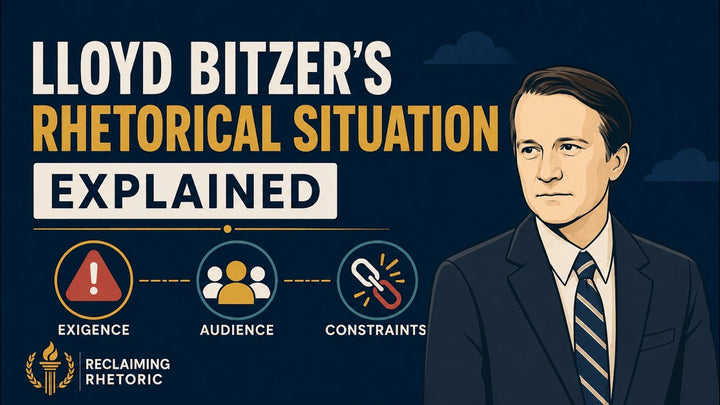
These questions map the ground before you build on it. Without them, arguments wander. With them, persuasion gains direction. The first three are essentially the elements of Bitzer's rhetorical situation: the exigence that calls for a response, the audience who can act, and the constraints that limit what you can say.
2. Evidence supplies the raw material
Invention gathers support: facts, examples, testimony, data, historical precedent, and personal experience. Each carries persuasive potential, but not every kind works for every audience. A room of engineers may want numbers. A town meeting may respond more to a neighbor's story. The challenge is not just collecting evidence but selecting the evidence that fits this situation.
3. Perspectives expose what critics will say
Strong arguments consider more than one angle. What would a skeptic say? Where is my case weakest? What counterarguments exist? Anticipating opposition strengthens persuasion, because acknowledging competing views shows intellectual honesty, and that raises your credibility. An objection you have already answered cannot ambush you.
4. Appeals decide the balance of credibility, emotion, and reason
During invention you also decide which persuasive forces to emphasize: ethos, pathos, and logos. Almost every argument mixes all three, but the balance matters. Some audiences want data. Some want reassurance. Some want inspiration. Invention is where you choose which appeal will carry the message.
The ancients built tools to make discovery systematic
Classical teachers did not leave invention to inspiration. They built methods for it.
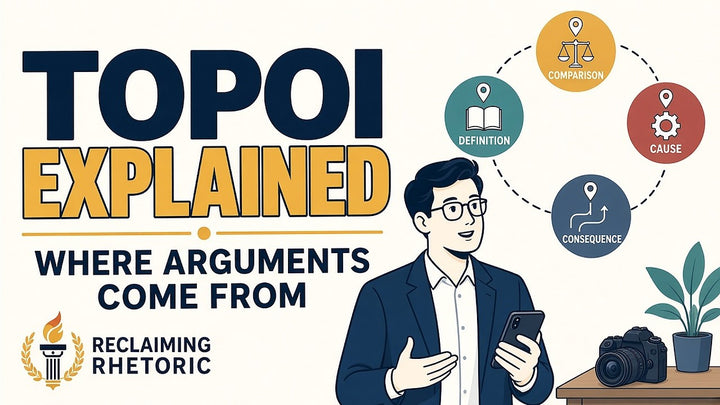
The best known are the topics, from the Greek topoi, literally "places." A topic is a place to go looking for an argument: definition (what is it?), comparison (what is it like or unlike?), cause and effect (what produced it, and what will it produce?), and degree (is it more or less than something else?). Aristotle catalogued many of these, and later teachers turned them into checklists a student could run through when stuck.
Another tool was stasis theory, developed by later Greek teachers, most famously Hermagoras of Temnos in the second century BCE. Stasis asks where a disagreement actually sits: is it about the facts, about how to define them, about how serious they are, or about whether this is the right place to decide? Finding the real point of dispute tells you which arguments are worth building.
Both tools share an assumption worth keeping: arguments are found by asking structured questions, not by waiting for a flash of insight.
Some proof is found, and some proof is built
Aristotle drew a further distinction that sharpens what invention is for. Some means of persuasion, he said, are not supplied by the speaker at all but exist before the speech begins: witnesses, written contracts, sworn testimony, and similar documents. Others the speaker has to construct through the art itself (Rhetoric 1.2). Later writers call these inartistic and artistic proofs.
Invention handles both, but differently. Inartistic proof has to be located, checked, and selected: the contract exists, but you still have to find it, read it closely, and decide which clause matters. Artistic proof has to be made: the reasoning that connects that clause to your conclusion, the way you establish your own credibility, and the emotional frame that helps an audience see why it matters. Aristotle's three artistic proofs are exactly the ethos, pathos, and logos that the fourth move of invention balances.
The distinction is useful today because people often confuse the two. A spreadsheet, a quotation, or a screenshot is inartistic proof. It does not argue anything by itself. Someone still has to explain what it shows, why it is reliable, and why it bears on this decision. When an argument consists of a pasted chart and nothing else, the inventing has not been done yet.
Most weak communication fails at invention
Here is why this stage matters so much. People rush to expression. They start writing immediately. They begin speaking before they have finished thinking. The result is predictable: scattered arguments, thin evidence, and ideas that feel unfinished, because the discovery stage was skipped.
Strong communicators do the opposite. They pause, explore, and ask questions before asserting answers. They look for a better idea before committing to the first one. Invention slows the process down, but it strengthens the result. Good arguments are rarely the first arguments. They are the refined ones.
Invention exposes flaws before the audience does
There is another benefit. Discovery reveals the limits of your own case. While gathering material you may find the evidence is weaker than you expected, an assumption is shaky, or a competing explanation fits the facts just as well.
That is not failure. It is clarity. You can narrow your claim, find better support, or change your mind. Either way, you find the problem before a listener does, and that makes your persuasion more honest as well as more effective.
Invention matters more in an age of information overload
It might seem that invention is easier now. Information is everywhere. Data is abundant. Opinions multiply faster than anyone can check them.
But that abundance changes the job rather than removing it. The ancient challenge was finding enough material. The modern challenge is selecting what matters: separating signal from noise, telling evidence from assertion, and discovering which arguments are actually worth making. Search results are not invention. Judgment about them is.
That judgment can be practiced. For any piece of material you are tempted to use, ask three quick questions: Who is the source, and how would they know? Is this a claim, or evidence for a claim? And what would I expect to see if this were false? Material that survives those questions is worth carrying forward into the argument. Material that does not is noise, however often it has been shared.
Running a small proposal through invention
Suppose you want your city council to add a marked crosswalk near a neighborhood park. Here is what invention looks like before you write a word of your public comment.

- Questions. What exactly is the problem: speed, visibility, or the distance to the nearest crossing? Who decides: the full council, a traffic committee, or city staff? What do they care about: safety, budget, liability, neighborhood complaints?
- Evidence. Count how many people cross at that spot on a Saturday morning. Note the distance to the nearest signal. Collect a few short statements from parents and older residents. Check whether the city has a pedestrian safety plan you can cite.
- Perspectives. The obvious objections are cost and the claim that crosswalks alone do not slow drivers. Find out what a basic crosswalk costs and whether signage or a curb extension could address the second point.
- Appeals. For a council, lead with logos (counts and costs) and ethos (neighbors who have organized and done the homework), with pathos used sparingly through one concrete story.
Only now are you ready to decide the order, which is the work of arrangement, and the wording, which is the work of style.
Weak invention and strong invention look very different
Weak invention looks like talking points without evidence, claims without support, and arguments built on slogans. Strong invention looks like this:
- A clear claim you can state in one sentence.
- Evidence chosen because it fits the audience, not just because it was easy to find.
- Objections anticipated and answered.
- Assumptions you have noticed and can defend.
- Ideas that have been tested before they are presented.
Before you try to persuade anyone, ask yourself: What exactly am I arguing? Why does it matter? What evidence supports it? What objections exist? What assumptions am I relying on? If those answers are unclear, the argument is not ready yet.
A diagnostic for spotting invention in someone else's argument
Invention is also a powerful lens for analyzing other people's arguments. When you meet a persuasive message, ask:
- What question is this argument responding to?
- What evidence was selected?
- What evidence was ignored?
- What alternatives were considered, if any?
- What assumptions shape the conclusion?
These questions reveal the invention process behind an argument, or the absence of one. A message that cannot survive them was probably assembled, not discovered.
Persuasion does not begin with speaking. It begins with searching, with asking better questions before offering answers. Invention is the starting point of every strong message, and once you see it, you cannot unsee it.
The five canons series: 1. Invention (you are here) · 2. Arrangement · 3. Style · 4. Memory · 5. Delivery. For the overview of all five in one place, start with The Five Canons of Rhetoric.
To keep going, browse all articles, explore structured lessons on the Courses page, or see the illustrated guides on the Guides page.
Foundations Series · Volume 3
How to Build a Better Argument
A practical visual guide to claims, evidence, structure, and objections. Opinion in. Case out.
Move from an initial opinion to a clear, well-supported case that can withstand fair scrutiny. Gather evidence that tests the claim, then treat serious objections fairly.
Sources and further reading
- Rhetorica ad Herennium, Book 1 (LacusCurtius, trans. H. Caplan)
- Aristotle, Rhetoric, Book 1, Chapter 2 (Perseus Digital Library, trans. J. H. Freese)
- Quintilian, Institutio Oratoria, Book 3, Chapter 3 (LacusCurtius, trans. H. E. Butler)
- Reclaiming Rhetoric, The Five Canons of Rhetoric: How to Build a Better Message
- Reclaiming Rhetoric, The Rhetorical Situation: Exigence, Audience, and Constraints
Frequently Asked Questions
What is invention in rhetoric?
Invention is the first of the five canons of rhetoric: the process of discovering what to say. It covers finding arguments, gathering evidence, anticipating objections, and choosing which appeals to emphasize.
Does invention mean making things up?
No. The Latin inventio comes from invenire, "to find." Rhetorical invention means discovering material that fits the situation, not fabricating it.
How did Aristotle describe invention?
He defined rhetoric itself as the faculty of discovering the possible, or available, means of persuasion in any case. That act of discovery is what later teachers called invention.
What are the topics, or topoi?
Topoi, Greek for "places," are standard lines of inquiry for finding arguments, such as definition, comparison, cause and effect, and degree. They turn invention into a set of questions you can ask.
What is stasis theory?
A method, associated with Hermagoras of Temnos, for locating the real point of disagreement: fact, definition, quality, or jurisdiction. Knowing where the dispute sits tells you which arguments to build.
Why do so many arguments fail at invention?
Because people start writing or speaking before they have discovered their best material. The result is thin evidence, unanswered objections, and claims that wander.
How is invention different from research?
Research collects information. Invention also selects and shapes it for a particular audience and purpose, deciding which evidence, objections, and appeals matter here.
How can I practice invention?
Before drafting, write your claim in one sentence, list the audience's concerns, gather two or three kinds of evidence, write down the strongest objection, and decide which appeal should lead.
Reclaiming Rhetoric is independent and reader-supported.
If this helped, you can help keep it free.