Imagine someone getting ready to speak at a photography club meeting. Their proposal is simple: We should let people enter photos taken on phones.
Why? “Because I think it's a good idea.” Why is it a good idea? “Because there's no reason not to.”
They have a position. They do not yet have much of an argument. But there are other directions they could explore. What is the competition actually designed to test? How are different kinds of cameras already treated? What problem would changing the rules solve? And what consequences might follow?
You may not need a more forceful version of your opinion. You may need a different place to look for a reason. And notice that looking in those places won't necessarily help the proposal. A good method should be able to strengthen it, weaken it, or revise it.
This article, a companion to the Reclaiming Rhetoric video, looks at topoi: the places rhetoricians look when they need to discover what can be argued.

Foundations Series · Volume 3
How to Build a Better Argument
A practical visual guide to claims, evidence, structure, and objections.
What is a topos?
A quick bit of vocabulary. One is a topos; more than one are topoi. The word is Greek for “place,” and the spatial metaphor matters. A topos is a rhetorical place where you can search for material that might be useful in an argument.
That is different from the subject itself. Here, the topic in the everyday sense is smartphone photography. A topos might be comparison: what relevant similarities and differences connect this case to others? The subject is what you are arguing about. The topos is where you go looking for reasons.
Cicero's Topica treats topics as the seats or places from which arguments can be found, and it draws on a classical distinction between two parts of careful reasoning: discovering arguments and judging them. Finding a possible line of reasoning is one job. Deciding whether it holds up is another. That distinction will organize everything that follows.
A topos does not tell you what to believe. It gives you a productive way to examine the question.
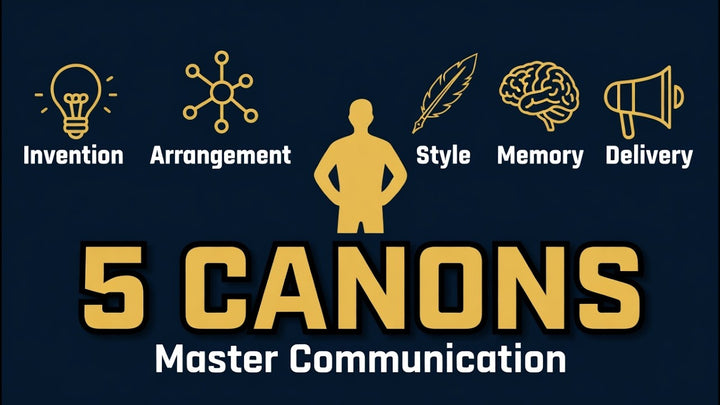
One more clarification. In rhetoric, invention means discovering and developing possible arguments. It does not mean inventing facts.

Four places to look
Let's try four accessible places to look at the same proposal. This isn't the one official classical list (Aristotle alone offers dozens of lines of argument in Rhetoric II.23). It's a working set.
1. Definition: what kind of activity is this?
Ask: what is this competition supposed to evaluate? Suppose the club says it judges composition, visual storytelling, timing, and image quality. Then the speaker might argue: If we are judging the resulting photograph, we need a reason why the device alone should disqualify it.
But imagine instead that the competition explicitly exists to test mastery of a specific class of camera. Now the definition might support the restriction. That is the point. The topos does not automatically favor one side. Definition helps connect the purpose of the activity to the proposed rule. Merely calling something “photography” does not settle whether it is eligible.
2. Comparison: what is relevantly similar or different?
Suppose the club already allows DSLRs, mirrorless cameras, film, different lenses, and different sensor formats. So ask: Which equipment differences have we already accepted, and why is this one decisive?
That might generate a consistency argument: if equipment differences are already allowed, we should explain why this particular difference changes eligibility. But perhaps smartphones involve automated processing that the club believes materially changes the exercise. Then the comparison exposes a potentially relevant difference. The important word is relevant. Similarity somewhere does not imply identical treatment everywhere.
3. Cause: what problem is the rule supposed to address?
Supporters of the change may say the existing rule discourages newcomers. Now investigate that causal claim. Is equipment actually the barrier? Or is it judging anxiety, inconvenient meeting times, lack of instruction, membership fees, or uncertainty about skill?
The possible argument is: if the equipment requirement is keeping interested people from participating, changing it may address the barrier. Crucially, the topos tells us what evidence we now need. It does not establish the cause merely because that cause would be rhetorically useful.
4. Consequences: what would follow?
Imagine the rule changes. Possible benefits include more entrants, greater accessibility, and different creative styles. Possible complications include judging criteria that need revision, members who disagree about computational processing, and a dramatic jump in entries.
These are possibilities to investigate. They are not facts simply because the speaker can imagine them. Aristotle explicitly includes arguments from consequences among the reusable lines of argument available to a speaker (Rhetoric II.23).
The position has not become better merely because we found more things to say. It has become more testable, because we found more specific reasons to examine.

Common topics and special topics
Aristotle also distinguishes between lines of argument that can travel across many subjects, often called the common topics, and propositions tied closely to particular subject matter, the special topics of fields such as politics, ethics, or law (Rhetoric I.2).
Take reasoning from more and less, one of the common lines. If the same judging team cannot evaluate twenty entries fairly under these rules, we should not assume it can evaluate two hundred without changes. That is a recognizable inferential pattern. But it still depends on real circumstances. Maybe the club adds judges. Maybe the process changes. Maybe entries become easier to evaluate. The rhetorical form does not supply those facts.
A reusable form of reasoning is not a substitute for knowing the case.
More than a who-what-where checklist
This is also why topoi are more than a checklist of who, what, where, when, and why. Questions become useful for invention when they reveal a relationship that could support or challenge a conclusion.
“Who belongs to the club?” may simply gather information. But suppose the club defines its mission around welcoming beginners. Now membership information becomes relevant to whether an equipment restriction serves that mission. Similarly, what happened in another photography competition is merely information until the speaker establishes why that case is meaningfully comparable.
A short history of the places
Topoi have a long history, which is part of why the concept can feel slippery: the word has meant slightly different things in different eras.
Aristotle wrote a whole treatise called the Topics, devoted to dialectical argument, the kind of reasoning people use when they debate from reputable opinions rather than from first principles. In the Rhetoric, he adapted the idea for public speaking, offering a catalog of lines of argument a speaker could bring to almost any case.
Cicero wrote his Topica in 44 BCE for the jurist Gaius Trebatius Testa, who had asked him to explain Aristotle's method. Cicero's version is compact and practical, aimed at people who argue for a living. Later, the philosopher Boethius produced influential treatises on the topics that shaped medieval logic and teaching for centuries.
In the Renaissance, students kept commonplace books: notebooks organized under headings where they collected quotations, examples, and arguments to reuse later. That practice shifted the emphasis from places for finding arguments toward stores of ready-made material, which is one reason “commonplace” now often means a cliché.
The modern lesson draws on the older sense. Topoi are most valuable not as a stock of prefabricated claims, but as a set of questions that send you looking in places you would not otherwise have checked.
Topoi and their neighbors
It helps to see how topoi sit next to a few nearby ideas, as neighbors rather than walled-off territories:
- Doxa asks what people are already prepared to accept.
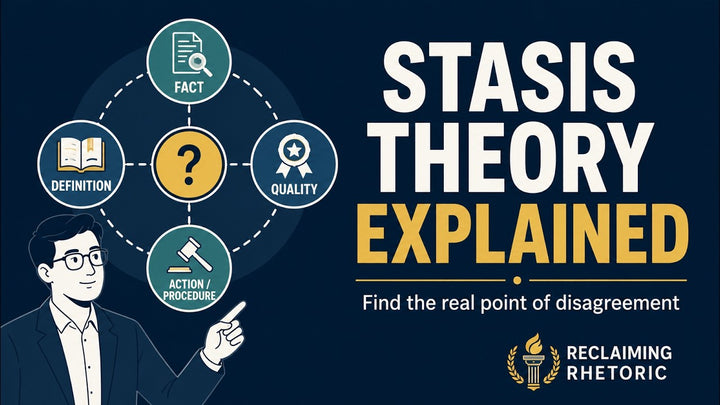
- Stasis helps identify what question they are disputing.
- Topoi help us look for reasons that could bear on that question.
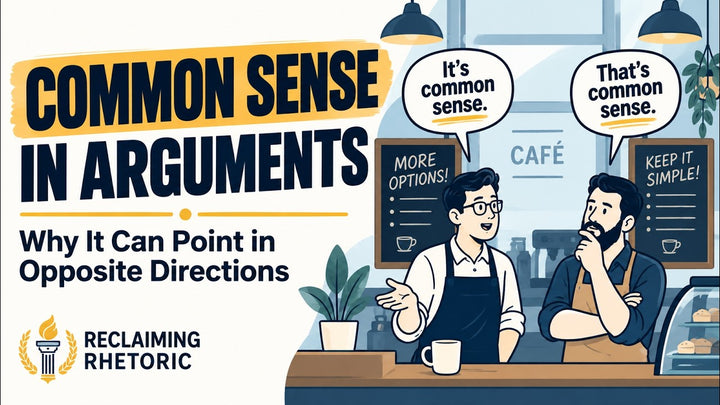
- Commonplaces, in the later topical tradition, are the culturally available maxims an audience already recognizes, such as appeals to common sense.
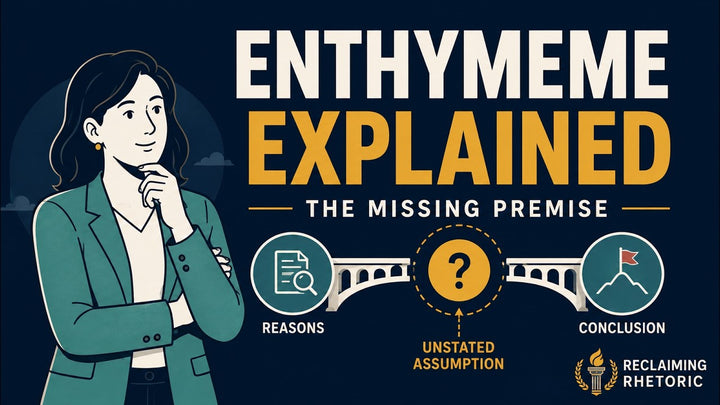
A topos is useful when it moves you from what else can I mention? to what relationship could actually matter? And once you have a relationship, you often have the core of an enthymeme: a claim, a reason, and an assumption the audience can evaluate.
The critical turn: invention vs. rationalization
Now for the critical turn. Someone could use topoi only to build a bigger pile of reasons for a conclusion they've already decided to defend. Definition becomes whatever favors them. Comparisons become selective. Causes are simply assumed. Consequences include only the desirable ones. That turns invention into rationalization.
So for each promising line of argument, generate three things:
- A candidate reason. Allowing phone photographs would remove an obstacle to participation.
- The evidence needed. Do interested newcomers actually identify the equipment restriction as a barrier?
- A potential complication. Perhaps their main barriers are meeting times, judging anxiety, or lack of instruction.
Now the method can strengthen, weaken, or modify the original proposal. That fits the classical tradition. Aristotle emphasizes that argument still depends on the relevant facts of the case. Quintilian, in his long discussion of arguments in Institutio Oratoria Book 5, similarly cautions that not every argumentative resource can be drawn equally from every circumstance; the places are aids to search, not guarantees of a good argument.
Topoi help generate candidates. Evidence and judgment determine which candidates deserve to survive.

Where the photography club might land
The eventual result could go several ways:
- Full smartphone eligibility.
- A separate smartphone category.
- A trial period with review.
- Revised judging criteria that apply to every device.
- Keeping the existing restriction for a clearly stated reason.
The method shouldn't decide the policy in advance. And being able to build arguments for both sides doesn't mean both sides are equally supported. Classical training often had students argue both sides of a question precisely so that they could see which reasons held up under pressure, a practice described in how to argue like a classical rhetorician.
Using topoi in everyday arguments
You don't need a photography club to use this. Whenever you're stuck repeating your conclusion, try running it through the four places:
- Definition: What is this thing, policy, or role actually for?
- Comparison: How have we treated similar cases, and what's relevantly different here?
- Cause: What problem is this supposed to solve, and what's actually causing that problem?
- Consequences: What would plausibly follow, good and bad, and how would we know?
At work, this turns “We should switch tools” into a discussion of what the tool is for, how past switches went, what is really slowing the team down, and what the transition would cost. At home, it turns “We should move” into a conversation with specific, checkable reasons on both sides.
The four places also work as a listening tool. When someone else makes a case, notice which places they visited and which they skipped. An argument built entirely on consequences may never have asked what the policy is for. An argument built entirely on comparison may have assumed that the cases are alike in the ways that matter. The missing place is often where the best question is hiding.
The takeaway
Go back to where we started: We should allow phone photographs because I think it's a good idea. Now the speaker has better questions. What is the competition for? Which comparisons matter? What actual barrier exists? What consequences can be supported?
The result is not merely more material for a speech. It is a better understanding of what could justify the proposal. Topoi do not hand you a finished argument. They help you discover where an argument might begin.
So when you run out of things to say, do not simply repeat your conclusion more confidently. Change where you are looking. And remember: a place to find a reason is not permission to stop testing it.
To keep going, browse all articles, explore structured lessons on the Courses page, or see the illustrated guides on the Guides page.
Foundations Series · Volume 3
How to Build a Better Argument
A practical visual guide to claims, evidence, structure, and objections. Opinion in. Case out.
Move from an initial opinion to a clear, well-supported case that can withstand fair scrutiny. Gather evidence that tests the claim, then treat serious objections fairly.
Sources and further reading
- Aristotle. Rhetoric, Book II, ch. 23, lines of argument (Perseus Digital Library)
- Aristotle. Rhetoric, Book I, ch. 2, on common and special topics (Perseus Digital Library)
- Cicero. Topica, on the places of argument and the distinction between discovery and judgment
- Quintilian. Institutio Oratoria, Book 5, ch. 10, on arguments and their places
- Reclaiming Rhetoric, Invention: The First Canon of Rhetoric
- Reclaiming Rhetoric, Stasis Theory
- Reclaiming Rhetoric, What Is Doxa?
Frequently Asked Questions
What are topoi in rhetoric?
Topoi (singular topos, Greek for "place") are the places a speaker looks to find possible arguments, such as definition, comparison, cause, and consequences. They guide the search for reasons, not the conclusion.
What is the difference between a topic and a topos?
The topic is the subject you're arguing about, like smartphone photography. A topos is a line of inquiry for finding reasons about it, like comparing it to how other cameras are treated.
What are the common topics?
Lines of argument that can apply across many subjects, such as definition, comparison, cause and effect, consequences, and more and less. Aristotle contrasts them with special topics tied to particular fields.
What did Cicero say about topics?
Cicero's Topica treats topics as places from which arguments are drawn and distinguishes the art of discovering arguments from the art of judging whether they hold up.
Does invention in rhetoric mean making things up?
No. Rhetorical invention means discovering and developing possible arguments from the available facts and reasons. It never means inventing facts.
How can topoi be misused?
By using them only to pile up reasons for a conclusion already chosen: selective comparisons, assumed causes, and only favorable consequences. That turns invention into rationalization.
How do I use topoi to test an argument?
For each line of argument, write a candidate reason, the evidence needed to support it, and a potential complication. The result can strengthen, weaken, or revise your original position.
Reclaiming Rhetoric is independent and reader-supported.
If this helped, you can help keep it free.