Every argument you have ever heard fits into one of three categories. Every speech, every debate, every ad, every courtroom closing statement. That is not a modern marketing framework. Aristotle laid it out more than 2,300 years ago, when he argued that rhetoric is not one thing but three.
He called them deliberative, forensic, and epideictic. What makes the framework so durable is that the categories are not arbitrary. They map onto three different jobs human beings need persuasion to do: to establish what happened, to decide what to do, and to define what we value. Past, future, present.
This article, a companion to the Reclaiming Rhetoric video on the three types of oratory, explains where the framework comes from, what each type is for, the standard each one should be judged by, and the most common mistake people make with all three: answering an argument by the wrong standard.
The three types of rhetoric series: The three types (you are here) · Forensic · Deliberative · Epideictic.
Where the three types come from
The division appears in Book 1, Chapter 3 of Aristotle's Rhetoric. His starting point is not the speaker or the subject but the audience. "The kinds of Rhetoric are three in number," he writes, "corresponding to the three kinds of hearers" (Rhetoric 1.3). A listener, he explains, is "either a mere spectator or a judge, and a judge either of things past or of things to come."
That gives three positions an audience can occupy. A member of an assembly judges what will happen, so speeches to them are deliberative. A juror judges what has happened, so speeches to them are forensic. A spectator at a ceremony is not deciding anything, but is assessing the speaker's skill and the worth of the person or thing praised, so speeches to them are epideictic. Hence, Aristotle concludes, there are "three kinds of rhetorical speeches, deliberative, forensic, and epideictic."

The names have their own histories. Forensic comes from the Latin forensis, "of the forum," the public square where Roman cases were argued; Aristotle's own word was closer to "judicial." Deliberative comes from the Latin deliberare, to weigh or consider carefully. Epideictic comes from a Greek verb meaning to display or show forth.
Roman writers sometimes translated epideictic as demonstrativum, "demonstrative," which is why the video uses that label too. Quintilian was not entirely happy with the translation: "The term epideictic seems to me however to imply display rather than demonstration" (Institutio Oratoria 3.4). His point is worth keeping. Epideictic speech does not mainly prove something to the audience. It shows the audience something, holding up a person, an act, or an ideal so that everyone can see it and judge its worth together.
The framework stuck. The Roman handbook known as the Rhetorica ad Herennium opens its discussion of the speaker's task with the same three: "There are three kinds of causes which the speaker must treat: Epideictic, Deliberative, and Judicial" (Ad Herennium 1.2). Two centuries later Quintilian noted that "all the most eminent authorities among ancient writers, following Aristotle" had been "content with the threefold division" (Institutio Oratoria 3.4). The three types became one of the first things every student of rhetoric learned, alongside the five canons.
Three times, three ends
Aristotle gives each type a characteristic time and a characteristic goal, which he calls its "end." The deliberative speaker is concerned with the future, the forensic speaker with the past, and the epideictic speaker "most appropriately" with the present, although, he adds, epideictic speakers often recall the past and anticipate the future too.
The ends are what make the framework practical. The end of deliberative speech is "the expedient or harmful": will this help us or hurt us? The end of forensic speech is "the just or the unjust": did this person do wrong? The end of epideictic speech is "the honorable and disgraceful": is this worthy of admiration or of shame? Each type has a different question at its center, and so each type has a different test of success.
- Forensic: the past. What happened, and who is responsible? Judged by truth and justice: does the evidence hold up?
- Deliberative: the future. What should we do? Judged by advantage: will it work, and is it worth the cost?
- Epideictic: the present. What should we value? Judged by honor: does it rightly praise or blame, and does it resonate?

Foundations Series · Volume 1
An Introduction to Rhetoric
A visual guide to persuasion, argument, and influence.
Forensic rhetoric: the rhetoric of the past
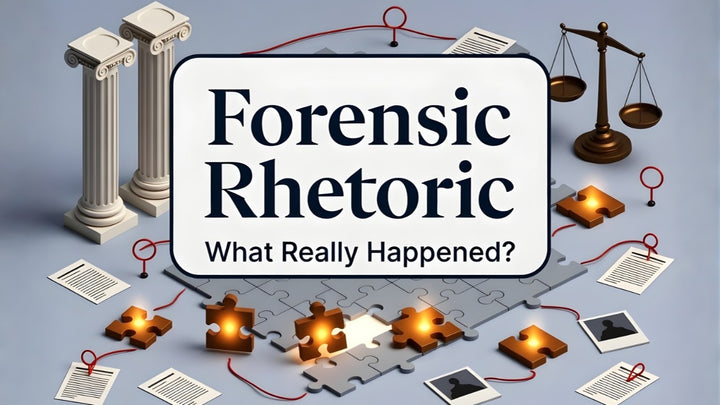
Forensic rhetoric, also called judicial rhetoric, asks: What happened? What is true? Who is responsible? Aristotle says it is "either accusatory or defensive." Its home was the law court, but its reach is much wider. Any time someone is reconstructing events, weighing evidence, or assigning blame, from a courtroom to an investigation to a piece of journalism to a work of history, they are doing forensic rhetoric.
The standard is truth. Did it happen? Can you show it? Here is the warning: forensic arguments are misread constantly. People treat them like values debates, arguing about whether they like the conclusion instead of whether the evidence supports it. Forensic rhetoric is not about what should have happened. It is about what did. The full breakdown is in Forensic Rhetoric: What Really Happened?.
Deliberative rhetoric: the rhetoric of the future
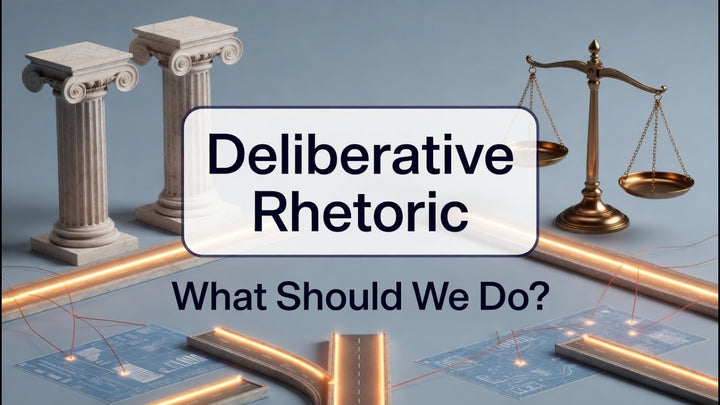
Deliberative rhetoric, also called political rhetoric, asks: What should we do? What is the best path forward? Aristotle says it is "either hortatory or dissuasive," urging an action or warning against one. Its home was the assembly, but you hear it in policy debates, business strategy, campaign speeches, and the personal decisions you talk through with your family.
The standard is usefulness. Will it work? Is it worth the cost? The warning here is the mirror image of the forensic one. Deliberative arguments get attacked as if they were factual claims. "That's not true" is a strange reply to "we should do X." Facts matter, but the real question is whether the plan is wise. The full breakdown is in Deliberative Rhetoric: What Should Happen?.
Epideictic rhetoric: the rhetoric of the present
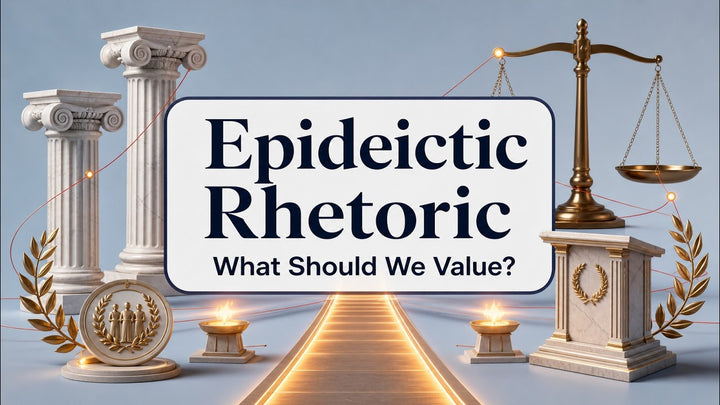
Epideictic rhetoric, also called ceremonial or demonstrative rhetoric, asks: What should we value? What deserves praise, and what deserves blame? Aristotle says it "has for its subject praise or blame." Its home was the funeral oration and the festival, but today it lives in eulogies, award speeches, graduation addresses, anniversary tributes, cultural commentary, and a great deal of advertising.
The standard is value. Does it honor the right things? Does it express what a community believes, or ought to believe? The warning: epideictic rhetoric gets dismissed as "just emotional" or illogical, as if a eulogy had failed because it lacked a policy proposal. Logic in the narrow sense was never the point. The point is alignment, shaping shared identity and belief. The full breakdown is in Epideictic Rhetoric: What Should We Value?.
The real lesson: use the right standard

Three types, three timeframes, three standards. Past and truth. Future and usefulness. Present and values. The most useful question the framework gives you is this: which type of rhetoric am I actually dealing with, and am I evaluating it by the right standard? Most people are not.
- A forensic claim about what happened gets judged by whether you like the conclusion, instead of whether the evidence holds.
- A deliberative proposal about what to do gets attacked as factually wrong, when the real question is whether it will work.
- An epideictic appeal to shared values gets dismissed as illogical, when logic was never what it was trying to do.
Wrong standard, wrong response, wrong conclusion. It happens in news debates, political discussions, comment sections, and workplace meetings: people talking past each other because they are not playing the same game. One person says, "The report shows the project went over budget." Another replies, "We need to stop blaming people and look ahead." A third says, "This team has always pulled through." The first speaker is making a forensic claim, the second a deliberative one, the third an epideictic one. None of them has answered the others.
Aristotle noticed the same slippage. A defendant in court, he observes, will often concede the facts but deny the wrong, and "will never admit that the act is unjust." Deliberative speakers will sometimes grant that a course is unjust while insisting it is expedient. Epideictic speakers may praise a hero for choosing what was honorable over what was advantageous, as when Achilles avenged Patroclus knowing it would cost him his life. Each type can borrow the others' language, but each keeps its own central question.
A quick diagnostic
When you meet an argument, ask three questions before you respond:
- What time is it about? Is it describing the past, proposing something for the future, or characterizing the present?
- What is the audience being asked to do? Render a verdict, make a decision, or feel and affirm something?
- What would count as a good answer? Better evidence, a better plan, or a better account of what matters?
Once you can name the type, you know what questions to ask and what counts as a strong argument, and you stop wasting energy answering the wrong thing. It is also a good habit for analysis; the step-by-step version is in how to do a rhetorical analysis.
Real speeches mix the types
The categories are tools, not boxes. Real speeches routinely blend them. The Ad Herennium admits that "if epideictic is only seldom employed by itself independently, still in judicial and deliberative causes extensive sections are often devoted to praise or censure" (Ad Herennium 3.15). A closing argument in court praises the victim and blames the defendant. A campaign speech tells a story about what happened, proposes what to do, and celebrates who "we" are, often within a few minutes.
Aristotle even shows how one type turns into another. "Praise and counsels have a common aspect," he writes; "what you might suggest in counseling becomes encomium by a change in the phrase" (Rhetoric 1.9). Saying "a good leader puts the community first" is praise; saying "put the community first" is advice. The framework does not deny the mixing. It helps you see which job each part of a speech is doing, and judge each part by the right test.
Why the framework still matters

Aristotle's categories came out of a specific world: the Athenian law courts, the citizen assembly, and the festivals and funerals of the city. That world is gone, but the three jobs remain. Every community still has to work out what happened, decide what to do next, and remind itself what it stands for. Courts, legislatures, boardrooms, newsrooms, and memorial services are all versions of those three ancient scenes.
The types also depend on each other. Without a shared account of what happened, you cannot make wise decisions about the future. Without a shared sense of what you value, neither the facts nor the plans have any direction. That is why the framework is worth learning as a set. The canon of invention teaches you how to find arguments. The three types teach you which kind of argument the moment calls for. If you are new to the field, what rhetoric is, from Aristotle to TikTok gives the broader picture.
Three types of rhetoric, three modes of persuasion, one framework. Once you see it, you will never hear an argument the same way again.
The three types of rhetoric series: The three types (you are here) · Forensic · Deliberative · Epideictic.
To keep going, browse all articles, explore structured lessons on the Courses page, or see the illustrated guides on the Guides page.
Foundations Series · Volume 1
An Introduction to Rhetoric
A visual guide to persuasion, argument, and influence. See how messages work.
A clear, visual introduction to the choices inside a message: credibility, emotion, reasoning, and timing, and how to tell them apart in something you have already read or watched.
Sources and further reading
- Aristotle, Rhetoric, Book 1, Chapter 3, on the three kinds of speech (Perseus Digital Library, trans. J. H. Freese)
- Aristotle, Rhetoric, Book 1, Chapter 9, on praise and counsel (Perseus Digital Library, trans. J. H. Freese)
- Rhetorica ad Herennium, Book 1, on the three kinds of causes and the types of issue (LacusCurtius, trans. H. Caplan)
- Rhetorica ad Herennium, Book 3, on deliberative and epideictic causes (LacusCurtius, trans. H. Caplan)
- Quintilian, Institutio Oratoria, Book 3, Chapters 1–5, on the kinds of oratory (LacusCurtius, trans. H. E. Butler)
- Reclaiming Rhetoric, The Five Canons of Rhetoric
Frequently Asked Questions
What are the three types of rhetoric?
Forensic (judicial), deliberative (political), and epideictic (ceremonial). Aristotle defined them in Rhetoric 1.3 based on the kind of judgment the audience is asked to make.
Who came up with the three types of rhetoric?
Aristotle, in the fourth century BCE. Roman writers including the author of the Rhetorica ad Herennium and Quintilian adopted the same threefold division.
What time does each type focus on?
Forensic rhetoric focuses on the past, deliberative on the future, and epideictic on the present, though epideictic speakers often recall the past and look ahead.
What is the goal of each type?
Aristotle says deliberative speech aims at the expedient or harmful, forensic at the just or unjust, and epideictic at the honorable or disgraceful.
Can one speech use more than one type?
Yes. Most real speeches mix them. A courtroom closing praises and blames; a campaign speech recounts the past, proposes plans, and celebrates shared values.
Why does it matter which type of rhetoric I'm hearing?
Because each type is judged by a different standard. Answering a proposal with "that's not true" or a eulogy with "what's your plan?" means arguing past the speaker.
What does epideictic mean?
It comes from a Greek verb meaning to display or show forth. Epideictic speeches display what a community honors or condemns.
Reclaiming Rhetoric is independent and reader-supported.
If this helped, you can help keep it free.