Right now, someone is trying to change your mind. Not with force, and often not with facts. With words, images, timing, and order. It might be the video queued up next, the notification you just dismissed, or the comment thread you are about to open. You are being persuaded constantly, and most of the time you do not notice.
The people who shape how you think already know something most of us were never taught. They know rhetoric. This article is a companion to the opening video on the Reclaiming Rhetoric channel. It covers what rhetoric actually is, why its reputation is so poor, how a framework from roughly 2,300 years ago still explains a modern feed, and why learning it makes you both a clearer communicator and harder to manipulate.
Rhetoric is not empty talk, even though bad rhetoric exists
Say the word rhetoric and most people picture a politician dodging a question, a corporate statement that apologizes without admitting anything, or a speaker who talks for ten minutes and says nothing. In everyday speech, "that's just rhetoric" means "that's just spin."
That reputation is not entirely wrong. Deceptive communication is real. Empty phrasing is real. Some people use language to hide what they are doing rather than to explain it. But the everyday definition has a problem. If rhetoric only meant lying with fancy words, it would be hard to explain why it has been taught for more than two thousand years, why it sat at the center of education in Athens and Rome, and why universities still run whole programs devoted to it.
The answer is that the everyday meaning is a shadow of the real one. What people call rhetoric today is usually bad rhetoric: persuasion used carelessly or dishonestly. The discipline itself is something broader and more useful. It is the study of how communication works when someone wants an audience to believe, feel, or do something.
That distinction matters. A knife can cook a meal or cause harm. Nobody concludes that knives are evil and refuses to learn how they work. Rhetoric is similar. The tool is neutral. The use is not.
Rhetoric began as a survival skill for citizens
The word comes from ancient Greek. A rhētōr was a public speaker, and rhētorikē was the art that speaker practiced. In classical Athens, that art was not a luxury. Citizens spoke for themselves in court. Policy was argued out loud in the assembly. If you could not make a case in public, you could not fully take part in the life of the city. You could lose property, standing, or a vote simply because someone else argued better.
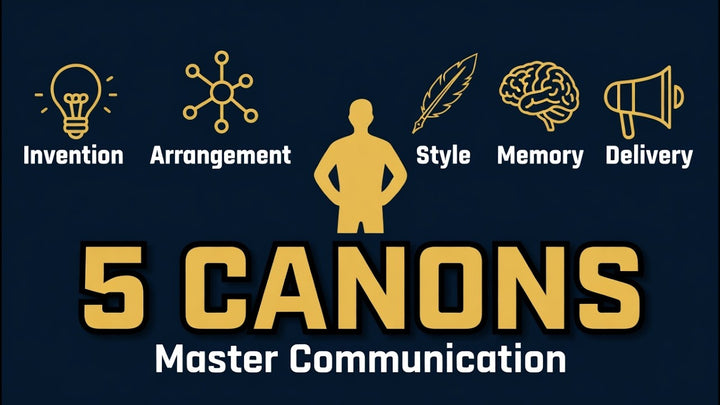
So rhetoric was taught the way we teach reading and writing now. It was basic civic equipment. Teachers trained students to find arguments, put them in order, choose their words, remember what they planned to say, and deliver it to a live audience. Those five tasks later became the five canons of rhetoric, which get their own article: the five canons of rhetoric as a working system.
The key point is that rhetoric grew up alongside democracy. Where people have to persuade each other instead of simply obeying, persuasion becomes a skill worth studying. That is as true in a group chat or a school board meeting today as it was in Athens.

Foundations Series · Volume 1
An Introduction to Rhetoric
A visual guide to persuasion, argument, and influence.
Aristotle defined rhetoric as seeing, not tricking
Aristotle gave the definition that shaped the field for more than two millennia. In the Perseus translation of his Rhetoric, it reads: "Rhetoric then may be defined as the faculty of discovering the possible means of persuasion in reference to any subject whatever" (Aristotle, Rhetoric 1.2). Another widely used translation, the one quoted in the video, renders it as the faculty of observing, in any given case, the available means of persuasion.
Look at what the definition leaves out. It does not say the art of tricking people. It does not say decorative language that hides the truth. It does not even say the art of winning. It says the ability to see how persuasion could work in a particular situation.
That makes rhetoric closer to perception than to performance. It is pattern recognition for communication. Think of it as x-ray vision for arguments: the ability to look at a speech, an ad, or a post and see the structure holding it up. The Stanford Encyclopedia of Philosophy's entry on Aristotle's Rhetoric makes a related point: Aristotle treated rhetoric as a counterpart to dialectic, an art concerned with reasoning about matters where certainty is not available, rather than as a bag of tricks.
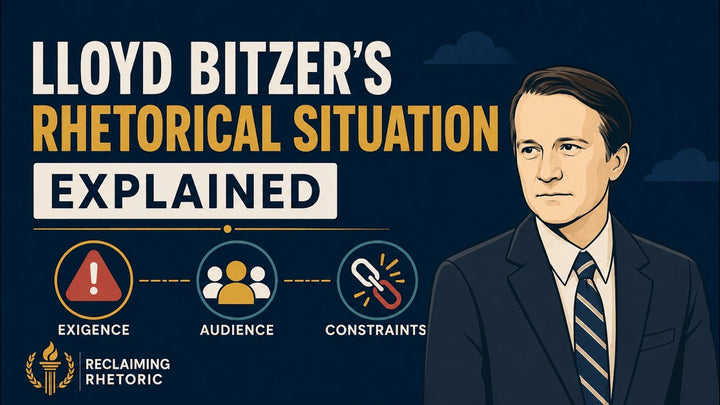
Notice too the phrase "in any given case." Rhetoric is always situational. The same words can persuade one audience and alienate another. What works in a courtroom fails at a funeral. That idea, that persuasion depends on the situation, was developed much later by Lloyd Bitzer, and it is the subject of our guide to Bitzer's rhetorical situation.

The stage changed, but the principles did not
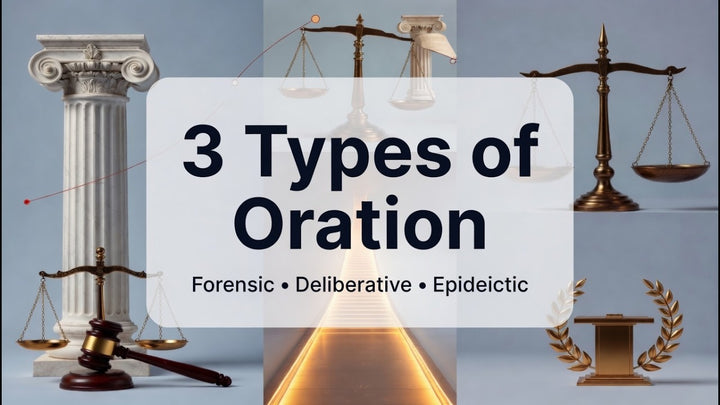
In Aristotle's world, persuasion happened in a few public places: the law court, the political assembly, and ceremonial occasions such as funerals and festivals. Today the assembly looks different. Persuasion happens in social feeds, push notifications, subject lines written to raise open rates, pitch decks structured to close a deal, and headlines tuned for clicks.
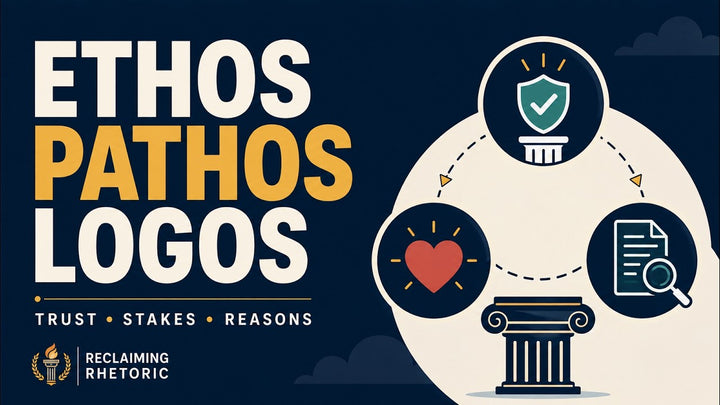
The medium has changed almost beyond recognition. The underlying moves have not. Whether the speaker is a Roman senator or a modern brand, the same three basic appeals keep appearing. Aristotle described three kinds of proof: those that depend on "the moral character of the speaker," those that depend on "putting the hearer into a certain frame of mind," and those that depend on "the speech itself, in so far as it proves or seems to prove" (Rhetoric 1.2). We usually shorten them to three Greek words:
- Ethos, credibility. Why should I trust you?
- Pathos, emotion. Why should I care?
- Logos, reasoning. Why should I believe this makes sense?
Nearly every persuasive message is some mix of the three. The proportions change. The ingredients rarely do. For a full treatment of each appeal, including how each one goes wrong, see Rhetorical Appeals Explained: Ethos, Pathos, and Logos.
A product launch shows all three appeals working together
Abstract categories make more sense with a concrete case. Picture a major phone launch, the kind a large tech company stages every year. Watch how the presentation layers the three appeals.
Ethos. A chief executive walks on stage. Engineers explain the new chip. The company's track record hangs over the whole event. The message underneath is simple: these people know what they are doing, so you can trust what they tell you.
Pathos. Slow, beautiful product shots. Swelling music. Short films of people doing creative, joyful things with the device: a parent filming a child's first steps, a musician recording on the road. The message: this will make your life feel more like this.
Logos. Charts. Percentages. "Up to 50 percent faster." Battery comparisons, benchmark scores, and a list of specifications. The message: the numbers prove it is better.
None of this needs to be dishonest. The engineers may be excellent, the films may be lovely, and the numbers may be accurate. But all of it is constructed persuasion. Someone chose which engineer to show, which family to film, and which benchmark to put on the slide. Those choices are rhetoric.
The same structure appears when a manager pitches a project, a journalist writes an op-ed, a friend talks you into a restaurant, or you explain to yourself why you really do need the thing in your cart. Rhetoric is not something only special people do. It is the invisible architecture of communication whenever someone wants you to act.

Algorithms now make rhetorical choices at scale
This is where the jump from Aristotle to algorithms gets interesting. In Aristotle's world, rhetoric was human to human: one speaker, one audience, one occasion. Today, systems persuade too.
Your video homepage is not random. It is, in effect, an argument that these are the videos you want to watch next. A short-video feed makes a quieter argument with every swipe: this will keep you here. A "customers who bought this also bought" panel looks like neutral information, but it functions as a reasoned appeal: people like you chose this, so you probably will too.
The platforms are open about the fact that these choices are engineered. YouTube describes its recommendation system as drawing on "over 80 billion pieces of information we call signals," including clicks, watch time, survey responses, sharing, likes, and dislikes (YouTube, "On YouTube's recommendation system"). No individual wrote the specific selection you see. The system assembled it from what has worked on people who behave like you.
Call it algorithmic rhetoric: persuasion that is personalized, optimized, and largely invisible. When a system whispers "you might like this," we tend to hear it as neutral. It is not neutral. It is a set of choices about what to show, in what order, and when. That is rhetoric with better data.
The stakes are not hypothetical. A large study of Twitter by researchers at MIT found that false news stories were 70 percent more likely to be retweeted than true ones, and that true stories took about six times as long as false ones to reach 1,500 people (MIT News, 2018). Novelty and emotional charge travel well. A feed that rewards what travels will reward that, whether or not it is true. Rhetorical awareness does not fix the system, but it gives you a way to notice what the system is doing to you.
The suspicion of rhetoric is healthy, but refusing to learn it backfires
If rhetoric is this basic, why does the word still feel dirty? Because persuasion is power, and power makes people nervous, often with good reason. Across history, critics have worried about charismatic speakers who can move a crowd away from the truth.
The most famous early critic was Plato. In the dialogue Gorgias, Socrates compares rhetoric of the flattering kind to cookery: something that tastes good without being good for you. In the Perseus translation, he puts it bluntly: "cookery is flattery disguised as medicine" (Plato, Gorgias 465). Rhetoric that only tells people what they want to hear, in his view, stands in the same relation to justice that cookery stands to medicine.
That suspicion deserves respect. Manipulation is real. But it leads to a paradox. If you decide rhetoric is bad and refuse to learn how it works, you do not escape persuasion. You simply stop noticing it, which makes you easier to persuade. Ignoring rhetoric does not make you immune. It makes you blind.
Aristotle's answer to Plato, in effect, was that the remedy for bad rhetoric is better understanding of rhetoric, not less. If you know how an appeal to emotion is built, you can feel it working and still ask whether the feeling fits the facts. If you know how credibility is borrowed, you can ask whether the expert on the screen is actually an expert in this subject.

Reclaiming rhetoric means treating it as a critical thinking tool
To reclaim rhetoric is to treat it as a lens rather than a trick. The lens works through questions. When a message lands in front of you, try these:
- What is this trying to make me feel, and is that feeling proportionate to the facts?
- Why is this voice presented as credible, and is it credible on this specific subject?
- Whose voice is missing from this message?
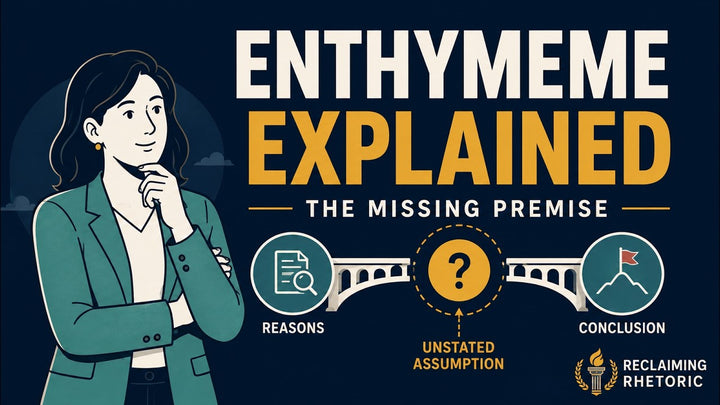
- What assumptions am I being asked to accept without anyone stating them?
- What does the speaker want me to do next?
Those questions are the core of rhetorical analysis, which is why teachers assign it, journalists study persuasive technique, marketers obsess over messaging, and media literacy programs build their curricula around it. The National Association for Media Literacy Education defines media literacy as "the ability to access, analyze, evaluate, create, and act using all forms of communication" (NAMLE). Every verb in that list is a rhetorical skill.
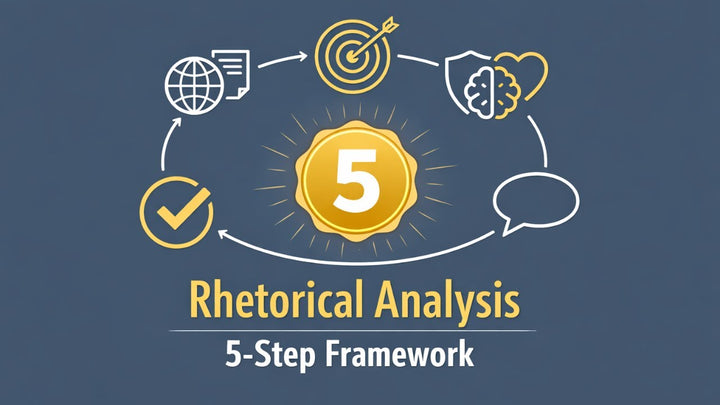
If you want a structured version of those questions, with steps you can apply to any speech, ad, or post, read How to Do a Rhetorical Analysis: A Simple 5-Step Framework. It turns the lens into a repeatable method.
Learning rhetoric makes you clearer and harder to manipulate
There is an obvious benefit to learning rhetoric: you persuade better. You learn to anticipate what an audience needs, to put your strongest point where it will land, and to choose words that carry the right weight. That is useful in an essay, an interview, a meeting, or a hard conversation at home.
The less obvious benefit is defensive. Once you can see the moves, they lose some of their automatic force. A dramatic statistic stops feeling like proof and starts looking like a claim that needs a source. A moving story stops feeling like the whole picture and starts looking like one carefully chosen example. A confident tone stops sounding like authority and starts sounding like a choice.
This does not make you cynical. Cynicism is just another way of not thinking: it rejects everything instead of accepting everything. Rhetorical awareness is different. It lets you tell a good argument from a clever distraction, and it lets you be moved by a good argument without apology.
Most importantly, it changes how you participate. Public life still runs on persuasion, just as it did in Athens. People who understand persuasion can argue for what they care about, listen fairly to those who disagree, and notice when a message is designed to make them stop thinking. That is the kind of discourse the channel's motto points to: clarify ideas, strengthen reasoning, elevate discourse.
Where to go from here
This article is the broad map. The rest of the first batch zooms in. Start with the three rhetorical appeals if you want the building blocks. Read the five canons if you are preparing to write or speak. Use the five-step rhetorical analysis framework when a specific message is in front of you, and Bitzer's rhetorical situation when you want to understand why the same words succeed in one setting and fail in another. Everything else lives on the Articles page, and the structured courses are on the Courses page.
If you prefer to learn from a single, illustrated guide, the Foundations Series on the Guides page starts exactly where this article does.
Foundations Series · Volume 1
An Introduction to Rhetoric
A visual guide to persuasion, argument, and influence. See how messages work.
A clear, visual introduction to the choices inside a message: credibility, emotion, reasoning, and timing, and how to tell them apart in something you have already read or watched.
Sources and further reading
- Aristotle, Rhetoric, Book 1, Chapter 2 (Perseus Digital Library, trans. J. H. Freese)
- Christof Rapp, "Aristotle's Rhetoric," Stanford Encyclopedia of Philosophy
- Plato, Gorgias 465 (Perseus Digital Library, trans. W. R. M. Lamb)
- YouTube Official Blog, "On YouTube's recommendation system"
- MIT News, "Study: On Twitter, false news travels faster than true stories" (2018)
- National Association for Media Literacy Education, "Media Literacy Defined"
Frequently Asked Questions
What is rhetoric in simple terms?
Rhetoric is the study and practice of how communication persuades. It looks at how a speaker or writer gets an audience to believe, feel, or do something, and at the choices that make that happen.
Is rhetoric the same as manipulation?
No. Manipulation is one dishonest use of rhetoric. Rhetoric itself is the broader skill of seeing and using the available means of persuasion. The same knowledge that lets someone manipulate also lets you spot manipulation.
How did Aristotle define rhetoric?
In Rhetoric 1.2, Aristotle defines it as the faculty of discovering the possible means of persuasion in reference to any subject. The emphasis is on seeing how persuasion works in a given case, not on tricking anyone.
What are ethos, pathos, and logos?
They are the three modes of persuasion. Ethos appeals to the speaker's credibility, pathos to the audience's emotions, and logos to reasoning and evidence. Most persuasive messages blend all three.
Why does rhetoric have a bad reputation?
Because persuasion is power, and people have long feared speakers who use it to mislead. Plato compared flattering rhetoric to cookery that pleases without nourishing. The fear is reasonable, but avoiding the subject only makes people easier to persuade.
What is algorithmic rhetoric?
It is persuasion performed by systems rather than individual speakers. Recommendation feeds, autoplay queues, and "customers also bought" panels make choices about what to show you and when, based on what has worked on people like you.
Why should students learn rhetoric?
It improves writing and speaking, it is central to courses such as AP English Language, and it builds media literacy. Students who understand rhetoric can analyze arguments instead of simply reacting to them.
Is rhetoric only about speeches?
No. Classical rhetoric focused on speeches, but the same principles apply to essays, ads, social posts, videos, emails, product launches, and everyday conversations.
How can I start analyzing rhetoric in daily life?
Ask a few questions of any persuasive message: what it wants you to feel, why the voice seems credible, whose voice is missing, what assumptions it relies on, and what it wants you to do next.
What should I read after this introduction?
Read the articles on the three rhetorical appeals and the five canons next, then the five-step rhetorical analysis framework. The Foundations Series guides cover the same ground in an illustrated format.
Reclaiming Rhetoric is independent and reader-supported.
If this helped, you can help keep it free.