“More choices. Give customers more options. It's common sense.”
“No, keep the menu short. Don't overwhelm people. That's common sense.”
Same cafe. Same decision. Two opposite recommendations. And somehow both sides are claiming the same authority.
One owner thinks a bigger menu gives more people a chance to find something they want. The other thinks a smaller menu makes choosing easier. Both have reasons. But when each adds it's common sense, they are doing something more than offering a reason. They are making a claim about the status of that reason: this should already be obvious, and reasonable people should be able to see it.
So if common sense can point toward opposite conclusions, what exactly is the phrase contributing? Does it settle the disagreement? Or does it make each side sound like the position sensible people should already occupy? Common sense can sound like the end of an argument, even when it is the very thing the argument needs to examine.
This article, a companion to the Reclaiming Rhetoric video, looks at what happens when it's common sense becomes part of an argument, and how to move a stuck disagreement back toward the evidence.

Foundations Series · Volume 2
How to Analyze Any Argument
A visual guide to claims, evidence, assumptions, and reasoning.
Common sense isn't worthless
The point is not that ordinary practical judgment is worthless. We make sensible decisions constantly without conducting a study first. Experience matters. Familiar patterns matter. Sometimes the obvious answer really is right: you do not need a meta-analysis to know you should look both ways before crossing the street.
The question is what happens when common sense becomes a label placed on a conclusion that is already under dispute. Once two reasonable people disagree, the label stops describing shared ground and starts claiming it.
Common sense vs. doxa
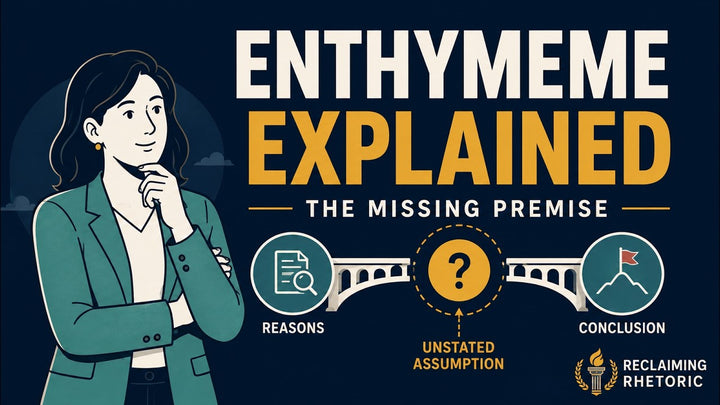
This is related to doxa, but it is not quite the same thing. Doxa concerns the background beliefs an audience brings into a situation, often without anyone stating them. With “it's common sense,” the speaker is doing something more explicit: presenting a disputed conclusion as something sensible people should already accept.
Rhetoric scholar Derek G. Ross, in a 2012 article in Social Epistemology, analyzed “common sense” (alongside “balance”) as a rhetorical commonplace, a shared, reusable appeal that functions as a kind of shortcut for decision-making. That helps explain its power. It can point people toward familiar understandings without rebuilding every assumption from scratch. But it can also make one judgment feel like the natural baseline, so that alternatives seem to need special justification. In that sense it works like the classical topoi: a ready-made line of argument a speaker can reach for in almost any dispute.
There is a difference between offering a practical reason and announcing that practical people should not need another reason.

The invisible crowd
Go back to the cafe. “We should add more options. It's common sense.” The owner is not merely saying I think more variety could help. The phrase presents the recommendation as obvious. Add “Everyone knows customers want options,” and now the judgment seems to arrive with an invisible crowd behind it.
That can also change the position of the person who disagrees. If the other owner asks for evidence, the response might become “You're overthinking this.” Now the issue is not only the menu. It is the person questioning the recommendation. Are they being impractical, needlessly complicated, detached from ordinary reality? The phrase can make one person's judgment sound less like one interpretation and more like the minimum any reasonable person should recognize.
This is a quiet shift in ethos: the person who invokes common sense positions themselves as grounded and practical, and implicitly positions the skeptic as the opposite. The argument about the menu becomes an argument about who is sensible.
None of this requires deliberate manipulation. People can sincerely experience their own conclusions as obvious. Something can feel self-evident from inside one person's experience and still be much less universal than it seems.
How common is common sense?
In a 2024 study in PNAS, Mark Whiting and Duncan Watts set out to measure common sense directly. They recruited about 2,000 online participants to rate thousands of everyday claims, asking whether each respondent agreed with a claim and whether they thought most other people would. They found substantial variation in what people treated as common-sensical. Agreement was strongest around plainly worded, fact-like claims about ordinary physical reality, and claims that nearly everyone shared turned out to be rare. Their conclusion was that common sense, in the strong sense of beliefs held by almost everyone, is much less common than the phrase suggests.
That does not mean common sense does not exist. It does not mean every contested judgment is subjective. But it exposes an important gap. Something feeling obvious to you does not tell you how widely it is shared. And widespread agreement would still be different from correctness.

Why your own view feels like the common one
Part of the reason common sense is so easy to invoke is that our own judgments rarely feel like one option among many. They feel like the way things are. Social psychologists have a name for one piece of this: the false consensus effect. In a classic set of studies, Lee Ross, David Greene, and Pamela House (1977) found that people tended to see their own choices and judgments as relatively common and appropriate, and to see alternative responses as less common and more revealing about the person who chose them.
Apply that to the cafe. The owner who loves variety probably imagines customers like themselves, who enjoy browsing a long menu. The owner who prefers simplicity probably imagines customers who want to order quickly and go. Each is generalizing from a vivid picture of the customers they identify with. Neither picture is foolish. Both are partial. And because each owner experiences their picture as typical, each experiences the other's recommendation as a strange departure from the obvious.
This is why the cure is not to argue harder about whose sense is more common. It is to bring in information neither owner fully has: what customers actually order, how long they take, what they ask for, and what they say when they leave.
The missing word is "when"
Return to the cafe. One owner says more choice is better. The other says less complexity is better. Both principles can be plausible. The missing word is when.
Research on choice overload is useful here precisely because it does not support a simple rule that more choice is bad. The popular version of the idea, often traced to a famous jam-tasting study, suggests big assortments paralyze shoppers. But a 2010 meta-analysis by Scheibehenne, Greifeneder, and Todd found a mean effect close to zero across the experiments it examined, with substantial variation between studies: sometimes more options hurt, sometimes they helped, often they made little difference.
Later meta-analytic work by Chernev, Böckenholt, and Goodman (2015) identified conditions that help explain when larger assortments become difficult. They pointed to four factors:
- Choice set complexity: how hard the options are to compare.
- Decision task difficulty: time pressure, how information is presented, and similar constraints.
- Preference uncertainty: how certain people are about what they want.
- Decision goal: what people are trying to accomplish while choosing.
Now the cafe question changes. Are the extra menu items meaningfully different, or small variations that make comparison harder? Do customers already know what they want? Is the menu easy to navigate? Are people choosing leisurely, or standing in line before work with thirty seconds to decide?
A practical principle can be useful without being universally applicable. Calling it common sense does not tell us when it applies.
A simple diagnostic: remove the phrase
That gives us a simple diagnostic. Delete “it's common sense” and see what reason is left.
We should add more options because customers are leaving without finding something they want.
Now there is a factual claim. Are customers actually leaving? What are they asking for? How often does it happen?
We should shorten the menu because customers are struggling to distinguish the options.
Also testable. Are orders taking longer? Are people asking staff to explain the differences? Is the line backing up at the register? The conversation has moved away from which one of us has common sense and toward what is actually happening here.
Prediction or value?
You can go one step further and ask what kind of claim sits underneath the phrase.
- “More options will increase customer satisfaction” predicts an outcome. Evidence from the cafe itself can test it.
- “Customers should have more autonomy even if choosing takes longer” expresses a value. It needs a different kind of discussion about priorities.
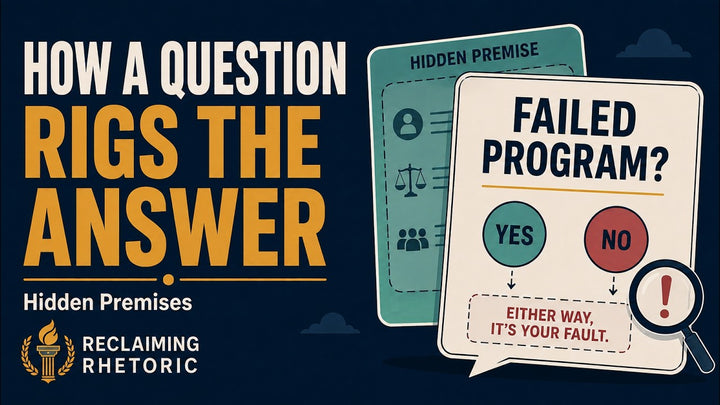
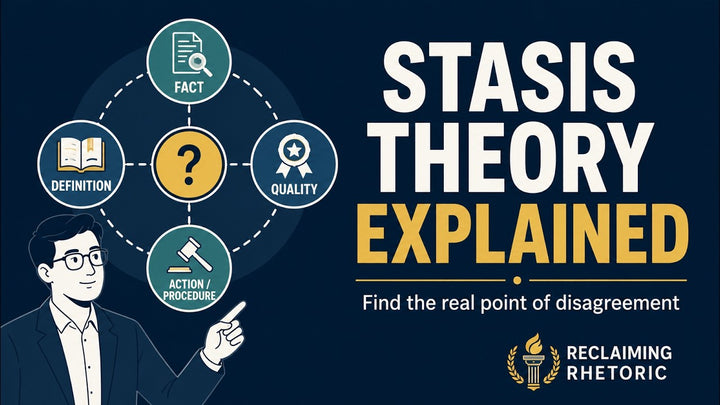
Those are different claims, and they require different kinds of discussion. Rhetoricians would say they sit at different points of stasis: one is a question of fact and consequence, the other a question of quality or value. A lot of stuck arguments are stuck because two people are answering different kinds of question while each insists the answer is obvious.

What to say when someone says "It's just common sense"
When someone says “It's just common sense,” a useful response is often not “No, it isn't.” That usually produces two people trading declarations of obviousness. Better questions keep the conversation on the reasons:
- “What makes that the sensible choice in this situation?”
- “Show me how the principle applies here.”
- “What would we expect to see if you're right?”
- “Is there a situation where the opposite would make more sense?”
That does not mean every everyday decision needs to become a dissertation. Familiar ideas genuinely help us think efficiently. Practical experience can be relevant. Simple explanations can be correct. Complicated arguments can be wrong. Critical thinking is not a contest to see who can make the obvious sound difficult, and smart people can over-complicate just as easily as anyone can over-simplify.
The problem begins when presumed obviousness is used to shield a disputed claim from examination. Once reasonable disagreement already exists, repeating that the answer is obvious does not resolve the disagreement. It just describes how obvious the answer feels from one side.
Common sense in public debate
The cafe is small, but the move scales. “Common-sense” is a favorite adjective in politics and policy: common-sense reform, common-sense regulation, common-sense solutions. The word signals that a proposal is moderate and practical, and it implies that opponents are extreme or out of touch. Sometimes the proposal really is sensible. But the adjective itself is not the evidence. The same diagnostic applies: remove the phrase and ask what reason remains, what outcome is predicted, and what values are being prioritized.
The takeaway
Imagine the cafe owners one last time. More choice: common sense. Less complexity: common sense. Both statements point toward considerations that may matter. Neither phrase establishes which consideration should control this particular decision.
And there is something revealing inside the phrase itself. Common concerns what people share. Sense concerns whether a judgment makes sense. Saying “common sense” does not automatically establish either one.
So the next time someone says “It's just common sense,” do not stop at whether the conclusion feels familiar. Ask what supports it. Ask where it applies. Ask what might change it. If the conclusion really makes sense, we should be able to examine the sense, not merely announce that it is common.
To keep going, browse all articles, explore structured lessons on the Courses page, or see the illustrated guides on the Guides page.
Foundations Series · Volume 2
How to Analyze Any Argument
A visual guide to claims, evidence, assumptions, and reasoning. Stop reacting. Start diagnosing.
A visual method for seeing where an argument actually works, and where it does not. Name the claim, test the evidence, and find the assumption holding it all together.
Sources and further reading
- Ross, D. G. (2012). Ambiguous weighting and nonsensical sense: The problems of “balance” and “common sense” as commonplaces in environmental discourse. Social Epistemology, 26(1), 115–144
- Whiting, M. E., & Watts, D. J. (2024). A framework for quantifying individual and collective common sense. Proceedings of the National Academy of Sciences, 121(4), e2309535121
- Ross, L., Greene, D., & House, P. (1977). The “false consensus effect”: An egocentric bias in social perception and attribution processes. Journal of Experimental Social Psychology, 13(3), 279–301
- Scheibehenne, B., Greifeneder, R., & Todd, P. M. (2010). Can there ever be too many options? A meta-analytic review of choice overload. Journal of Consumer Research, 37(3), 409–425
- Chernev, A., Böckenholt, U., & Goodman, J. (2015). Choice overload: A conceptual review and meta-analysis. Journal of Consumer Psychology, 25(2), 333–358
- Reclaiming Rhetoric, What Is Doxa?
- Reclaiming Rhetoric, Topoi
- Reclaiming Rhetoric, Stasis Theory
Frequently Asked Questions
Why is "it's common sense" a rhetorical move?
It claims a status for a reason: that it should already be obvious to any sensible person. In a dispute, that can shield a conclusion from examination and cast the skeptic as unreasonable.
Is common sense always wrong?
No. Practical judgment and experience are often right, and simple explanations can be correct. The problem is using "common sense" as a label to settle a conclusion that is reasonably disputed.
How common is common sense, according to research?
Whiting and Watts (2024, PNAS) found wide variation in what people rate as common-sensical. Agreement was strongest for plain, fact-like claims about physical reality; universally shared beliefs were rare.
Is choice overload real?
Sometimes. A 2010 meta-analysis found an average effect near zero with wide variation. A 2015 meta-analysis found overload depends on choice complexity, task difficulty, preference uncertainty, and goals.
What's the best response to "it's just common sense"?
Ask for the reasoning rather than denying it: "What makes that the sensible choice here?" or "Show me how the principle applies in this situation." This moves the discussion to evidence.
How is common sense different from doxa?
Doxa is the background belief an audience already brings, often unstated. Invoking common sense is more explicit: a speaker labels a disputed conclusion as something sensible people should already accept.
What is the "remove the phrase" test?
Delete "it's common sense" and see what reason remains. Usually a testable factual claim or a value judgment is left, and either can be discussed on its own terms.
Reclaiming Rhetoric is independent and reader-supported.
If this helped, you can help keep it free.