"Keep the library open on Saturdays."
Say that at a gathering of people who already support the library and you might get applause. Say it to a volunteer behind the circulation desk and the response might be, "I agree, but I don't decide the staffing budget." Say the exact same sentence at a budget hearing and a committee member might ask, "What would keeping those hours require?"
Nothing about the sentence changed. The goal is understandable, and some of the people hearing it even agree. Yet the message is doing a different job in each setting. At the community gathering, applause might be useful if you are trying to build support or get people to show up at the hearing. At the counter, a volunteer's agreement does not produce funding. At the committee meeting, support for Saturday hours still leaves questions about money, staffing, and implementation.
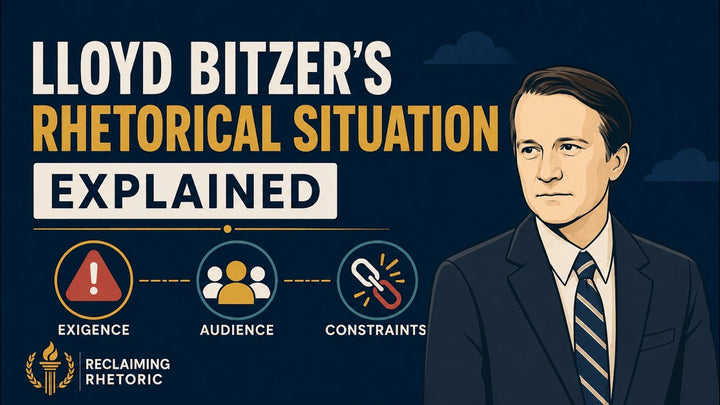
The same words can be asked to do different jobs, and before judging a message we need to know which job it is supposed to do. That is what the concept of the rhetorical situation is for. This article, a companion to the Reclaiming Rhetoric video, focuses on using the idea as a practical planning tool. For a fuller treatment of the theory and the scholarly debate, see the companion article on Bitzer's rhetorical situation: exigence, audience, and constraints.

Foundations Series · Volume 1
An Introduction to Rhetoric
A visual guide to persuasion, argument, and influence.
Context is not the same as situation
The foundational account is Lloyd Bitzer's 1968 essay "The Rhetorical Situation" (Bitzer, 1968). Bitzer's point goes beyond saying that context matters. He treats rhetoric as a response to conditions in the world: communication that can help change a situation through people's decisions and actions.
That makes a difference to how you analyze any message. Suppose someone tells you the library speech happened at a public meeting. That tells you where it occurred. It does not tell you what decision is pending, who can influence it, or what conditions shape what is possible.
The setting tells you where the message appeared. The rhetorical situation helps explain what it was trying to accomplish there.
Bitzer named three constituents: exigence, audience, and constraints. They are not three boxes to fill in on a worksheet. Each one changes what a message should say and to whom.

Exigence: the problem, not the topic
An exigence is not just the subject you are talking about. Bitzer described it as "an imperfection marked by urgency," a defect or obstacle that discourse can help modify.
In the example, the topic is library hours. The exigence is more specific: imagine that Saturday opening hours are about to be eliminated, and that decision may remove an important access opportunity for residents who cannot easily visit during the week. Now the purpose sharpens. The message is not merely saying libraries are important. It is trying to preserve, reconsider, or replace a particular form of access before a decision changes it.
- "I want to talk about libraries" gives you a subject.
- "A pending decision may remove access for people who cannot attend during the week" gives you a reason to intervene.
Rhetoric is only part of the intervention. A speech cannot staff the circulation desk. But it might help secure funding, coordinate public support, change a committee vote, or bring forward information that alters the decision. A quick test for any message you are writing: if you cannot state the exigence in one sentence that includes a change, you may only have a topic. Timing matters here too; an exigence often comes with a window, which is the territory of kairos.
Audience: who can act, not just who will hear
In ordinary speech, "audience" means everyone who happens to receive a message. Bitzer's definition is narrower: a rhetorical audience "consists only of those persons who are capable of being influenced by discourse and of being mediators of change." Return to the three groups:
- Supporters at the community meeting cannot authorize the budget, but they can organize testimony, contact decision makers, document their own Saturday use, and bring other residents into the conversation.
- Library staff may not control funding either, but they can explain staffing needs, identify operational problems, and propose workable alternatives.
- The funding committee, in this fictional example, can authorize the money that determines whether management can staff those hours.
Agreement is not the same as authority, and authority is not the only kind of influence. Argumentation scholars Rudi Palmieri and Sabrina Mazzali-Lurati (named slightly differently in the video captions) have developed a framework for multiple audiences, treating the different readers of a message as "text stakeholders" with different interests and different capacities to act (Palmieri & Mazzali-Lurati, 2016). The public is rarely one undifferentiated audience.
Don't ask only who will hear this. Ask what each of these people could do with it.

Constraints: what shapes the possibilities
Suppose the committee is considering Saturday hours. What shapes what can happen? Available funding, staffing capacity, the decision deadline, required procedures, and existing beliefs about how heavily Saturdays are used. Those can limit the campaign.
But constraints are not only obstacles. Rhetoric scholar Keith Grant-Davie (rendered "Grant Davy" in the captions), in his influential 1997 elaboration of Bitzer's model, stressed that the features of a situation can work against a rhetor's objective or in its favor (Grant-Davie, 1997). Maybe attendance records show substantial Saturday use. Maybe residents can document that weekends are their only reliable access. Maybe committee members already share a commitment to public access. Those are situational conditions too.
A constraint is not simply something stopping the argument. It is something shaping what the argument can do. Even the budget should not automatically be treated as fixed; a campaign might argue that the allocation itself should change. Constraints shape the available rhetorical work. They do not necessarily settle the outcome.
Who decides what the situation is?
Here the theory gets more interesting. In 1973, Richard Vatz (the captions spell it "VATS") challenged Bitzer's emphasis on situations calling forth rhetorical responses. Vatz argued that "meaning is not discovered in situations, but created by rhetors": communicators help decide which events become salient and how they are described (Vatz, 1973).
Imagine two descriptions of the same library proposal:
- "Reducing an underused service."
- "Removing the only opening some residents can use."
These are not neutral substitutes. The first directs attention toward overall usage and cost. The second directs attention toward access and the people who depend on Saturday availability. That is framing at work, and Kenneth Burke would call each description a terministic screen.
Neither description becomes correct merely because it sounds more sympathetic. Now we need evidence. How many people use Saturdays? Who are they? What alternatives do they have? What would keeping the hours cost? What other schedules are possible? We respond to conditions we did not invent, but our descriptions help determine which conditions become the problem everyone is asked to address. (Later scholars, such as Jenny Edbauer, went further and described rhetoric as circulating through wider "ecologies" rather than single situations; see Edbauer, 2005 and the Bitzer article for that debate.)
Rewriting the message for each audience
That changes how we should think about the original sentence. "Keep the library open on Saturdays" may not need more eloquence. It may need a clearer relationship to action. Here is the same goal, rewritten for each audience:
- For residents: "Tell us whether Saturday is the only time you can visit, and help bring those experiences to the budget hearing."
- For library management: "What staffing arrangements would preserve Saturday access, and what would each require?"
- For the funding committee: "Before eliminating Saturday hours, compare the savings with the access residents would lose, and consider a funded trial of an alternative schedule."
The larger goal stays consistent. The evidence, the audience, and the requested action all change.
The planning sentence
The video offers a useful diagnostic for any message you need to write, whether a speech, an email, a proposal, or a difficult conversation:
Because this problem needs attention, this speaker is asking this audience to take this action under these conditions.
It is not a magic template. It forces you to check whether you actually know what your communication is supposed to accomplish. Try it on a few everyday cases:
- Workplace email: Because the launch date is at risk, I am asking my manager to approve one extra contractor this week, given the budget freeze.
- Neighborhood issue: Because cars speed past the school, residents are asking the council to fund a traffic study before the spring budget closes.
- Family conversation: Because holiday travel is getting expensive, I am asking my siblings to agree on hosting dates by Friday, given everyone's work schedules.
If you cannot fill in one of the blanks, that is useful information. A missing audience usually means you are talking to whoever will listen rather than to whoever can act. A missing action means the message may produce agreement without producing anything else.

Diagnosing a message that stalled
The three constituents are just as useful after the fact, when a message did not land. Suppose you sent a team-wide email asking colleagues to "please be more careful with the shared calendar," and nothing changed. Run the diagnosis:
- Exigence: Was the problem stated, or only implied? "Two client meetings were double-booked last week" is an exigence; "be more careful" is a mood.
- Audience: Who can actually fix it? Perhaps only two people book client rooms, and the email went to forty. Everyone agreed; no one in particular acted.
- Constraints: Maybe the calendar tool does not show room conflicts, so care alone cannot solve it. That points toward a different request entirely, aimed at whoever administers the tool.
- Action: Was anything specific requested? "Check the room calendar before sending an invite" can be done; "be more careful" cannot be verified.
Very often, a message that "didn't work" was well written but aimed at the wrong audience, asked for no specific action, or ignored a constraint that made the request impossible. Diagnosing the situation is usually faster than rewriting the prose.
What counts as progress?
Then ask one more question: what would count as progress? Applause might be meaningful if the goal is mobilization. A staffing assessment might move planning forward. A funding vote might directly change the schedule. Those are different outcomes, and treating them as interchangeable measures of whether communication "worked" leads to bad judgments in both directions: celebrating applause that changed nothing, or treating a useful first step as failure.
What situational awareness cannot do
Understanding the rhetorical situation does not mean flattering every audience or telling people what they already want to hear. Sometimes a fitting response challenges the audience's priorities. Sometimes it exposes a group that has been overlooked. Sometimes it questions who has been allowed to define the problem in the first place.
And even a well-designed message can fail. People can have incompatible interests. Resources can genuinely be limited. Decision makers can reject good evidence. Better wording cannot remove every condition shaping a situation.
The situation also does not freeze after you speak. A response can reveal new information that changes what needs to happen next. If library management identifies a staffing problem nobody had considered, the next communication task is different. Situational awareness is not a promise of control. It is a way to make the intervention more deliberate. For a step-by-step method that builds on these questions, see how to do a rhetorical analysis.
The takeaway
Return to the sentence: "Keep the library open on Saturdays." The sentence was never the whole strategy. You still needed to know what decision was pending, who could help change it, what evidence mattered, what conditions shaped the possibilities, and what action you were actually asking someone to take.
So before asking how can I make this message more persuasive?, ask something more basic: what change is this message supposed to make possible, and through whom? A message does not work in the abstract. It works or fails as an intervention in a situation.
To keep going, browse all articles, explore structured lessons on the Courses page, or see the illustrated guides on the Guides page.
Foundations Series · Volume 1
An Introduction to Rhetoric
A visual guide to persuasion, argument, and influence. See how messages work.
A clear, visual introduction to the choices inside a message: credibility, emotion, reasoning, and timing, and how to tell them apart in something you have already read or watched.
Sources and further reading
- Bitzer, L. F. (1968). The rhetorical situation. Philosophy & Rhetoric, 1(1), 1–14
- Vatz, R. E. (1973). The myth of the rhetorical situation. Philosophy & Rhetoric, 6(3), 154–161
- Grant-Davie, K. (1997). Rhetorical situations and their constituents. Rhetoric Review, 15(2), 264–279
- Palmieri, R., & Mazzali-Lurati, S. (2016). Multiple audiences as text stakeholders: A conceptual framework for analyzing complex rhetorical situations. Argumentation, 30(4), 467–499
- Edbauer, J. (2005). Unframing models of public distribution: From rhetorical situation to rhetorical ecologies. Rhetoric Society Quarterly, 35(4), 5–24
- Reclaiming Rhetoric, Bitzer's Rhetorical Situation: Exigence, Audience, and Constraints
Frequently Asked Questions
What is the rhetorical situation?
A concept from Lloyd Bitzer (1968): the combination of a problem (exigence), the people who can help change it (audience), and the conditions shaping what is possible (constraints) that a message responds to.
What is the difference between context and the rhetorical situation?
Context tells you where and when a message appeared. The rhetorical situation explains what change the message is trying to make possible and through whom.
What is an exigence?
An imperfection marked by urgency that discourse can help modify. It is more specific than a topic: it names a problem and a reason to intervene now.
What is a rhetorical audience?
In Bitzer's sense, only those people who can be influenced by the message and can help bring about the change, not everyone who happens to hear it.
Are constraints always obstacles?
No. Keith Grant-Davie emphasized that situational features can work for a rhetor as well as against one, such as supportive evidence or shared values.
What was Vatz's critique of Bitzer?
Richard Vatz (1973) argued that rhetors create meaning by choosing which events to make salient and how to describe them, rather than simply responding to situations.
How can I use the rhetorical situation to plan a message?
Fill in: "Because this problem needs attention, this speaker is asking this audience to take this action under these conditions," then decide what would count as progress.
Reclaiming Rhetoric is independent and reader-supported.
If this helped, you can help keep it free.