You bought a small appliance online. It worked for a few weeks, then developed a defect. Unfortunately, you are just outside the normal return window. So you contact customer support, explain what happened, and the representative checks the order. Then comes the sentence:
Unfortunately, there's nothing we can do.
There is something strangely final about that wording. It does not merely say "I can't approve your request." It describes the entire situation as though every possible path has already been examined and reality itself has delivered the answer. Nothing can be done.
But what does can't actually mean here? Does the company literally have no mechanism for helping you? Does this employee lack permission? Does a policy prohibit the refund? Does this support team lack the necessary tool? Or has the organization simply decided not to make exceptions in cases like yours? Those are very different situations. "There's nothing we can do" can turn an institutional decision into something that sounds like a law of nature.
This article, a companion to the Reclaiming Rhetoric video, looks at what customer service language reveals and conceals about agency, authority, and choice, and how both customers and service staff can turn a dead end into a map.

Foundations Series · Volume 3
How to Build a Better Argument
A practical visual guide to claims, evidence, structure, and objections.
Who is "we"?
Slow the sentence down. There's nothing we can do. Who is we? The representative? Their department? The computer system? Management? Company policy? The organization as a whole?
The sentence compresses all of those possible actors into one collective speaker, and that matters because they do not possess the same authority. The representative may genuinely be unable to issue your refund while a supervisor can. A supervisor may lack discretion while another department handles exceptions. Nobody in customer service may be permitted to override the policy. Or the payment system may literally make the requested transaction impossible.
Those are materially different kinds of can't. A limit on my authority is not the same claim as a limit on the organization's capacity.
That does not mean can't secretly always means won't. Sometimes can't genuinely means can't. The useful question is which kind of limitation you are dealing with. Language that hides who is acting is a familiar rhetorical move; it shows up in non-apologies too, as in why apologies fail.

Four kinds of "can't"
Return to the defective appliance. There are at least four useful possibilities behind the same sentence.
1. A technical constraint
"The system no longer allows a refund to the original payment method." The requested action may genuinely be unavailable through the system being used. This is the closest to a literal can't, though another system or method might still exist.
2. A policy constraint
"Our policy does not allow refunds after 30 days." Now the action may be technically possible, but the organization has set a rule against doing it under these circumstances. A policy is a decision someone made, and decisions can sometimes be reviewed.
3. An authority constraint
"I'm not authorized to approve exceptions beyond 30 days." That tells you something narrower: this representative does not have that power. It does not tell you whether anyone else does.
4. A channel or process constraint
"This team can't process warranty replacements, but the warranty department can." The limitation belongs partly to where the conversation is happening. The request may still be possible somewhere else in the organization.
This is not meant as a universal taxonomy for every service interaction. It is a practical way to recover distinctions that "there's nothing we can do" can erase. In the language of the rhetorical situation, these are different kinds of constraints, and each one points to a different audience who could actually act. The more specific the constraint becomes, the more useful the conversation becomes.
Why the process matters even when the answer is no
You might reasonably ask: what difference does any of this make if the answer is still no? Maybe you still don't get the refund.
But people do not experience complaint handling only through the final outcome. Service researchers have long distinguished three kinds of fairness customers judge: the fairness of the outcome itself, the fairness of the procedures used to reach it, and the fairness of how they were treated along the way, including whether they received an honest explanation. In an influential study of service complaints, Stephen Tax, Stephen Brown, and Murali Chandrashekaran found that all three dimensions shaped how satisfied customers were with the way their complaint was handled (Tax, Brown & Chandrashekaran, 1998). (The video gestures at this research without naming it; we have added the citation here.)
Compare two responses:
- "There's nothing we can do."
- "I can't issue a refund because this order is outside the 30-day window. I can still check whether the manufacturer warranty applies, and a supervisor can review an exception request."
The second might produce exactly the same outcome. But now the customer knows what the constraint is, where some of the authority sits, and what possibilities remain.
A clear no gives you a boundary. A vague no gives you a wall.
What the language research adds
Two lines of research on actual service conversations support the video's instinct that specific wording matters.
Grant Packard, Sarah Moore, and Brent McFerran analyzed customer service interactions and ran follow-up experiments on pronouns. Customers tended to respond better when agents spoke as "I" ("I can help with that") than as the institutional "we". The authors suggest that the first-person singular signals that a specific person is taking responsibility and acting on the customer's behalf (Packard, Moore & McFerran, 2018). That fits the point above: a we that blurs who can act tends to sound like a wall.
In a separate project, Packard and Jonah Berger found that customers were more satisfied when service employees used more concrete language (specific, tangible words such as naming the exact item or step) rather than abstract phrasing, because concreteness signals that the employee is actually listening and attending to the specific problem (Packard & Berger, 2020). "Nothing can be done" is about as abstract as a service sentence gets.
These findings are about satisfaction, not about whether the customer ultimately got what they wanted, and they come from particular contexts and datasets. But they point in the same direction: precise, owned, specific language makes even a refusal easier to accept.

Don't assume a hidden override button
There is an important counterweight. Once you start analyzing agency and authority, it is tempting to treat every frontline employee as someone hiding a secret override button. That is not a useful assumption.
Frontline service employees often work inside tightly constrained systems. They may have limited permissions. They may be required to follow procedures they did not design. They may be unable to access tools another department has. And they are often handling frustrated people all day while being held responsible for decisions they did not make.
Recognizing that an employee has limited authority should make the conversation more precise, not more hostile. The goal is not to keep demanding a manager until someone gives in. The goal is to identify the actual boundary.
Questions that turn a wall into a map
Instead of "No, there has to be something you can do," try a question that clarifies the kind of constraint:
- Is that a policy limitation, or something the system can't process?
- Is that outside your authorization, or is there no exception process at all?
- Is there another option available, even if a refund isn't?
- Is there another department that handles warranty claims?
- Can you tell me where the 30-day policy is written, so I understand exactly what it covers?
Notice what those questions are not doing. They are not accusing the representative of lying. They are not assuming an exception exists. And they are not hunting for a magic sequence of words that secretly unlocks a refund. They are turning a terminal statement into a map of the situation. They are also not loaded questions: each one can be answered honestly without anyone conceding fault.
Don't argue first about whether the answer is no. Find out what kind of no it is.
Better language from the service side
The same principle improves the language from the other side of the counter. Instead of "There's nothing we can do," a representative might say:
- "I'm not able to override the return window from this account, but I can submit an exception request."
- "A refund isn't available under this policy. What I can do is check the warranty replacement process."
- "Our system can't refund to that card anymore. I can issue store credit, or a supervisor can look at other refund methods."
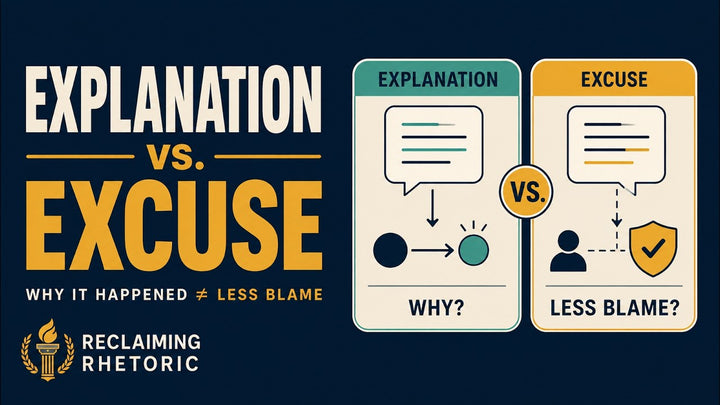
Those answers do not pretend the employee has authority they lack. They do not promise a solution that may not exist. They separate the boundary from whatever action remains possible. That is the difference between an explanation and an excuse: an explanation makes the reasoning visible and leaves room for the next step.
Good service language does not pretend every problem has a solution. It makes the remaining possibilities visible.

The same call, done differently
Here is how the appliance conversation might go when both sides use precise language. None of it requires anyone to be unusually generous or unusually tough.
- Customer: "The blender stopped working after five weeks. I know I'm past the return window. Is there anything that still applies?"
- Agent: "I can't process a return after 30 days from my end. That's a policy limit, and I don't have authority to override it. But the manufacturer warranty usually covers defects for a year."
- Customer: "Is the warranty something you handle, or a different team?"
- Agent: "A different team. I can transfer you, or send you the claim form now. I can also note your case so a supervisor can review an exception if the warranty doesn't work out."
- Customer: "The form is great, and please add the note. Thanks."
The customer may or may not end up with a refund. But each turn narrowed the problem instead of hardening it: the constraint was named (policy), its owner was named (not this agent), and the remaining paths were made visible (warranty, exception review). Neither side had to guess, accuse, or bluff. Compare that with the version that ends after one sentence, and you can see why the wording, not just the outcome, shapes whether people walk away feeling the process was fair.
Beyond customer service
The same compression happens far beyond help desks. "There's nothing we can do" has cousins in workplaces ("that's just how it's done here"), in schools ("the system won't let me"), in landlord disputes ("it's out of our hands"), and in government offices ("those are the rules"). In each case, the sentence may be completely accurate. But it may also be folding a technical limit, a rule someone wrote, a gap in one person's authority, or a choice into a single statement of impossibility.
The same four-way sort works everywhere: is this a limit of the tool, the rule, the person, or the channel? And if it is a choice, whose choice is it, and how can it be reviewed? Asking those questions is not cynicism. It is the ordinary work of figuring out who in a situation can actually mediate change.
The takeaway
Return to the sentence we started with: "There's nothing we can do." Maybe that is completely accurate. But rhetorically, the sentence can compress a great deal: a technical limit, a policy, an authority boundary, a process, a choice.
You do not need to assume bad faith to ask for precision. When someone says there's nothing they can do, the most useful response may not be "yes, there is." It may simply be: what kind of can't is this?
To keep going, browse all articles, explore structured lessons on the Courses page, or see the illustrated guides on the Guides page.
Foundations Series · Volume 3
How to Build a Better Argument
A practical visual guide to claims, evidence, structure, and objections. Opinion in. Case out.
Move from an initial opinion to a clear, well-supported case that can withstand fair scrutiny. Gather evidence that tests the claim, then treat serious objections fairly.
Sources and further reading
- Tax, S. S., Brown, S. W., & Chandrashekaran, M. (1998). Customer evaluations of service complaint experiences: Implications for relationship marketing. Journal of Marketing, 62(2), 60–76
- Packard, G., Moore, S. G., & McFerran, B. (2018). (I'm) happy to help (you): The impact of personal pronoun use in customer–firm interactions. Journal of Marketing Research, 55(4), 541–555
- Packard, G., & Berger, J. (2021). How concrete language shapes customer satisfaction. Journal of Consumer Research, 47(5), 787–806 (published online 2020)
- Reclaiming Rhetoric, The Rhetorical Situation Explained
- Reclaiming Rhetoric, Explanation vs. Excuse
Frequently Asked Questions
What does "there's nothing we can do" really mean?
It can mean several different things: a technical limit, a policy rule, a limit on one employee's authority, or a process handled by another team. The sentence often compresses them into one.
Does "can't" always mean "won't" in customer service?
No. Sometimes can't genuinely means can't. The useful step is to find out which kind of limitation you are facing.
How should I respond when customer service says nothing can be done?
Ask clarifying questions: is it a policy or a system limit, is it outside your authorization, is there another option, is there another department that handles this?
Is it rude to ask for a supervisor?
Not inherently, but the aim should be to find the actual boundary, not to keep escalating until someone gives in. Frontline staff often have limited authority.
Why does a clear explanation matter if the answer is still no?
Research on complaint handling (Tax, Brown & Chandrashekaran, 1998) found that customers judge the fairness of procedures and treatment, not just the outcome.
What should service agents say instead of "there's nothing we can do"?
Name the specific constraint and the remaining option, such as: "I can't override the return window, but I can submit an exception request."
Does saying "I" instead of "we" help in customer service?
Packard, Moore, and McFerran (2018) found customers responded better when agents used "I," which signals personal responsibility for helping.
Reclaiming Rhetoric is independent and reader-supported.
If this helped, you can help keep it free.