The agenda says Launch readiness. Maya, the product manager, opens with a simple question: “What will it take to keep Friday's launch on track?”
Jonah, the engineer, says there is still an unresolved bug. Priya, the marketing lead, points out that campaign placements are already booked. Luis, from customer support, says his team can create a temporary workaround. A few minutes later, Maya says, “Okay, it sounds like we can launch Friday as long as support has the workaround ready. Let's move to the next item.”
Freeze. When, exactly, did the team decide to launch Friday? Nobody voted. Nobody explicitly said, “I think we should launch.” And yet the conversation arrived at a decision.
This article, a companion to the Reclaiming Rhetoric video, looks at who actually controls a meeting, and why the answer is more complicated than whoever talks the most. Control can begin before anyone gets the floor, and it often lives in moves that look like simple housekeeping: an agenda title, an opening question, a choice of who speaks next, a decision to “park” something, and a summary.

Foundations Series · Volume 3
How to Build a Better Argument
A practical visual guide to claims, evidence, structure, and objections.
Control starts with the agenda
Start with the agenda: Launch readiness. Compare that with Should we delay the launch? or What are our options given the unresolved bug? Those are different starting points. Each one makes a different outcome feel like the normal path and a different outcome feel like the deviation that needs justifying.
Maya's opening question narrows things further: “What will it take to keep Friday's launch on track?” Friday has quietly become the default the group is trying to preserve. Anyone who wants to delay now has to argue against the frame of the meeting, not just for an option.
That does not make the agenda manipulative. Meetings need structure, and someone has to write the agenda. But structure helps establish what already counts as legitimate business. This is the meeting-room version of framing: the frame is not an argument, but it shapes which arguments seem relevant. It is also a version of what rhetoricians call stasis, the question of what point is actually in dispute. “How do we keep Friday on track?” and “Should Friday be the target?” locate the disagreement in completely different places.

Who gets the next turn
Then watch who gets the floor.
- “Jonah, how serious is the bug?” Jonah speaks.
- “Priya, what happens if we delay?” Priya speaks.
- “Luis, can support cover this?” Luis speaks.
The sequence looks inclusive, and it may genuinely be inclusive. But Maya still selects the next speaker, defines what that person is being asked to contribute, and helps determine when the answer is sufficient to move on. Notice that Jonah is asked how serious the bug is, not whether the launch should be delayed. Priya is asked about the costs of delay, not the costs of launching. Luis is asked whether support can cover it, which invites a yes.
Speaking time is visible. The power to distribute speaking opportunities is easier to miss. Research on workplace talk has paid close attention to exactly this. In a conversation-analytic study of leadership in meetings, Jonathan Clifton (2006) argued that leadership can be observed in the turn-by-turn work of talk itself, including how participants shape decisions in interaction, rather than only in formal titles.
Still, the chair does not control everything. Participants can jump in, ask follow-ups, introduce expertise, or redirect the discussion. As Asmuß and Svennevig (2009) put it in their introduction to a special issue on meeting talk, meetings are an interactional achievement: participants collaboratively produce their structure. Meeting control is distributed, but it is not evenly distributed.
Questions build the conversational architecture
Questions are one of the main ways control moves. Compare three versions of the same broad decision:
- What will it take to keep Friday's launch on track?
- Given the bug, should Friday still be our target?
- What are the costs of launching Friday versus delaying?
Same decision, different conversational architecture. The first assumes Friday and asks for requirements. The second puts Friday itself on the table. The third asks for a comparison and treats both options as live. Each question makes different information relevant and defines what has to be resolved before the meeting can move forward.
The person asking the questions does not have to provide the answers to shape the conversation. This is why questions can be among the most powerful moves in a meeting, and why loaded questions work so well: the presupposition rides along without ever being argued for.

“Let's park that”: controlling relevance
Then Jonah says, “I'm also worried this bug suggests a larger problem with the authentication system.” Maya responds, “That's important, but let's park the architecture question and stay focused on launch readiness.”
That might be reasonable. A meeting cannot pursue every issue at once. But something still happened. One concern remains inside the active decision. Another has become later. And Jonah's concern, if true, bears directly on whether Friday is safe. Parking it means the launch decision is made without it.
One of the quietest forms of conversational control is deciding what counts as relevant right now. So when somebody says “let's park that,” ask four questions:
- What is being deferred?
- Who has the standing to defer it?
- Why is it being deferred: time, scope, or convenience?
- Does it ever come back, and is anyone responsible for bringing it back?
A parking lot with a named owner and a date is a coordination tool. A parking lot nobody revisits is a quiet way of deciding an issue does not matter.
The summary: the most powerful sentence in the meeting
And then we reach perhaps the most powerful sentence in the meeting: the summary. Here is what has been said:
- Jonah: “The bug is serious, and I'd be more comfortable with another week.”
- Priya: a delay would create problems because the campaign is already running.
- Luis: support can create a workaround, although it will increase support volume.
Maya summarizes: “So what I'm hearing is that the launch is workable if support prepares the workaround.”
Nothing there is completely fabricated. But it is not a neutral transcript. Jonah's recommendation to delay disappeared. Luis's warning about support volume became evidence of capability. Priya's constraint remained. The discussion now has a gist, and that gist points toward Friday.
Conversation analysts call moves like this formulations: summaries of the gist or upshot of prior talk. The term comes from work by John Heritage and D. R. Watson, whose 1979 chapter “Formulations as Conversational Objects” showed how formulations preserve some parts of what was said, delete others, and transform the rest. They help groups move forward, and they invite the others to confirm or reject them. But a summary selects. It decides what becomes central, what becomes secondary, and what the group is now supposed to understand itself as having established.
The person who summarizes the conversation may not own the decision, but they can shape the version of the conversation that becomes the decision.
This is why meeting minutes, recap emails, and “just to close the loop” messages carry so much weight. Whoever writes the record writes the version people will later remember, a dynamic closely related to terministic screens: every summary selects, and therefore deflects.

Influence can be challenged
That influence can still be challenged, and this is the hopeful part. Because a formulation invites confirmation, it also opens a slot for correction.
- Jonah can clarify: “To be clear, I'm recommending a delay.”
- Luis can ask: “Does accepting the workaround also mean accepting the projected support volume?”
- Priya can introduce new information, such as whether placements could move by a week.
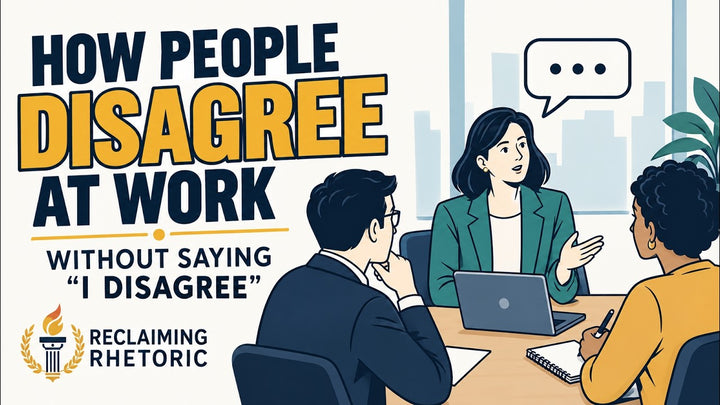
Formal authority matters, but conversational influence can also emerge from expertise, questions, objections, and clarification. The participant who says “Can I check that summary before we move on?” is exercising real control over the outcome. For practical language for those moments, see how to disagree at work.
Why invisible control has real costs
It is tempting to treat all of this as harmless process. The team needed to decide, and Maya helped it decide. But invisible control has costs that show up later.
First, information gets lost. Jonah's concern about the authentication system may have been the single most important fact in the room. If the meeting's architecture filtered it out, the organization made a decision without its best available evidence. Second, accountability gets blurry. If the launch fails, who decided? The meeting record will say the team agreed. Jonah will remember recommending a delay. Nobody will remember a vote, because there wasn't one.
Third, people learn what kinds of contributions are welcome. If concerns that complicate the default are repeatedly parked, participants stop raising them. Over time, the meeting looks more efficient because fewer objections surface, while the decisions it produces quietly get worse. None of this requires bad intentions. It only requires a structure that nobody examines.
The same moves happen in chat and email
These patterns are not limited to conference rooms. In a team chat thread, the person who posts the first framing message sets the agenda. The person who tags specific colleagues decides who gets the next turn. The person who replies “let's take this offline” parks an issue. And the person who posts “Great, so we're aligned on Friday” writes the formulation that everyone else must either accept or visibly contest.
Written channels make the summary even more powerful, because it persists and gets forwarded. They also make it easier to correct: a short reply such as “Small clarification: I'd still recommend a one-week delay” puts dissent on the record right where future readers will see it.
How to read a meeting more carefully
If you want to read a meeting more carefully, do not just count who spoke the longest. Watch the architecture:
- What did the agenda assume?
- What question defined the problem?
- Who got the next turn, and what were they asked to contribute?
- Who decided what was relevant now and what belonged later?
- Who got to say what the group had just decided?
A strong chair may perform all of those functions well. That is not a flaw. Meetings require coordination. The question is not whether someone is managing the conversation; a meeting has to be managed. The question is how that management shapes what the group can say and decide. Reading a meeting this way is a small-scale rhetorical analysis: you are looking at how choices of arrangement and emphasis move an audience toward a conclusion.
A better version of Maya's meeting
A better version of Maya's meeting might begin like this:
We have two decisions to separate. First, is the bug serious enough to justify delaying? Second, if we launch Friday, is the workaround acceptable?
Then, before moving on:
I'm hearing one recommendation to delay and two constraints that make delay costly. Before we call this decided, does anyone disagree with that summary?
The chair still chairs. But the management of the conversation becomes visible and contestable. A few habits make this easier for anyone running a meeting:
- Write agenda items as questions that leave the real options open.
- Separate decisions that are tangled together.
- When you park an issue, name an owner and a time it returns.
- Include dissent explicitly in your summary, then ask for corrections before closing the item.
- Send the recap with an invitation to correct it.
The takeaway
Go back to the original meeting. Everyone got to speak. Nobody explicitly ordered the team to launch Friday. And yet the conversation had an architecture: an agenda, a starting question, a sequence of speakers, boundaries around relevance, a summary, and a stopping point.
So after your next meeting, do not ask only “Who talked the most?” Ask who decided what you were talking about. Who decided what question you were answering? Who decided when you had answered it? And who got to say what you had just decided?
Sometimes the person controlling the conversation is not the person holding the floor. It is the person shaping where the floor can go.
To keep going, browse all articles, explore structured lessons on the Courses page, or see the illustrated guides on the Guides page.
Foundations Series · Volume 3
How to Build a Better Argument
A practical visual guide to claims, evidence, structure, and objections. Opinion in. Case out.
Move from an initial opinion to a clear, well-supported case that can withstand fair scrutiny. Gather evidence that tests the claim, then treat serious objections fairly.
Sources and further reading
- Clifton, J. (2006). A conversation analytical approach to business communication: The case of leadership. Journal of Business Communication, 43(3), 202–219
- Asmuß, B., & Svennevig, J. (2009). Meeting talk: An introduction. Journal of Business Communication, 46(1), 3–22
- Heritage, J. C., & Watson, D. R. (1979). Formulations as conversational objects. In G. Psathas (Ed.), Everyday Language: Studies in Ethnomethodology (pp. 123–162). Irvington
- Reclaiming Rhetoric, How Framing Changes What You Believe
- Reclaiming Rhetoric, Loaded Questions
- Reclaiming Rhetoric, How to Disagree at Work
Frequently Asked Questions
Who really controls a meeting?
Control is distributed but uneven. The chair often shapes the agenda, opening question, speaker order, relevance, and summary, while participants can redirect through questions, expertise, objections, and corrections.
How does an agenda shape a decision?
An agenda title and opening question set the default. "Keep Friday's launch on track" makes launching the normal path and forces anyone favoring delay to argue against the frame.
What is a formulation in conversation analysis?
A formulation is a summary of the gist or upshot of prior talk. Heritage and Watson (1979) showed formulations keep some content, delete some, and transform some, and invite confirmation.
Why are meeting summaries so powerful?
A summary decides what the group is treated as having said and established. Recaps and minutes become the version people remember, so selective summaries can quietly settle a decision.
Is it bad when a chair says "let's park that"?
Not necessarily. Meetings must limit scope. Ask what is deferred, why, who decided, and whether it returns with an owner and date. Parking that never returns can quietly bury a concern.
How can I challenge a summary without being confrontational?
Treat it as a check: "Before we move on, I want to make sure my recommendation to delay is captured." Summaries invite confirmation, so a correction is a normal response.
How can I run a fairer meeting?
Write agenda items as open questions, separate tangled decisions, name owners for parked issues, include dissent in summaries, and ask for corrections before closing each item.
Reclaiming Rhetoric is independent and reader-supported.
If this helped, you can help keep it free.