Have you ever heard an argument that used real evidence and still arrived somewhere that felt wrong? A manager says, "This employee sends fewer emails, so they must be less productive." The evidence may be perfectly accurate. The employee really does send fewer emails. But the conclusion only follows if you accept something the manager never said out loud: that the number of emails a person sends is a reliable measure of how much useful work they do.
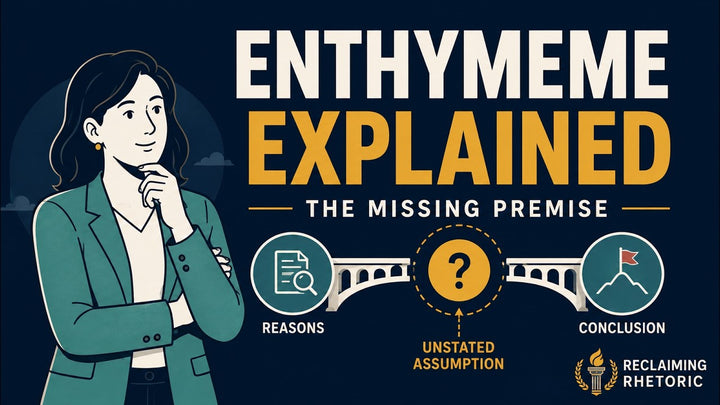
That unspoken assumption is doing most of the work. Once you drag it into the light, the argument looks very different, because evidence never connects itself to a conclusion. Something always bridges what we know and what someone wants us to believe. The philosopher Stephen Toulmin called that bridge the warrant, and he built one of the most useful frameworks for analyzing everyday arguments around it.
This article, a companion to the Reclaiming Rhetoric video on the Toulmin model, walks through all six elements of the model with a single worked example, shows how to diagram an argument you meet in the wild, and explains the most common mistake people make when they disagree: attacking an argument at the wrong level.
Where the Toulmin model comes from
Toulmin introduced the model in his 1958 book The Uses of Argument (Cambridge University Press). His complaint was with the way logic textbooks treated reasoning. Formal logic divides an argument into premises and a conclusion and asks whether the conclusion follows necessarily, the way it does in a geometry proof. Toulmin noticed that almost nothing people actually argue about works that way. Doctors, judges, historians, engineers, and managers reason from evidence to conclusions that are probable, conditional, and open to exceptions.
His model for that kind of reasoning was not mathematics but the law court. He described logic as "generalised jurisprudence": a case is made, evidence is offered, a rule is invoked to connect the evidence to the verdict, the rule itself can be challenged, and the verdict can be overturned by special circumstances. A good argument is less like a proof and more like a case that holds up under cross-examination.

Toulmin's own example became famous. Someone claims that Harry is a British subject. Asked what they have to go on, they answer that Harry was born in Bermuda. Asked how that gets them to the claim, they offer a general rule: a man born in Bermuda will generally be a British subject. That rule is backed by the relevant statutes, the conclusion is stated as "presumably," and it holds unless, for example, both of Harry's parents were aliens or he has since become a naturalized American. In one short exchange, all six elements appear.
The framework gives us six parts: claim, grounds, warrant, backing, qualifier, and rebuttal. The first three form the core of any argument. The last three determine how strong it is, where its limits are, and whether it can survive criticism. Toulmin's own word for grounds was data; most textbooks now use "grounds" or "evidence," and they mean the same thing.

Foundations Series · Volume 2
How to Analyze Any Argument
A visual guide to claims, evidence, assumptions, and reasoning.
The core: claim, grounds, and warrant
1. The claim
The claim is the conclusion the argument wants you to accept. It answers the question what is this person actually trying to prove? A claim can be factual ("this policy reduced costs"), evaluative ("this is the most effective option"), or a call to action ("our company should allow eligible employees to work remotely two days per week").
We will use that last one throughout. Imagine a company deciding whether to keep a hybrid work policy after a three-month trial. The claim is the destination of the argument. A destination alone persuades no one; we need a reason to go there.
2. The grounds
The grounds are the facts, observations, and evidence offered in support of the claim. They answer what do we have to go on? In our company, the grounds might be that during the trial the team completed the same amount of work, met every major deadline, and recorded fewer unscheduled absences.
Here is the catch: facts do not interpret themselves. The same evidence can support quite different conclusions depending on the assumption you use to connect it to a claim. Fewer absences could be read as a sign of better morale, or as a sign that people are working while sick at home. That is why the third element matters most.
3. The warrant
The warrant is the principle, rule, value, or assumption that explains why the grounds support the claim. It answers why does this evidence justify that conclusion? Toulmin described warrants as "general, hypothetical statements, which can act as bridges" between data and claim.
In the hybrid work case, the warrant might be: when a workplace policy maintains performance while improving reliability, the company has good reason to keep it. Now the logic is visible. The trial kept output steady and reduced absences (grounds). Policies that maintain performance and improve reliability are worth keeping (warrant). So the company should continue hybrid work for eligible employees (claim).
The warrant is often the one part nobody says out loud. People state the evidence, announce the conclusion, and leave the connecting assumption hidden, and that is exactly where weak arguments survive. Return to the email example. Grounds: the employee sends fewer emails. Claim: the employee is less productive. Warrant: sending more email means producing more valuable work. Once that warrant is written down, you can evaluate it, and most people would reject it. The evidence was accurate. The bridge was bad.

The same move works on advertising. "Millions of people bought this product, so it must be the best one." The grounds may be true. The warrant is that popularity reliably indicates quality, an assumption that ignores price, marketing budgets, habit, and availability. When you hear a conclusion that seems to leap from its evidence, ask what rule would have to be true for the leap to work. You will usually find the weak spot there.
The strength: backing, qualifier, and rebuttal
4. Backing
Backing supports the warrant itself. It answers why should we trust the principle connecting the grounds to the claim? Our company might show that it already evaluates workplace policies by performance, attendance, and retention, and point to its own past decisions, expert guidance, or published research explaining why those standards are sensible.
The distinction is worth memorizing: grounds support the claim, backing supports the warrant. Grounds tell us what happened in this particular case. Backing tells us why the general rule we are using deserves credibility. In Toulmin's Harry example, the grounds are a fact about Harry's birth, while the backing is the body of nationality law. A warrant without backing may sound reasonable right up until someone asks where it came from.
5. The qualifier
The qualifier tells us how strongly the claim should be stated. It answers how certain are we? Most real-world evidence supports "probably," not "definitely," and "in most cases," not "always." So instead of claiming that every employee should work remotely two days per week, a more responsible version says that eligible employees should generally be allowed to.
Words like generally, usually, likely, and presumably are often mistaken for weakness. They are usually a sign of accuracy. A strong argument does not pretend to know more than its evidence allows; it matches the force of the claim to the strength of the support. An overconfident claim is easier to knock down, because one counterexample is enough to falsify "always."
6. The rebuttal
The rebuttal identifies the exceptions or conditions under which the claim would not hold. It answers when might this argument not apply? Our full claim becomes: eligible employees should generally be allowed to work remotely two days per week, unless their roles require on-site equipment, continuous in-person coverage, or particular periods of face-to-face collaboration.
This is the most misunderstood part of the model. In everyday speech, a rebuttal is the other side shouting back. In Toulmin's sense it is a condition of exception, a circumstance in which the warrant's general authority has to be set aside. Stating it does not destroy your argument. It draws the argument's boundaries. Weak arguments hide their exceptions; strong arguments account for them, because an argument that survives only when every complication is ignored is not strong at all.

The whole model in one argument
Put together, the hybrid work argument looks like this:
- Claim: Eligible employees should generally be allowed to work remotely two days per week.
- Grounds: During the trial, performance stayed stable, deadlines were met, and unscheduled absences fell.
- Warrant: A policy that preserves performance while improving reliability is worth continuing.
- Backing: The company already evaluates policies on performance, attendance, and retention, standards supported by its own experience and outside research.
- Qualifier: Generally, and for eligible employees.
- Rebuttal: Unless the role requires consistent on-site presence, special equipment, or set periods of in-person collaboration.
That is a complete Toulmin argument. Notice what the model does not do: it does not tell you whether the conclusion is right. Maybe the grounds are inaccurate, because three months is a short trial. Maybe the warrant is controversial, because some people care more about mentoring and culture than about measurable output. Maybe the backing is thin, or the qualifier too confident, or the rebuttal misses an important exception. The model's gift is that it converts one big, fuzzy disagreement into six smaller, answerable questions.
- What exactly is being claimed?
- What grounds support it?
- What warrant connects the grounds to the claim?
- What backing supports the warrant?
- How strongly should the claim be qualified?
- What exceptions could limit or defeat it?
The warning: most arguments are attacked at the wrong level
The most practical lesson of the Toulmin model is diagnostic. When two people argue, they often fight about the wrong element. They repeat opposing claims at each other without ever examining the evidence. They trade studies back and forth without noticing that they are using different warrants. They demand absolute certainty from a claim that was only offered as probable. Or they find one exception and treat it as if it demolished the entire case, when it really just marked a boundary the qualifier already allowed for.
Consider two people debating whether college is worth the cost. They may agree completely on the grounds: on average, graduates earn more than people without a degree. Their disagreement lives in the warrant. One assumes that a decision is worth making if it raises expected lifetime earnings. The other assumes that a decision is worth making only if the payoff justifies the debt for this particular student in this particular field. Throwing more salary statistics at each other will never resolve that. Naming the warrant might.
This connects to a wider point about why intelligent people get stuck, which we explored in why smart people believe bad arguments: the more fluent you are, the easier it becomes to defend a conclusion without ever examining the assumption underneath it. The Toulmin model is a way of slowing down long enough to look.
How to use the Toulmin model
You can use the model in two directions: to take an argument apart, and to build one of your own.
To analyze an argument
- Find the claim first. Strip away the anecdotes and the tone and write one sentence stating what the speaker wants you to believe or do.
- List the grounds. What facts, numbers, examples, or testimony are offered? Check whether they are accurate and relevant before going further.
- Write the warrant down, even if no one said it. Ask what rule would have to be true for these grounds to support this claim. This is usually where the analysis pays off.
- Ask for the backing. Why should anyone accept that warrant? Is it based on law, research, experience, or simply habit?
- Check the qualifier. Is the claim more certain than the evidence allows? Words like "always," "proves," and "everyone" deserve suspicion.
- Look for missing rebuttals. What exceptions has the speaker ignored? Would the argument still hold if one of them applied?
This sequence works particularly well alongside the broader method in how to do a rhetorical analysis, which asks who the audience is and what the situation demands. Toulmin tells you how an argument is built; rhetorical analysis tells you why it was built that way for those listeners.
To build an argument
Run the same questions on your own case before you present it. Stating your warrant explicitly forces you to check whether you actually believe it. Finding backing forces you to check whether anyone else should. Choosing a qualifier keeps you honest about uncertainty, and naming your own rebuttals in advance shows the audience that you have thought about the exceptions before they had to point them out. That last habit is one of the fastest ways to earn credibility, because it signals fairness rather than salesmanship.
In classical terms, this is the work of invention: discovering the available arguments and testing them before you speak. It is also the heart of courtroom argument, which is why the model maps so neatly onto forensic rhetoric, where every verdict depends on evidence, a rule connecting it to a charge, and the exceptions a defense can raise.
Warrants are everywhere
Once you start looking for warrants, you will find them in nearly every argument you hear. "He's a doctor, so he must know what he's talking about" relies on the warrant that expertise in one field transfers to whatever the person happens to be discussing. "The policy passed with bipartisan support, so it must be good" relies on the warrant that agreement between rival parties is a reliable sign of quality. "Sales went up after the rebrand, so the rebrand worked" relies on the warrant that what comes first must be the cause.
Some of those warrants are reasonable in context. Some are not. The point is not to reject every argument with a hidden assumption, since every argument has one. The point is to be able to see it, so that you can decide whether you actually accept it.
Because that is what the Toulmin model ultimately teaches. Evidence matters, but it never speaks for itself. Every argument travels from what we know to what someone wants us to believe, and the most important question is often not is this evidence true? but what makes this evidence lead there?
To keep going, browse all articles, explore structured lessons on the Courses page, or see the illustrated guides on the Guides page.
Foundations Series · Volume 2
How to Analyze Any Argument
A visual guide to claims, evidence, assumptions, and reasoning. Stop reacting. Start diagnosing.
A visual method for seeing where an argument actually works, and where it does not. Name the claim, test the evidence, and find the assumption holding it all together.
Sources and further reading
- Stephen Toulmin, The Uses of Argument (Cambridge University Press, 1958; updated edition 2003)
- Bart Verheij, "The Toulmin Argument Model in Artificial Intelligence" (2009), a clear summary of the six elements and the Harry example (PDF)
- Reclaiming Rhetoric, How to Do a Rhetorical Analysis
- Reclaiming Rhetoric, Why Smart People Believe Bad Arguments
- Reclaiming Rhetoric, Forensic Rhetoric
Frequently Asked Questions
What is the Toulmin model of argument?
A framework from Stephen Toulmin's 1958 book The Uses of Argument that breaks an argument into six parts: claim, grounds (data), warrant, backing, qualifier, and rebuttal.
What is a warrant in an argument?
The warrant is the general principle or assumption that connects the evidence to the claim. It answers the question "why does this evidence support that conclusion?" and is often left unstated.
What is the difference between grounds and backing?
Grounds support the claim with facts about this particular case. Backing supports the warrant, explaining why the general rule connecting evidence to claim deserves trust.
What does a qualifier do?
It states how strongly the claim holds, using words such as "generally," "probably," or "presumably." A good qualifier matches the claim's force to the strength of the evidence.
Is a Toulmin rebuttal the same as a counterargument?
Not quite. In Toulmin's sense a rebuttal is a condition of exception: a circumstance in which the warrant would not apply. Naming it sets the argument's boundaries rather than defeating it.
Why did Toulmin compare arguments to a courtroom?
He thought everyday reasoning works less like a mathematical proof and more like a legal case, describing logic as "generalised jurisprudence": claims are supported, challenged, qualified, and subject to exceptions.
How do I use the Toulmin model in an essay?
State your claim, present grounds, make your warrant explicit, support it with backing, qualify the claim honestly, and address the most important exceptions before your reader raises them.
Reclaiming Rhetoric is independent and reader-supported.
If this helped, you can help keep it free.